


A concentration-descending washing strategy with methanol for the enhancement of protein imaging in biological tissues by MALDI-MS
Literature Information
Publication Date
2022-12-21
DOI
10.1039/D2AN01678H
Impact Factor
4.616
Authors
Kun Xue, Jinchao Feng, Yijun Zhou, Biao Liu, Gaopeng Li
View Original
Abstract
Matrix-assisted laser desorption/ionization mass spectrometry imaging (MALDI-MSI) is a powerful approach that has been widely used for in situ detection of various endogenous compounds in tissues. However, there are still challenges with in situ analysis of proteins using MALDI-MSI due to the ion suppression effects of small molecules in tissue sections. Therefore, tissue-washing steps are crucial for protein MALDI tissue imaging to remove these interfering molecules. Here, we successfully developed a new method named the concentration-descending washing strategy (CDWS) with methanol (MeOH), i.e., washing of biological tissue with 100%, 95%, and 70% MeOH solutions, for the enhancement of endogenous in situ protein detection and imaging in tissues using MALDI-MS. The method of MeOH-based CDWS (MeOH-CDWS) led to the successful in situ detection of 272 ± 3, 185 ± 4, and 134 ± 2 protein ion signals from rat liver, rat brain, and germinating Chinese-yew seed tissue sections, respectively. By comparison, 161 ± 2, 121 ± 1, and 114 ± 2 protein ions were detected by three commonly used methods, i.e., Carnoy's wash, ethanol (EtOH)-based CAWS (i.e., concentration-ascending washing strategy, 70% EtOH followed by 90% EtOH/9% AcOH), and isopropanol (iPrOH)-based CAWS (70% iPrOH followed by 95% iPrOH), respectively, in rat liver tissue sections, indicating that 68.9 ± 3.1%, 124.8 ± 3.3%, and 138.6 ± 4.4% more protein ion signals could be detected by the use of MeOH-CDWS than the three abovementioned washing strategies. Our results show that the use of MeOH-CDWS improves the performance of MALDI-MSI for in situ protein detection such as the number and intensity of proteins. The use of MeOH-CDWS improves the fixation of proteins and thus reduces the loss of proteins, which significantly reduces protein delocalization in tissue and enhances the performance of MALDI tissue imaging of protein. Thus, the use of MeOH-CDWS improves the quality of protein images in tissue sections through MALDI-MSI and has the potential to be used as standard practice for MALDI tissue imaging of proteins.
Recommended Journals

Advanced Powder Technology

Construction and Building Materials

Advances in Cement Research

Journal of Physical Organic Chemistry

Bio-Medical Materials and Engineering

Computational Materials Science

Advanced Composite Materials

Catalysis Today

Current Medicinal Chemistry

Journal of Computer-Aided Molecular Design
Related Literature
Benzo[5]helicene-based conjugated polymers: synthesis, photophysical properties, and application for the detection of nitroaromatic explosives
Li-Li Zhou, Meng Li, Hai-Yan Lu, Chuan-Feng Chen
2015-11-24
Paper
DOI: 10.1039/C5PY01794G
Synthesis, properties and performance of organic polymers employed in flocculation applications
Vu H. Dao, Kei Saito
2015-11-03
Minireview
DOI: 10.1039/C5PY01572C
Triazine-mediated controlled radical polymerization: new unimolecular initiators
J. Areephong, J. W. Kramer, H. A. Sprafke
2015-11-03
Paper
DOI: 10.1039/C5PY01563D
Facile production of nanoaggregates with tuneable morphologies from thermoresponsive P(DEGMA-co-HPMA)
Nghia P. Truong, Michael R. Whittaker, John F. Quinn
2015-11-16
Paper
DOI: 10.1039/C5PY01467K
Continuous flow SET-LRP in the presence of P(VDF-co-CTFE) as macroinitiator in a copper tubular reactor
Ning Zhu, Xin Hu, Yajun Zhang, Kai Zhang, Zhenjiang Li, Kai Guo
2015-11-09
Paper
DOI: 10.1039/C5PY01728A
Cheap and fast: oxalic acid initiated CO2-based polyols synthesized by a novel preactivation approach
Yusheng Qin, Lijun Qiao, Yuyang Miao, Xianhong Wang, Fosong Wang
2015-10-12
Paper
DOI: 10.1039/C5PY01338K
Dual stimuli-responsive oligo(ethylene glycol)-based microgels: insight into the role of internal structure in volume phase transitions and loading of magnetic nanoparticles to design stable thermoresponsive hybrid microgels
Elise Deniau-Lejeune, Valérie Alard, Jean-François Tranchant, Laurent Billon, Maud Save
2015-10-22
Paper
DOI: 10.1039/C5PY01078K
Synthesis of poly(N-acryloylmorpholine) macromonomers using RAFT and their copolymerization with methacrylic acid for the design of graft copolymer additives for concrete
T. Boursier, S. Georges, M. Mosquet, D. Rinaldi, F. D'Agosto
2015-12-01
Paper
DOI: 10.1039/C5PY01730K
Physical hydrogels constructed on a macro-cross-linking cationic polysaccharide with tunable, excellent mechanical performance
Lei Guo, Yacheng Xing
2015-10-12
Communication
DOI: 10.1039/C5PY01437A
SET-LRP of NIPAM in water via in situ reduction of Cu(ii) to Cu(0) with NaBH4
Mikhail Gavrilov, Timothy J. Zerk, Paul V. Bernhardt, Virgil Percec, Michael J. Monteiro
2015-12-09
Paper
DOI: 10.1039/C5PY01855B
You might also like
Compound Q&A
What are the main uses of 4-Nitrophenyl phosphate disodium salt hexahydrate (CAS: 333338-18-4)?
4-Nitrophenyl phosphate disodium salt hexahydrate is primarily used as a substra...
333338-18-44-Nitrophenyl phosph...
Compound Q&A
What are the main uses of 2-(Trifluoromethyl)-1,3-oxazole-4-carboxylic Acid (CAS: 1060816-01-4)?
2-(Trifluoromethyl)-1,3-oxazole-4-carboxylic Acid (CAS: 1060816-01-4) is widely ...
1060816-01-42-(Trifluoromethyl)-...
Compound Q&A
How should 2-Fluoro-4-biphenylcarboxylic acid (CAS: 137045-30-8) be stored?
2-Fluoro-4-biphenylcarboxylic acid should be stored in a cool, dry place at room...
137045-30-82-Fluoro-4-biphenylc...
Compound Q&A
What industries use Prednisolone-21-Carboxylic Acid (CAS: 61549-70-0)?
Prednisolone-21-Carboxylic Acid is primarily used in the pharmaceutical industry...
61549-70-0Prednisolone-21-Carb...
Compound Q&A
How should 4-(Hydrazinomethyl)-1,2,3-benzenetriol (CAS: 3614-72-0) be stored?
4-(Hydrazinomethyl)-1,2,3-benzenetriol (CAS: 3614-72-0) should be stored in a co...
3614-72-04-(Hydrazinomethyl)-...
Compound Q&A
What industries use 4-Amino-1-methyl-1H-pyrazole-5-carboxylic acid hydrochloride (CAS: 92534-70-8)?
4-Amino-1-methyl-1H-pyrazole-5-carboxylic acid hydrochloride (CAS: 92534-70-8) i...
92534-70-84-Amino-1-methyl-1H-...
Compound Q&A
What regulatory guidelines apply to dehydropachymic acid (CAS: 77012-31-8)?
Dehydropachymic acid (CAS: 77012-31-8) is regulated by various agencies. It fall...
77012-31-8Dehydropachymic acid
Compound Q&A
What is the market or research trend for 6-[(2,2-Dimethylpropanoyl)amino]nicotinic acid (CAS: 898561-66-5)?
The market and research trends for 6-[(2,2-Dimethylpropanoyl)amino]nicotinic aci...
898561-66-56-[(2,2-Dimethylprop...
Compound Q&A
How should 1,10-Phenanthroline-2,9-dicarbaldehyde (CAS: 57709-62-3) be stored?
1,10-Phenanthroline-2,9-dicarbaldehyde should be stored in a cool, dry place awa...
57709-62-31,10-Phenanthroline-...
Compound Q&A
How is 5-Carbamoyl-11-oxo-10,11-dihydro-5H-dibenzo[b,f]azepin-10-yl acetate (CAS: 113952-21-9) typically synthesized?
5-Carbamoyl-11-oxo-10,11-dihydro-5H-dibenzo[b,f]azepin-10-yl acetate can be synt...
113952-21-95-Carbamoyl-11-oxo-1...
Source Journal
Analyst

CiteScore:
7.8
Self-citation Rate:
5.6%
Articles per Year:
653
Analyst publishes analytical and bioanalytical research that reports premier fundamental discoveries and inventions, and the applications of those discoveries, unconfined by traditional discipline barriers.
Recommended Compounds
![1-[(4-Methylphenyl)sulfonyl]-3-(4,4,5,5-tetramethyl-1,3,2-dioxaborolan-2-yl)-1H-pyrrolo[2,3-b]pyridine-5-carbonitrile structure](https://static.chemtradehub.com/structs/143/1434747-57-5-fc0d.webp "1-[(4-Methylphenyl)sulfonyl]-3-(4,4,5,5-tetramethyl-1,3,2-dioxaborolan-2-yl)-1H-pyrrolo[2,3-b]pyridine-5-carbonitrile structure")
1-[(4-Methylphenyl)sulfonyl]-3-(4,4,5,5-tetramethyl-1,3,2-dioxaborolan-2-yl)-1H-pyrrolo[2,3-b]pyridine-5-carbonitrile
CAS Number:
1434747-57-5
Molecular Formula:
C21H22BN3O4S
![(2E)-3-(3-Chlorophenyl)-N-{2-[4-(methylsulfonyl)-1-piperazinyl]-2-oxoethyl}acrylamide structure](https://static.chemtradehub.com/structs/250/2505001-54-5-c1e9.webp "(2E)-3-(3-Chlorophenyl)-N-{2-[4-(methylsulfonyl)-1-piperazinyl]-2-oxoethyl}acrylamide structure")
(2E)-3-(3-Chlorophenyl)-N-{2-[4-(methylsulfonyl)-1-piperazinyl]-2-oxoethyl}acrylamide
CAS Number:
2505001-54-5
Molecular Formula:
C16H20ClN3O4S
![(3R,5R)-1-[(Benzyloxy)carbonyl]-5-methyl-3-piperidinecarboxylic acid structure](https://static.chemtradehub.com/structs/126/1269757-29-0-c552.webp "(3R,5R)-1-[(Benzyloxy)carbonyl]-5-methyl-3-piperidinecarboxylic acid structure")
(3R,5R)-1-[(Benzyloxy)carbonyl]-5-methyl-3-piperidinecarboxylic acid
CAS Number:
1269757-29-0
Molecular Formula:
C15H19NO4
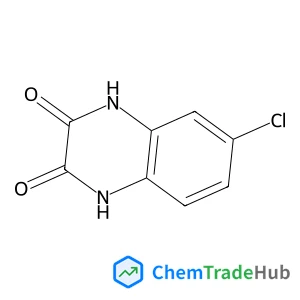
6-CHLORO-2,3-DIOXO-1,2,3,4-TETRAHYDROQUINOXALINE, 97
CAS Number:
169-14-2
Molecular Formula:
C8H5ClN2O2
Recommended Suppliers




Disclaimer
This page provides academic journal information for reference and research purposes only. We are not affiliated with any journal publishers and do not handle publication submissions. For publication-related inquiries, please contact the respective journal publishers directly.
If you notice any inaccuracies in the information displayed, please contact us at support@chemtradehub.com. We will promptly review and address your concerns.