


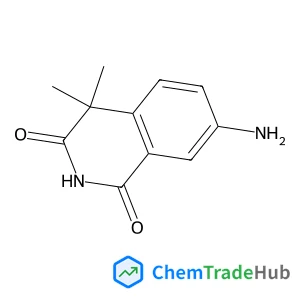
1,3(2H,4H)-Isoquinolinedione, 7-amino-4,4-dimethyl-
CAS Number:
14576-22-8
Molecular Formula:
C11H12N2O2
Xiaoyong Zhang, Jeremy N. Harvey
How solvent motions affect the dynamics of chemical reactions in which the solute undergoes a substantial shape change is a fundamental but elusive issue. This work utilizes reactive simulation and Grote-Hynes theory to explore the effect of solvent motions on the dynamics of the Diels–Alder reaction (in the reverse direction, this reaction involves very substantial solute expansion) in aprotic solvents. The results reveal that the solvent environment is not sufficiently constraining to influence transition state passage dynamics, with the calculated transmission coefficients being close to unity. Even when solvent motions are suppressed or artificially slowed down, the solvent only affects the reaction dynamics in the transition state region to a very small extent. The only notable effect of solvent occurs far from the transition state region and corresponds to caging of the reactants within the reactant well.

Nature Reviews Drug Discovery

Journal of Enzyme inhibition and Medicinal Chemistry

Mini-Reviews in Medicinal Chemistry

Physical Chemistry Chemical Physics

European Journal of Organic Chemistry

Contact Lens & Anterior Eye

Current Pharmaceutical Biotechnology

Environmental Toxicology and Pharmacology

CrystEngComm

Photochemical & Photobiological Sciences
Yanping Chen, Hongwei Qin, Ling Li, Changmin Shi, Liang Liu, Jifan Hu
DOI: 10.1039/C5CP00096C
Chuanbao Cao, Zulfiqar Ali
DOI: 10.1039/C5CP01655J
N. F. Santos, J. Rodrigues, T. Holz, N. Ben Sedrine, A. Sena, A. J. Neves, F. M. Costa, T. Monteiro
DOI: 10.1039/C4CP06114D
Mitra Ashouri, Ali Maghari, M. H. Karimi-Jafari
DOI: 10.1039/C5CP00693G
Michael S. Bodnarchuk, David M. Heyes, Angela Breakspear, Samir Chahine, Daniele Dini
DOI: 10.1039/C5CP00428D
Yuanyuan Jin, George Maroulis, Xiaoyu Kuang, Liping Ding, Cheng Lu, Jingjing Wang, Chuanzhao Zhang, Meng Ju
DOI: 10.1039/C5CP00728C
Gregorio García, Mert Atilhan, Santiago Aparicio
DOI: 10.1039/C5CP00076A
Wenjun Wu, Jing Shi, Yunhui Liang, Fang Liu, Yi Peng, Huabin Yang
DOI: 10.1039/C5CP01212K
N. A. Nebogatikova, V. Ya. Prinz, I. I. Kurkina, V. I. Vdovin, G. N. Aleksandrov, V. B. Timofeev, S. A. Smagulova, E. R. Zakirov, V. G. Kesler
DOI: 10.1039/C4CP04646C
Guangyuan Si, Eunice S. P. Leong, Xiaoxiao Jiang, Jiangtao Lv, Jiao Lin, Haitao Dai, Yan Jun Liu
DOI: 10.1039/C5CP00185D
4-Nitrophenyl phosphate disodium salt hexahydrate is primarily used as a substra...
2-(Trifluoromethyl)-1,3-oxazole-4-carboxylic Acid (CAS: 1060816-01-4) is widely ...
2-Fluoro-4-biphenylcarboxylic acid should be stored in a cool, dry place at room...
Prednisolone-21-Carboxylic Acid is primarily used in the pharmaceutical industry...
4-(Hydrazinomethyl)-1,2,3-benzenetriol (CAS: 3614-72-0) should be stored in a co...
4-Amino-1-methyl-1H-pyrazole-5-carboxylic acid hydrochloride (CAS: 92534-70-8) i...
Dehydropachymic acid (CAS: 77012-31-8) is regulated by various agencies. It fall...
The market and research trends for 6-[(2,2-Dimethylpropanoyl)amino]nicotinic aci...
1,10-Phenanthroline-2,9-dicarbaldehyde should be stored in a cool, dry place awa...
5-Carbamoyl-11-oxo-10,11-dihydro-5H-dibenzo[b,f]azepin-10-yl acetate can be synt...
Physical Chemistry Chemical Physics (PCCP) is an international journal co-owned by 19 physical chemistry and physics societies from around the world. This journal publishes original, cutting-edge research in physical chemistry, chemical physics and biophysical chemistry. To be suitable for publication in PCCP, articles must include significant innovation and/or insight into physical chemistry; this is the most important criterion that reviewers and Editors will judge against when evaluating submissions. The journal has a broad scope and welcomes contributions spanning experiment, theory, computation and data science. Topical coverage includes spectroscopy, dynamics, kinetics, statistical mechanics, thermodynamics, electrochemistry, catalysis, surface science, quantum mechanics, quantum computing and machine learning. Interdisciplinary research areas such as polymers and soft matter, materials, nanoscience, energy, surfaces/interfaces, and biophysical chemistry are welcomed if they demonstrate significant innovation and/or insight into physical chemistry. Joined experimental/theoretical studies are particularly appreciated when complementary and based on up-to-date approaches.

![[(1S,2S,3R,4S,7R,9S,10S,12R,15S)-4,12-Diacetyloxy-15-[(2R,3S)-3-benzamido-3-phenyl-2-(2,2,2-trichloroethoxycarbonyloxy)propanoyl]oxy-1,9-dihydroxy-10,14,17,17-tetramethyl-11-oxo-6-oxatetracyclo[11.3.1.03,10.04,7]heptadec-13-en-2-yl] benzoate structure](https://static.chemtradehub.com/structs/100/100431-55-8-7104.webp "[(1S,2S,3R,4S,7R,9S,10S,12R,15S)-4,12-Diacetyloxy-15-[(2R,3S)-3-benzamido-3-phenyl-2-(2,2,2-trichloroethoxycarbonyloxy)propanoyl]oxy-1,9-dihydroxy-10,14,17,17-tetramethyl-11-oxo-6-oxatetracyclo[11.3.1.03,10.04,7]heptadec-13-en-2-yl] benzoate structure")
![1-[(4-Methylphenyl)sulfonyl]-3-(4,4,5,5-tetramethyl-1,3,2-dioxaborolan-2-yl)-1H-pyrrolo[2,3-b]pyridine-5-carbonitrile structure](https://static.chemtradehub.com/structs/143/1434747-57-5-fc0d.webp "1-[(4-Methylphenyl)sulfonyl]-3-(4,4,5,5-tetramethyl-1,3,2-dioxaborolan-2-yl)-1H-pyrrolo[2,3-b]pyridine-5-carbonitrile structure")




