












The electronic temperature and the effective chemical potential parameters of an atom in a molecule. A Fermi–Dirac semi-local variational approach
Literature Information
Publication Date
2021-12-08
DOI
10.1039/D1CP04071E
Impact Factor
3.676
Authors
View Original
Abstract
We developed a numerical procedure to compute the electronic temperature and the effective (local) chemical potential undergone by electrons belonging to a particular molecular species. Our strategy relies on consider atomic basins as open quantum (sub)systems within the context of the quantum theory of atoms in molecules. Each basin is represented by the two parameters, the electronic temperature and the effective chemical potential, which are determined by distributing electrons (fermions) imbedded in each atomic region, through a Fermi–Dirac semi-local variational procedure. The results obtained for 40 different chemical species show that the effective chemical potential is a useful tool to reveal the most acidic/basic atoms in a molecule while the electronic temperature is closely related to the concept of chemical hardness at the local level. Our numerical data also indicate that the electronic temperature values undergone by electrons imbedded in atomic basins are way beyond the room temperature condition, allowing to fractionally occupy several of the one-particle quantum states. In this context, we developed two new indexes useful to reveal outstanding orbitals involved in the chemical reactivity of atoms in molecules.
Related Literature
Adsorption of the amyloid β40 monomer on charged gold nanoparticles and slabs: a molecular dynamics study
Pandurangan Kalipillai, Ethayaraja Mani
2021-08-02
Paper
DOI: 10.1039/D1CP01652K
Mechanical properties of calcium silicate hydrate under uniaxial and biaxial strain conditions: a molecular dynamics study
Dongyun Liu, Rongjia Wen, Qian Yu, Lennart Elfgren
2021-12-20
Paper
DOI: 10.1039/D1CP04474E
A Dirac nodal surface semi-metallic carbon-based structure as a universal anode material for metal-ion batteries with high performance
Shouren Zhang, Huili Liu, Yadan Zhang, Shuaiwei Wang, Baocheng Yang
2021-08-06
Paper
DOI: 10.1039/D1CP02306C
A molecular beam and computational study on the barrierless gas phase formation of (iso)quinoline in low temperature extraterrestrial environments
Long Zhao, Matthew Prendergast, Ralf I. Kaiser, Bo Xu, Wenchao Lu, Musahid Ahmed, A. Hasan Howlader, Stanislaw F. Wnuk, Alexander S. Korotchenko, Mikhail M. Evseev, Eugene K. Bashkirov, Alexander M. Mebel
2021-08-06
Paper
DOI: 10.1039/D1CP02169A
Kinetics of photon upconversion by triplet–triplet annihilation: a comprehensive tutorial
Yoichi Murakami, Kenji Kamada
2021-08-02
Perspective
DOI: 10.1039/D1CP02654B
Improving the theoretical description of Ln(iii)/An(iii) separation with phosphinic acid ligands: a benchmarking study of structure and selectivity‡
Robert C. Chapleski, Jr., Alexander S. Ivanov, Kirk A. Peterson, Vyacheslav S. Bryantsev
2021-08-17
Paper
DOI: 10.1039/D1CP02466C
Directed gas-phase preparation of the elusive phosphinosilylidyne (SiPH2, X2A′′) and cis/trans phosphinidenesilyl (HSiPH; X2A′) radicals under single-collision conditions
Chao He, Shane J. Goettl, Zhenghai Yang, Srinivas Doddipatla, Ralf I. Kaiser, Mateus Xavier Silva, Breno R. L. Galvão
2021-08-12
Paper
DOI: 10.1039/D1CP02812J
Fitting potential energy and induced dipole surfaces of the van der Waals complex CH4–N2 using non-product quadrature grids
Yulia N. Kalugina, Iouli E. Gordon
2021-08-04
Paper
DOI: 10.1039/D1CP02161C
You might also like
Compound Q&A
What are the main uses of 4-Nitrophenyl phosphate disodium salt hexahydrate (CAS: 333338-18-4)?
4-Nitrophenyl phosphate disodium salt hexahydrate is primarily used as a substra...
333338-18-44-Nitrophenyl phosph...
Compound Q&A
What are the main uses of 2-(Trifluoromethyl)-1,3-oxazole-4-carboxylic Acid (CAS: 1060816-01-4)?
2-(Trifluoromethyl)-1,3-oxazole-4-carboxylic Acid (CAS: 1060816-01-4) is widely ...
1060816-01-42-(Trifluoromethyl)-...
Compound Q&A
How should 2-Fluoro-4-biphenylcarboxylic acid (CAS: 137045-30-8) be stored?
2-Fluoro-4-biphenylcarboxylic acid should be stored in a cool, dry place at room...
137045-30-82-Fluoro-4-biphenylc...
Compound Q&A
What industries use Prednisolone-21-Carboxylic Acid (CAS: 61549-70-0)?
Prednisolone-21-Carboxylic Acid is primarily used in the pharmaceutical industry...
61549-70-0Prednisolone-21-Carb...
Compound Q&A
How should 4-(Hydrazinomethyl)-1,2,3-benzenetriol (CAS: 3614-72-0) be stored?
4-(Hydrazinomethyl)-1,2,3-benzenetriol (CAS: 3614-72-0) should be stored in a co...
3614-72-04-(Hydrazinomethyl)-...
Compound Q&A
What industries use 4-Amino-1-methyl-1H-pyrazole-5-carboxylic acid hydrochloride (CAS: 92534-70-8)?
4-Amino-1-methyl-1H-pyrazole-5-carboxylic acid hydrochloride (CAS: 92534-70-8) i...
92534-70-84-Amino-1-methyl-1H-...
Compound Q&A
What regulatory guidelines apply to dehydropachymic acid (CAS: 77012-31-8)?
Dehydropachymic acid (CAS: 77012-31-8) is regulated by various agencies. It fall...
77012-31-8Dehydropachymic acid
Compound Q&A
What is the market or research trend for 6-[(2,2-Dimethylpropanoyl)amino]nicotinic acid (CAS: 898561-66-5)?
The market and research trends for 6-[(2,2-Dimethylpropanoyl)amino]nicotinic aci...
898561-66-56-[(2,2-Dimethylprop...
Compound Q&A
How should 1,10-Phenanthroline-2,9-dicarbaldehyde (CAS: 57709-62-3) be stored?
1,10-Phenanthroline-2,9-dicarbaldehyde should be stored in a cool, dry place awa...
57709-62-31,10-Phenanthroline-...
Compound Q&A
How is 5-Carbamoyl-11-oxo-10,11-dihydro-5H-dibenzo[b,f]azepin-10-yl acetate (CAS: 113952-21-9) typically synthesized?
5-Carbamoyl-11-oxo-10,11-dihydro-5H-dibenzo[b,f]azepin-10-yl acetate can be synt...
113952-21-95-Carbamoyl-11-oxo-1...
Source Journal
Physical Chemistry Chemical Physics

CiteScore:
5.5
Self-citation Rate:
10.3%
Articles per Year:
3036
Physical Chemistry Chemical Physics (PCCP) is an international journal co-owned by 19 physical chemistry and physics societies from around the world. This journal publishes original, cutting-edge research in physical chemistry, chemical physics and biophysical chemistry. To be suitable for publication in PCCP, articles must include significant innovation and/or insight into physical chemistry; this is the most important criterion that reviewers and Editors will judge against when evaluating submissions. The journal has a broad scope and welcomes contributions spanning experiment, theory, computation and data science. Topical coverage includes spectroscopy, dynamics, kinetics, statistical mechanics, thermodynamics, electrochemistry, catalysis, surface science, quantum mechanics, quantum computing and machine learning. Interdisciplinary research areas such as polymers and soft matter, materials, nanoscience, energy, surfaces/interfaces, and biophysical chemistry are welcomed if they demonstrate significant innovation and/or insight into physical chemistry. Joined experimental/theoretical studies are particularly appreciated when complementary and based on up-to-date approaches.
Recommended Compounds



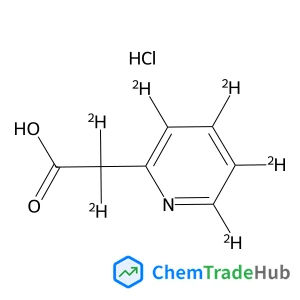
2,2-dideuterio-2-(3,4,5,6-tetradeuterio-2-pyridyl)acetic acid;hydrochloride
CAS Number:
1329799-67-8
Molecular Formula:
C7H2ClD6NO2
Recommended Suppliers



Disclaimer
This page provides academic journal information for reference and research purposes only. We are not affiliated with any journal publishers and do not handle publication submissions. For publication-related inquiries, please contact the respective journal publishers directly.
If you notice any inaccuracies in the information displayed, please contact us at support@chemtradehub.com. We will promptly review and address your concerns.