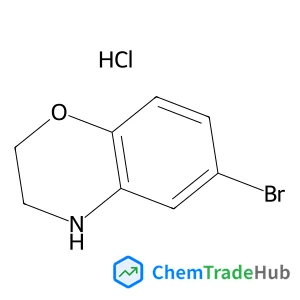
6-Bromo-3,4-dihydro-2H-1,4-benzoxazine hydrochloride (1:1)
CAS Number:
1260803-10-8
Molecular Formula:
C8H9BrClNO
Hexagonal boron nitride (h-BN) sheets possess high fluorescence quenching ability and high affinity towards DNA/RNA, and they can be used as a sensing platform for rapid detection. We report the absorption and emission properties of DNA nucleobases such as adenine (A), cytosine (C), guanine (G), and thymine (T) tagged with benzoxazole on h-BN and aluminium-doped h-BN (Al_hBN) sheets. The binding affinity of studied nucleobases on h-BN sheets at the M062X/6-31G* level of theory showed the following adsorption trend: G ≥ T ≥ A > C, which is in good agreement with the previous results. The calculated stability trend of nucleobases on the Al_hBN sheet follows as C > G > A > T at the same level of theory. The physically adsorbed behavior of nucleobases to h-BN sheets was confirmed by the non-covalent interactions (NCIs) and the total density of states (TDOS) plots. The NCI results indicated that van der Waals interactions contribute significantly to the adsorption of nucleobases on h-BN sheets. Atoms in molecules (AIM) calculations revealed the electrostatic interactions between nucleobases and the Al_hBN sheet. The quenching phenomenon of nucleobase-tagged fluorophores on h-BN and Al_hBN sheets was investigated by TD-DFT calculations using the same level of theory. The thymine-tagged fluorophore upon adsorption to the pristine h-BN sheet was found to be blue-shifted (∼43 nm); however, the guanine-tagged fluorophore with Al_hBN showed a remarkable difference from other nucleobase-tagged fluorophores in the absorption and emission spectrum. Guanine-tagged fluorophores showed a smaller blue shift (∼7 nm) in the absorption spectrum; however, it showed a larger red shift (∼55 nm) than the other nucleobase-tagged fluorophores on Al_hBN sheets and can be useful in recognizing a sequence-specific phenomenon as a fluorescent biosensor of DNA and RNA to ascertain the presence of such nucleobases.

Journal of Medical Biochemistry

Mini-Reviews in Medicinal Chemistry

Faraday Discussions

European Journal of Organic Chemistry

Molecular Diversity

Contact Lens & Anterior Eye

Journal of Enzyme inhibition and Medicinal Chemistry

Photochemical & Photobiological Sciences

Physical Chemistry Chemical Physics

Coloration Technology
William A. Elliott, R. John Clark, James G. Sutjianto, Jeremy C. Palmer, Jeffrey D. Rimer
DOI: 10.1039/D1CP02619D
Xiaoyong Yang, Ming Jiang, Lixin Chen, Zhiwen Chen
DOI: 10.1039/D1CP02852A
Venelin Enchev, Sofia Slavova
DOI: 10.1039/D1CP02158C
Robert C. Chapleski, Jr., Alexander S. Ivanov, Kirk A. Peterson, Vyacheslav S. Bryantsev
DOI: 10.1039/D1CP02466C
Chun Zhang, Yi-Tao Sun, Xue Yan, Xue-Hui Guo, Ai-Min Ren, Wen-Long Wang
DOI: 10.1039/D1CP04268H
Anna Maria Ferrari, Khaled E. El-Kelany, Francesco Silvio Gentile, Maddalena D’Amore, Roberto Dovesi
DOI: 10.1039/D1CP02363B
Zachary Morrow, Hyuk-Yong Kwon, C. T. Kelley, Elena Jakubikova
DOI: 10.1039/D1CP03446D
Joharimanitra Randrianandraina, Michael Badawi, Bruno Cardey, Manuel Grivet, Jean-Emmanuel Groetz, Christophe Ramseyer, Freddy Torrealba Anzola, Caroline Chambelland, Didier Ducret
DOI: 10.1039/D1CP02624K
Travis Sikes, Colin Banyon, Rachel A. Schwind, Patrick T. Lynch, Andrea Comandini, Raghu Sivaramakrishnan, Robert S. Tranter
DOI: 10.1039/D1CP02437J
Zhizhou Wu, Liuyang Li, Xuedong Zhou, Xiujian Zhao, Baoshun Liu
DOI: 10.1039/D1CP03135J
4-Nitrophenyl phosphate disodium salt hexahydrate is primarily used as a substra...
2-(Trifluoromethyl)-1,3-oxazole-4-carboxylic Acid (CAS: 1060816-01-4) is widely ...
2-Fluoro-4-biphenylcarboxylic acid should be stored in a cool, dry place at room...
Prednisolone-21-Carboxylic Acid is primarily used in the pharmaceutical industry...
4-(Hydrazinomethyl)-1,2,3-benzenetriol (CAS: 3614-72-0) should be stored in a co...
4-Amino-1-methyl-1H-pyrazole-5-carboxylic acid hydrochloride (CAS: 92534-70-8) i...
Dehydropachymic acid (CAS: 77012-31-8) is regulated by various agencies. It fall...
The market and research trends for 6-[(2,2-Dimethylpropanoyl)amino]nicotinic aci...
1,10-Phenanthroline-2,9-dicarbaldehyde should be stored in a cool, dry place awa...
5-Carbamoyl-11-oxo-10,11-dihydro-5H-dibenzo[b,f]azepin-10-yl acetate can be synt...
Physical Chemistry Chemical Physics (PCCP) is an international journal co-owned by 19 physical chemistry and physics societies from around the world. This journal publishes original, cutting-edge research in physical chemistry, chemical physics and biophysical chemistry. To be suitable for publication in PCCP, articles must include significant innovation and/or insight into physical chemistry; this is the most important criterion that reviewers and Editors will judge against when evaluating submissions. The journal has a broad scope and welcomes contributions spanning experiment, theory, computation and data science. Topical coverage includes spectroscopy, dynamics, kinetics, statistical mechanics, thermodynamics, electrochemistry, catalysis, surface science, quantum mechanics, quantum computing and machine learning. Interdisciplinary research areas such as polymers and soft matter, materials, nanoscience, energy, surfaces/interfaces, and biophysical chemistry are welcomed if they demonstrate significant innovation and/or insight into physical chemistry. Joined experimental/theoretical studies are particularly appreciated when complementary and based on up-to-date approaches.
![1-[(4-Methylphenyl)sulfonyl]-3-(4,4,5,5-tetramethyl-1,3,2-dioxaborolan-2-yl)-1H-pyrrolo[2,3-b]pyridine-5-carbonitrile structure](https://static.chemtradehub.com/structs/143/1434747-57-5-fc0d.webp "1-[(4-Methylphenyl)sulfonyl]-3-(4,4,5,5-tetramethyl-1,3,2-dioxaborolan-2-yl)-1H-pyrrolo[2,3-b]pyridine-5-carbonitrile structure")