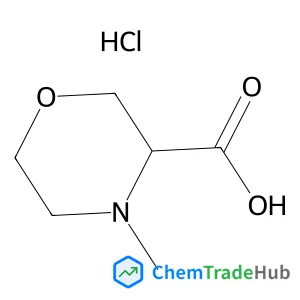
4-Methyl-3-morpholinecarboxylic acid hydrochloride (1:1)
CAS Number:
1240518-90-4
Molecular Formula:
C6H12ClNO3
Mark E. Wolf, Henry F. Schaefer, III
The reactions between substituted isocyanates (RNCO) and other small molecules (e.g. water, alcohols, and amines) are of significant industrial importance, particularly for the development of novel polyurethanes and other useful polymers. We present very high-level ab initio computations on the HNCO + H2O reaction, with results targeting the CCSDT(Q)/CBS//CCSD(T)/cc-pVQZ level of theory. Our results affirm that hydrolysis can occur across both the NC and CO bonds of HNCO via concerted mechanisms to form carbamate or imidic acid with ΔH0K barrier heights of 38.5 and 47.5 kcal mol−1. A total of 24 substituted RNCO + H2O reactions were studied. Geometries obtained with a composite method and refined with CCSD(T)/CBS single point energies determine that substituted RNCO species have a significant influence on these barrier heights, with an extreme case like fluorine lowering both barriers by close to 15 kcal mol−1 and most common alkyl substituents lowering both by approximately 3 kcal mol−1. Natural Bond Orbital (NBO) analysis provides evidence that the predicted barrier heights are strongly associated with the occupation of the in-plane C–O* orbital of the RNCO reactant. Key autocatalytic mechanisms are considered in the presence of excess water and RNCO species. Additional waters (one or two) are predicted to lower both barriers significantly at the CCSD(T)/aug-cc-pV(T+d)Z level of theory with strongly electron withdrawing RNCO substituents also increasing these effects, similar to the uncatalyzed case. The 298 K Gibbs energies are only marginally lowered by a second catalyst water molecule, indicating that the decreasing ΔH0K barriers are offset by loss of translational entropy with more than one catalyst water. Two-step 2RNCO + H2O mechanisms are characterized for the formation of carbamate and imidic acid. The second step of these two pathways exhibits the largest barrier and presents no clear pattern with respect to substituent choice. Our results indicate that an additional RNCO molecule might catalyze imidic acid formation but have less influence on the efficiency of carbamate formation. We expect that these results lay a firm foundation for the experimental study of substituted isocyanates and their relationship to the energetic pathways of related systems.
Bo Kong, Wentao Wang
DOI: 10.1039/D1CP02794H
You Yu, Yanhong Shen, Jiangfeng Song
DOI: 10.1039/D1CP01803E
Yiran Cao, Li Zhao, Jieqi Wang, Yunqi Shao, Xuelian He
DOI: 10.1039/D1CP01067K
DOI: 10.1039/D1CP04009J
Marta I. Hernández, José Campos-Martínez, Yury V. Suleimanov
DOI: 10.1039/D1CP02121D
Chao He, Shane J. Goettl, Zhenghai Yang, Srinivas Doddipatla, Ralf I. Kaiser, Mateus Xavier Silva, Breno R. L. Galvão
DOI: 10.1039/D1CP02812J
Chao Wu
DOI: 10.1039/D1CP02764F
Neda Rahmani, Mohammad Ebrahim Ghazi, Morteza Izadifard, Alireza Shabani, Jost Adam
DOI: 10.1039/D1CP02479E
Robert C. Chapleski, Jr., Alexander S. Ivanov, Kirk A. Peterson, Vyacheslav S. Bryantsev
DOI: 10.1039/D1CP02466C
4-Nitrophenyl phosphate disodium salt hexahydrate is primarily used as a substra...
2-(Trifluoromethyl)-1,3-oxazole-4-carboxylic Acid (CAS: 1060816-01-4) is widely ...
2-Fluoro-4-biphenylcarboxylic acid should be stored in a cool, dry place at room...
Prednisolone-21-Carboxylic Acid is primarily used in the pharmaceutical industry...
4-(Hydrazinomethyl)-1,2,3-benzenetriol (CAS: 3614-72-0) should be stored in a co...
4-Amino-1-methyl-1H-pyrazole-5-carboxylic acid hydrochloride (CAS: 92534-70-8) i...
Dehydropachymic acid (CAS: 77012-31-8) is regulated by various agencies. It fall...
The market and research trends for 6-[(2,2-Dimethylpropanoyl)amino]nicotinic aci...
1,10-Phenanthroline-2,9-dicarbaldehyde should be stored in a cool, dry place awa...
5-Carbamoyl-11-oxo-10,11-dihydro-5H-dibenzo[b,f]azepin-10-yl acetate can be synt...

Physical Chemistry Chemical Physics (PCCP) is an international journal co-owned by 19 physical chemistry and physics societies from around the world. This journal publishes original, cutting-edge research in physical chemistry, chemical physics and biophysical chemistry. To be suitable for publication in PCCP, articles must include significant innovation and/or insight into physical chemistry; this is the most important criterion that reviewers and Editors will judge against when evaluating submissions. The journal has a broad scope and welcomes contributions spanning experiment, theory, computation and data science. Topical coverage includes spectroscopy, dynamics, kinetics, statistical mechanics, thermodynamics, electrochemistry, catalysis, surface science, quantum mechanics, quantum computing and machine learning. Interdisciplinary research areas such as polymers and soft matter, materials, nanoscience, energy, surfaces/interfaces, and biophysical chemistry are welcomed if they demonstrate significant innovation and/or insight into physical chemistry. Joined experimental/theoretical studies are particularly appreciated when complementary and based on up-to-date approaches.