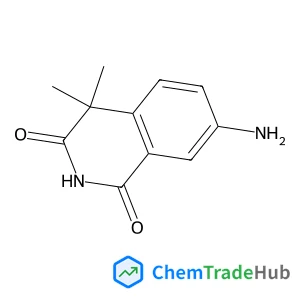
1,3(2H,4H)-Isoquinolinedione, 7-amino-4,4-dimethyl-
CAS Number:
14576-22-8
Molecular Formula:
C11H12N2O2
Qianqian Wang, Qinggao Zhang, Elaine Lai Han Leung, Yingqing Chen, Xiaojun Yao
As a human mitotic kinase, haspin is considered as a promising target for various diseases including cancers. However, no inhibitors targeting haspin have entered clinical trials presently. 5-iTU (5-iodotubercidin) is a useful and classical chemical probe for the investigation of haspin activity, but its inhibitory mechanism remains unclear. In this study, integrated molecular dynamics (MD) of conventional MD, extended adaptive biasing force (eABF), random acceleration MD and well-tempered metadynamics were applied to investigate the thermodynamic and kinetic features of 5-iTU and three derivatives targeting haspin. To emphasize the importance of gatekeeper Phe605, two haspin mutants (F605Y and F605T) were also built. The results showed that the binding affinity of 5-iTU and haspin was highest in all wild type (WT) systems, relying on the strong halogen aromatic π interaction between 5-iTU and gatekeeper Phe605. Gatekeeper mutations, because of damage to this interaction, led to the rearrangement of water distributions at the binding site and the decrease of 5-iTU residence times. Additionally, compared with the smaller 5-fTU, 5-iTU dissociated from WT haspin with more difficulty through distinct unbinding pathways. These findings will provide crucial guidance for the design and development of novel haspin inhibitors and the rational modification of existing inhibitors.
DOI: 10.1039/C5CP00217F
Juan G. Yañuk, María L. Alomar, M. Micaela Gonzalez, Francisco Simon, Rosa Erra-Balsells, Matías Rafti, Franco M. Cabrerizo
DOI: 10.1039/C5CP00308C
Maurizio Becucci, Jan Řezáč, Dana Nachtigallová, François Michels, Klaus Müller-Dethlefs
DOI: 10.1039/C5CP01166C
M. Zimmer, F. Rupp, P. Singer, F. Walz, F. Breher, W. Klopper, R. Diller, M. Gerhards
DOI: 10.1039/C5CP00959F
Sofia Babanova, Albert Perry III, Alexey Serov, Kateryna Artyushkova, Plamen Atanassov
DOI: 10.1039/C5CP00676G
M. H. Yang, S. N. Li, Y. Li, J. H. Li, B. X. Liu
DOI: 10.1039/C5CP00512D
Luis Rodríguez-Santiago, Jorge Alí-Torres, Mariona Sodupe
DOI: 10.1039/C5CP01615K
DOI: 10.1039/C5CP00740B
4-Nitrophenyl phosphate disodium salt hexahydrate is primarily used as a substra...
2-(Trifluoromethyl)-1,3-oxazole-4-carboxylic Acid (CAS: 1060816-01-4) is widely ...
2-Fluoro-4-biphenylcarboxylic acid should be stored in a cool, dry place at room...
Prednisolone-21-Carboxylic Acid is primarily used in the pharmaceutical industry...
4-(Hydrazinomethyl)-1,2,3-benzenetriol (CAS: 3614-72-0) should be stored in a co...
4-Amino-1-methyl-1H-pyrazole-5-carboxylic acid hydrochloride (CAS: 92534-70-8) i...
Dehydropachymic acid (CAS: 77012-31-8) is regulated by various agencies. It fall...
The market and research trends for 6-[(2,2-Dimethylpropanoyl)amino]nicotinic aci...
1,10-Phenanthroline-2,9-dicarbaldehyde should be stored in a cool, dry place awa...
5-Carbamoyl-11-oxo-10,11-dihydro-5H-dibenzo[b,f]azepin-10-yl acetate can be synt...

Physical Chemistry Chemical Physics (PCCP) is an international journal co-owned by 19 physical chemistry and physics societies from around the world. This journal publishes original, cutting-edge research in physical chemistry, chemical physics and biophysical chemistry. To be suitable for publication in PCCP, articles must include significant innovation and/or insight into physical chemistry; this is the most important criterion that reviewers and Editors will judge against when evaluating submissions. The journal has a broad scope and welcomes contributions spanning experiment, theory, computation and data science. Topical coverage includes spectroscopy, dynamics, kinetics, statistical mechanics, thermodynamics, electrochemistry, catalysis, surface science, quantum mechanics, quantum computing and machine learning. Interdisciplinary research areas such as polymers and soft matter, materials, nanoscience, energy, surfaces/interfaces, and biophysical chemistry are welcomed if they demonstrate significant innovation and/or insight into physical chemistry. Joined experimental/theoretical studies are particularly appreciated when complementary and based on up-to-date approaches.
![S-[2,3-Bis(palmitoyloxy)propyl]-N-[(9H-fluoren-9-ylmethoxy)(hydroxy)methylene]cysteine structure](https://static.chemtradehub.com/structs/210/210532-98-2-f6a7.webp "S-[2,3-Bis(palmitoyloxy)propyl]-N-[(9H-fluoren-9-ylmethoxy)(hydroxy)methylene]cysteine structure")
![N-[2-(4-Hydroxyphenoxy)-4-nitrophenyl]methanesulfonamide structure](https://static.chemtradehub.com/structs/109/109032-22-6-7c88.webp "N-[2-(4-Hydroxyphenoxy)-4-nitrophenyl]methanesulfonamide structure")