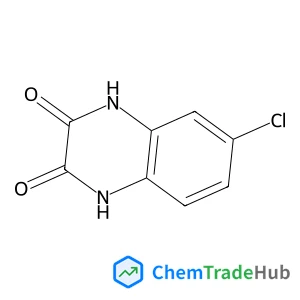
6-CHLORO-2,3-DIOXO-1,2,3,4-TETRAHYDROQUINOXALINE, 97
CAS Number:
169-14-2
Molecular Formula:
C8H5ClN2O2
Mircea Guna, Bradley B. Schneider, J. C. Yves Le Blanc, Marcel Nooijen
Two prototropic isomers of adenine are formed in an electrospray ion source and are resolved spatially in a differential mobility spectrometer before detection in a triple quadrupole mass spectrometer. Each isomer is gated in CV space before being trapped in the linear ion trap of the modified mass spectrometer, where they are irradiated by the tuneable output of an optical parametric oscillator and undergo photodissociation to form charged fragments with m/z 119, 109, and 94. The photon-normalised intensity of each fragmentation channel is measured and the action spectra for each DMS-gated tautomer are obtained. Our analysis of the action spectra, aided by calculated vibronic spectra and thermochemical data, allow us to assign the two signals in our measured ionograms to specific tautomers of protonated adenine.
Stefano Poggio, Brendan Wang, Ursula J. Gibson, Joseph J. BelBruno
DOI: 10.1039/C5CP00574D
Yanping Chen, Hongwei Qin, Ling Li, Changmin Shi, Liang Liu, Jifan Hu
DOI: 10.1039/C5CP00096C
Jiameng Qiu, Feilong Wu, Xin Jin, Xinyuan Gu, Wenbin Cai, Dalin Sun, Fang Fang
DOI: 10.1039/C5CP00800J
Sofia Babanova, Albert Perry III, Alexey Serov, Kateryna Artyushkova, Plamen Atanassov
DOI: 10.1039/C5CP00676G
Peng-Cheng Chen, Xiao-Jun Huang, Zhi-Kang Xu
DOI: 10.1039/C5CP00802F
Debojit Bhattacharya, Suranjan Shil, Anirban Misra, Laimutis Bytautas, Douglas J. Klein
DOI: 10.1039/C5CP00801H
Nan Feng, Wenbo Mi, Xiaocha Wang
DOI: 10.1039/C5CP01857A
Gongbiao Xin, Huiping Yuan, Lijun Jiang, Shumao Wang, Xiaopeng Liu, Xingguo Li
DOI: 10.1039/C5CP01897H
Chu Chen, Weixing Kong, Haiming Duan, Jun Zhang
DOI: 10.1039/C5CP00357A
Ignacio R. Solá, Jesús González-Vázquez, Rebeca de Nalda, Luis Bañares
DOI: 10.1039/C5CP00627A
4-Nitrophenyl phosphate disodium salt hexahydrate is primarily used as a substra...
2-(Trifluoromethyl)-1,3-oxazole-4-carboxylic Acid (CAS: 1060816-01-4) is widely ...
2-Fluoro-4-biphenylcarboxylic acid should be stored in a cool, dry place at room...
Prednisolone-21-Carboxylic Acid is primarily used in the pharmaceutical industry...
4-(Hydrazinomethyl)-1,2,3-benzenetriol (CAS: 3614-72-0) should be stored in a co...
4-Amino-1-methyl-1H-pyrazole-5-carboxylic acid hydrochloride (CAS: 92534-70-8) i...
Dehydropachymic acid (CAS: 77012-31-8) is regulated by various agencies. It fall...
The market and research trends for 6-[(2,2-Dimethylpropanoyl)amino]nicotinic aci...
1,10-Phenanthroline-2,9-dicarbaldehyde should be stored in a cool, dry place awa...
5-Carbamoyl-11-oxo-10,11-dihydro-5H-dibenzo[b,f]azepin-10-yl acetate can be synt...

Physical Chemistry Chemical Physics (PCCP) is an international journal co-owned by 19 physical chemistry and physics societies from around the world. This journal publishes original, cutting-edge research in physical chemistry, chemical physics and biophysical chemistry. To be suitable for publication in PCCP, articles must include significant innovation and/or insight into physical chemistry; this is the most important criterion that reviewers and Editors will judge against when evaluating submissions. The journal has a broad scope and welcomes contributions spanning experiment, theory, computation and data science. Topical coverage includes spectroscopy, dynamics, kinetics, statistical mechanics, thermodynamics, electrochemistry, catalysis, surface science, quantum mechanics, quantum computing and machine learning. Interdisciplinary research areas such as polymers and soft matter, materials, nanoscience, energy, surfaces/interfaces, and biophysical chemistry are welcomed if they demonstrate significant innovation and/or insight into physical chemistry. Joined experimental/theoretical studies are particularly appreciated when complementary and based on up-to-date approaches.
phosphoryl}methyl 4-methylbenzenesulfonate structure](https://static.chemtradehub.com/structs/864/864068-45-1-ba7c.webp "{[3-(Hexadecyloxy)propoxy](hydroxy)phosphoryl}methyl 4-methylbenzenesulfonate structure")