











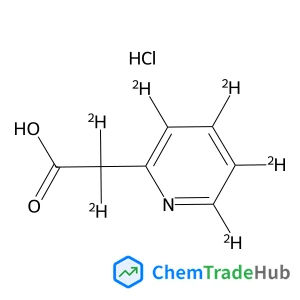
2,2-dideuterio-2-(3,4,5,6-tetradeuterio-2-pyridyl)acetic acid;hydrochloride
CAS Number:
1329799-67-8
Molecular Formula:
C7H2ClD6NO2
Anna Maria Ferrari, Khaled E. El-Kelany, Francesco Silvio Gentile, Maddalena D’Amore, Roberto Dovesi
The NV−⋯N+ charged pair in diamond has been investigated by using a Gaussian-type basis set, the B3LYP functional, the supercell scheme and the CRYSTAL code. It turns out that: (i) when the distance between the two defects is larger than 6–7 Å, the properties of the double defect are the superposition of the properties of the individual defects. (ii) The energy required for the reaction NV0 + Ns → NV− + N+ is roughly −1.3 eV at about 12 Å, irrespective of the basis set and functional adopted, and remains negative at any larger distance. (iii) These results support the observation of a charge transfer mechanism through a Ns → NV0 donation occurring in the ground state, through a tunnelling process, without irradiation. (iv) The IR spectrum of the two subunits is characterized by specific peaks, that might be used as fingerprints. (v) Calculation of electrostatic interaction permitted an estimate of the effective charge of the defects.
Chiara Negri, Gabriele Deplano, Kirill A. Lomachenko, Ton V. W. Janssens, Elisa Borfecchia, Gloria Berlier, Silvia Bordiga
DOI: 10.1039/D1CP01754C
D. A. Hardy, J. Archer, P. Lemaitre, R. Vehring, J. P. Reid, J. S. Walker
DOI: 10.1039/D1CP02840E
Mircea Guna, Bradley B. Schneider, J. C. Yves Le Blanc, Marcel Nooijen
DOI: 10.1039/D1CP02688G
Xin Shen, Yinan Bai
DOI: 10.1039/D1CP02770K
Zhizhou Wu, Liuyang Li, Xuedong Zhou, Xiujian Zhao, Baoshun Liu
DOI: 10.1039/D1CP03135J
Zhen Tong, Traian Dumitrică
DOI: 10.1039/D1CP00682G
DOI: 10.1039/D1CP02524D
Kai Guo, Sitong Liu, Haoming Tu, Zhikun Wang, Liang Chen, Haiqing Lin, Maosheng Miao, Jing Xu, Wei Liu
DOI: 10.1039/D1CP03069H
Adriana E. Candia, Eduardo A. Albanesi, Gustavo D. Ruano
DOI: 10.1039/D1CP01855H
4-Nitrophenyl phosphate disodium salt hexahydrate is primarily used as a substra...
2-(Trifluoromethyl)-1,3-oxazole-4-carboxylic Acid (CAS: 1060816-01-4) is widely ...
2-Fluoro-4-biphenylcarboxylic acid should be stored in a cool, dry place at room...
Prednisolone-21-Carboxylic Acid is primarily used in the pharmaceutical industry...
4-(Hydrazinomethyl)-1,2,3-benzenetriol (CAS: 3614-72-0) should be stored in a co...
4-Amino-1-methyl-1H-pyrazole-5-carboxylic acid hydrochloride (CAS: 92534-70-8) i...
Dehydropachymic acid (CAS: 77012-31-8) is regulated by various agencies. It fall...
The market and research trends for 6-[(2,2-Dimethylpropanoyl)amino]nicotinic aci...
1,10-Phenanthroline-2,9-dicarbaldehyde should be stored in a cool, dry place awa...
5-Carbamoyl-11-oxo-10,11-dihydro-5H-dibenzo[b,f]azepin-10-yl acetate can be synt...

Physical Chemistry Chemical Physics (PCCP) is an international journal co-owned by 19 physical chemistry and physics societies from around the world. This journal publishes original, cutting-edge research in physical chemistry, chemical physics and biophysical chemistry. To be suitable for publication in PCCP, articles must include significant innovation and/or insight into physical chemistry; this is the most important criterion that reviewers and Editors will judge against when evaluating submissions. The journal has a broad scope and welcomes contributions spanning experiment, theory, computation and data science. Topical coverage includes spectroscopy, dynamics, kinetics, statistical mechanics, thermodynamics, electrochemistry, catalysis, surface science, quantum mechanics, quantum computing and machine learning. Interdisciplinary research areas such as polymers and soft matter, materials, nanoscience, energy, surfaces/interfaces, and biophysical chemistry are welcomed if they demonstrate significant innovation and/or insight into physical chemistry. Joined experimental/theoretical studies are particularly appreciated when complementary and based on up-to-date approaches.
![(2E)-3-(3-Chlorophenyl)-N-{2-[4-(methylsulfonyl)-1-piperazinyl]-2-oxoethyl}acrylamide structure](https://static.chemtradehub.com/structs/250/2505001-54-5-c1e9.webp "(2E)-3-(3-Chlorophenyl)-N-{2-[4-(methylsulfonyl)-1-piperazinyl]-2-oxoethyl}acrylamide structure")
![(3R,5R)-1-[(Benzyloxy)carbonyl]-5-methyl-3-piperidinecarboxylic acid structure](https://static.chemtradehub.com/structs/126/1269757-29-0-c552.webp "(3R,5R)-1-[(Benzyloxy)carbonyl]-5-methyl-3-piperidinecarboxylic acid structure")




