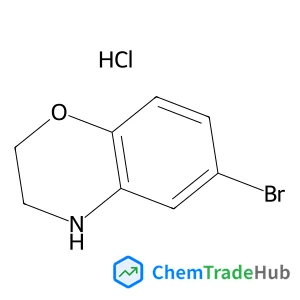
6-Bromo-3,4-dihydro-2H-1,4-benzoxazine hydrochloride (1:1)
CAS Number:
1260803-10-8
Molecular Formula:
C8H9BrClNO
Philipp Pracht, Fabian Bohle, Stefan Grimme
We propose and discuss an efficient scheme for the in silico sampling for parts of the molecular chemical space by semiempirical tight-binding methods combined with a meta-dynamics driven search algorithm. The focus of this work is set on the generation of proper thermodynamic ensembles at a quantum chemical level for conformers, but similar procedures for protonation states, tautomerism and non-covalent complex geometries are also discussed. The conformational ensembles consisting of all significantly populated minimum energy structures normally form the basis of further, mostly DFT computational work, such as the calculation of spectra or macroscopic properties. By using basic quantum chemical methods, electronic effects or possible bond breaking/formation are accounted for and a very reasonable initial energetic ranking of the candidate structures is obtained. Due to the huge computational speedup gained by the fast low-cost quantum chemical methods, overall short computation times even for systems with hundreds of atoms (typically drug-sized molecules) are achieved. Furthermore, specialized applications, such as sampling with implicit solvation models or constrained conformational sampling for transition-states, metal-, surface-, or noncovalently bound complexes are discussed, opening many possible applications in modern computational chemistry and drug discovery. The procedures have been implemented in a freely available computer code called CREST, that makes use of the fast and reliable GFNn-xTB methods.
Shu Wang, Grant A. Knappe, Norman J. Wagner
DOI: 10.1039/C7PY01431G
Mattia Sponchioni, Nicolò Manfredini, Matteo Maraldi, Davide Moscatelli
DOI: 10.1039/C8PY00649K
Shi Wang, Xu Liu, Ailian Wang, Zhinan Wang, Jie Chen, Qinghui Zeng, Xuefei Wang, Liaoyun Zhang
DOI: 10.1039/C8PY00951A
Prasanta Kumar Behera, Prantik Mondal, Nikhil K. Singha
DOI: 10.1039/C8PY00549D
Razvan Rotaru, Marcela Savin, Nita Tudorachi, Cristian Peptu, Petrisor Samoila, Liviu Sacarescu, Valeria Harabagiu
DOI: 10.1039/C7PY01587A
DOI: 10.1039/C7PY01969F
Weiqiang Fu, Lichao Dong, Jianbing Shi, Bin Tong, Zhengxu Cai, Junge Zhi, Yuping Dong
DOI: 10.1039/C8PY00819A
Qian Li, Xiao Li, Zhongying Wu, Yuhao Sun, Jianglin Fang, Dongzhong Chen
DOI: 10.1039/C8PY00710A
Tongtong Zhou, Tao Liu, Yu Bao, Ping Zhang, Casey Yan, Fujun Yao, Shuxun Cui, Yongming Chen, Xin Chen, You Yu
DOI: 10.1039/C7PY01844D
4-Nitrophenyl phosphate disodium salt hexahydrate is primarily used as a substra...
2-(Trifluoromethyl)-1,3-oxazole-4-carboxylic Acid (CAS: 1060816-01-4) is widely ...
2-Fluoro-4-biphenylcarboxylic acid should be stored in a cool, dry place at room...
Prednisolone-21-Carboxylic Acid is primarily used in the pharmaceutical industry...
4-(Hydrazinomethyl)-1,2,3-benzenetriol (CAS: 3614-72-0) should be stored in a co...
4-Amino-1-methyl-1H-pyrazole-5-carboxylic acid hydrochloride (CAS: 92534-70-8) i...
Dehydropachymic acid (CAS: 77012-31-8) is regulated by various agencies. It fall...
The market and research trends for 6-[(2,2-Dimethylpropanoyl)amino]nicotinic aci...
1,10-Phenanthroline-2,9-dicarbaldehyde should be stored in a cool, dry place awa...
5-Carbamoyl-11-oxo-10,11-dihydro-5H-dibenzo[b,f]azepin-10-yl acetate can be synt...

Physical Chemistry Chemical Physics (PCCP) is an international journal co-owned by 19 physical chemistry and physics societies from around the world. This journal publishes original, cutting-edge research in physical chemistry, chemical physics and biophysical chemistry. To be suitable for publication in PCCP, articles must include significant innovation and/or insight into physical chemistry; this is the most important criterion that reviewers and Editors will judge against when evaluating submissions. The journal has a broad scope and welcomes contributions spanning experiment, theory, computation and data science. Topical coverage includes spectroscopy, dynamics, kinetics, statistical mechanics, thermodynamics, electrochemistry, catalysis, surface science, quantum mechanics, quantum computing and machine learning. Interdisciplinary research areas such as polymers and soft matter, materials, nanoscience, energy, surfaces/interfaces, and biophysical chemistry are welcomed if they demonstrate significant innovation and/or insight into physical chemistry. Joined experimental/theoretical studies are particularly appreciated when complementary and based on up-to-date approaches.

![(3R,5R)-1-[(Benzyloxy)carbonyl]-5-methyl-3-piperidinecarboxylic acid structure](https://static.chemtradehub.com/structs/126/1269757-29-0-c552.webp "(3R,5R)-1-[(Benzyloxy)carbonyl]-5-methyl-3-piperidinecarboxylic acid structure")