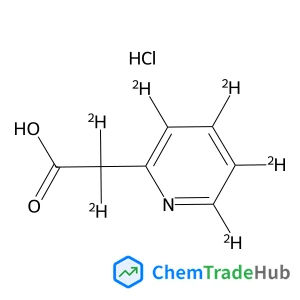
2,2-dideuterio-2-(3,4,5,6-tetradeuterio-2-pyridyl)acetic acid;hydrochloride
CAS Number:
1329799-67-8
Molecular Formula:
C7H2ClD6NO2
Masahiro Asahara, Haruhiko Kurimoto, Masato Nakamizu, Shingo Hattori, Kazuteru Shinozaki
This work assessed solvent isotope effects on the photoracemization rate and emission lifetime for [Ru(bpy)3]2+ (bpy = 2,2′-bipyridine) in water. An analysis of the effects of temperature on photoracemization rate and emission lifetime demonstrated that the transition from one enantiomer to the other is unaffected by the isotopic composition of the solvent. The results also showed that deactivation from the metal-to-ligand charge-transfer (3MLCT) excited state to the ground state is responsible for the solvent isotope effect on the photoracemization rate. The photoracemization reaction was found to proceed via a bond-breaking mechanism. In this process, a five-coordinated species produced through breaking of the Ru–N bond in the 3d–d* state undergoes a structural change to produce an achiral five-coordinated species. An analysis of the effect of temperature on emission lifetime, excluding the activation to the 3d–d* state that leads to the structural change, showed that the solvent isotopic composition affects deactivation from the 4th MLCT state.
Yusheng Qin, Lijun Qiao, Yuyang Miao, Xianhong Wang, Fosong Wang
DOI: 10.1039/C5PY01338K
Xu Zhi, Jingjing Liu, Zhenjiang Li, Huiying Wang, Xin Wang, Saide Cui, Cheng Chen, Chengxu Zhao, Xiaopei Li, Kai Guo
DOI: 10.1039/C5PY01315A
Yuan-Da Jiu, Cheng-Fang Liu, Jian-Yun Wang, Yi Jiang, Wei-Dong Xu, Xin-Wen Zhang
DOI: 10.1039/C5PY01480H
Khooi Y. Tan, Madeleine Ramstedt, Wilhelm T. S. Huck
DOI: 10.1039/C5PY01687H
Philip Hodge, Abdel Chakiri
DOI: 10.1039/C5PY00272A
Ling-Bao Xing, Xiao-Jun Wang, Jing-Li Zhang, Ziyan Zhou, Shuping Zhuo
DOI: 10.1039/C5PY01741F
Alexander S. Shaplov, Sofia M. Morozova, Elena I. Lozinskaya, Petr S. Vlasov, Andreia S. L. Gouveia, Liliana C. Tomé, Isabel M. Marrucho, Yakov S. Vygodskii
DOI: 10.1039/C5PY01553G
Pradip Dey, Shabnam Hemmati-Sadeghi, Rainer Haag
DOI: 10.1039/C5PY01326G
Birgit Huber, Vanessa Trouillet, Steffen M. Weidner, Leonie Barner, Peter W. Roesky, Jiayin Yuan
DOI: 10.1039/C5PY01320H
4-Nitrophenyl phosphate disodium salt hexahydrate is primarily used as a substra...
2-(Trifluoromethyl)-1,3-oxazole-4-carboxylic Acid (CAS: 1060816-01-4) is widely ...
2-Fluoro-4-biphenylcarboxylic acid should be stored in a cool, dry place at room...
Prednisolone-21-Carboxylic Acid is primarily used in the pharmaceutical industry...
4-(Hydrazinomethyl)-1,2,3-benzenetriol (CAS: 3614-72-0) should be stored in a co...
4-Amino-1-methyl-1H-pyrazole-5-carboxylic acid hydrochloride (CAS: 92534-70-8) i...
Dehydropachymic acid (CAS: 77012-31-8) is regulated by various agencies. It fall...
The market and research trends for 6-[(2,2-Dimethylpropanoyl)amino]nicotinic aci...
1,10-Phenanthroline-2,9-dicarbaldehyde should be stored in a cool, dry place awa...
5-Carbamoyl-11-oxo-10,11-dihydro-5H-dibenzo[b,f]azepin-10-yl acetate can be synt...

Physical Chemistry Chemical Physics (PCCP) is an international journal co-owned by 19 physical chemistry and physics societies from around the world. This journal publishes original, cutting-edge research in physical chemistry, chemical physics and biophysical chemistry. To be suitable for publication in PCCP, articles must include significant innovation and/or insight into physical chemistry; this is the most important criterion that reviewers and Editors will judge against when evaluating submissions. The journal has a broad scope and welcomes contributions spanning experiment, theory, computation and data science. Topical coverage includes spectroscopy, dynamics, kinetics, statistical mechanics, thermodynamics, electrochemistry, catalysis, surface science, quantum mechanics, quantum computing and machine learning. Interdisciplinary research areas such as polymers and soft matter, materials, nanoscience, energy, surfaces/interfaces, and biophysical chemistry are welcomed if they demonstrate significant innovation and/or insight into physical chemistry. Joined experimental/theoretical studies are particularly appreciated when complementary and based on up-to-date approaches.

![S-[2,3-Bis(palmitoyloxy)propyl]-N-[(9H-fluoren-9-ylmethoxy)(hydroxy)methylene]cysteine structure](https://static.chemtradehub.com/structs/210/210532-98-2-f6a7.webp "S-[2,3-Bis(palmitoyloxy)propyl]-N-[(9H-fluoren-9-ylmethoxy)(hydroxy)methylene]cysteine structure")