












Investigation of glycerol hydrogen-bonding networks in choline chloride/glycerol eutectic-forming liquids using neutron diffraction
Literature Information
Publication Date
2019-09-19
DOI
10.1039/C9CP04343H
Impact Factor
3.676
Authors
View Original
Abstract
The structure of choline chloride/glycerol (ChCl : Gly) mixtures at two mole fractions (the eutectic χChCl = 0.33 (1 : 2), and a higher χChCl = 0.50 (1 : 1) composition) in the liquid state at 333 K and 1 atm. has been investigated using neutron diffraction coupled with hydrogen/deuterium isotopic substitution. Modelling using the empirical potential structure refinement (EPSR) technique, constrained to the experimental neutron diffraction data, produced structural models at both compositions consistent with the experimental data with an extensive, persistent homo-molecular glycerol hydrogen bonding network at χChCl = 0.33 similar to that present in pure glycerol and suggests that persistence of the latent glycerol hydrogen bonding network is key to formation of the ChCl : Gly deep eutectic solvent. In the choline chloride-rich χChCl = 0.50 composition, significant domain segregation is observed with a dramatic reduction in the extent of the homo-molecular glycerol hydrogen bond network which is replaced by a more homogeneous system-wide hydrogen bonded network incorporating glycerol, Cl−, and choline cations.
Related Literature
Post-polymerization modification of poly(vinyl ether)s: a Ru-catalyzed oxidative synthesis of poly(vinyl ester)s and poly(propenyl ester)s
Di Liu
2015-10-20
Paper
DOI: 10.1039/C5PY01409C
Study of thiol–ene chemistry on polymer brushes and application to surface patterning and protein adsorption
Khooi Y. Tan, Madeleine Ramstedt, Wilhelm T. S. Huck
2015-12-16
Paper
DOI: 10.1039/C5PY01687H
Facile synthesis of a multifunctional copolymer via a concurrent RAFT-enzymatic system for theranostic applications
Changkui Fu, Andre Bongers, Ke Wang, Bin Yang, Yuan Zhao, Yen Wei, Hien T. T. Duong, Zhiming Wang, Lei Tao
2015-11-11
Paper
DOI: 10.1039/C5PY01652E
A novel stimuli-responsive fluorescent elastomer based on an AIE mechanism
Dong Huang, Jun Wang, Wenjun Shen, Lizhuang Chen, Shengyuan Yang, Meifang Zhu, Guodong Liang, Zexiao Xu
2015-09-24
Paper
DOI: 10.1039/C5PY01273B
Cheap and fast: oxalic acid initiated CO2-based polyols synthesized by a novel preactivation approach
Yusheng Qin, Lijun Qiao, Yuyang Miao, Xianhong Wang, Fosong Wang
2015-10-12
Paper
DOI: 10.1039/C5PY01338K
Physical hydrogels constructed on a macro-cross-linking cationic polysaccharide with tunable, excellent mechanical performance
Lei Guo, Yacheng Xing
2015-10-12
Communication
DOI: 10.1039/C5PY01437A
Ru(bpy)32+ derivatized polystyrenes constructed by nitroxide-mediated radical polymerization. Relationship between polymer chain length, structure and photophysical properties
Gyu Leem, Shahar Keinan, Junlin Jiang, Zhuo Chen, Toan Pho, Zachary A. Morseth, Zhenya Hu, Egle Puodziukynaite, Zhen Fang, John M. Papanikolas, John R. Reynolds, Kirk S. Schanze
2015-10-01
Paper
DOI: 10.1039/C5PY01289A
Tunable doubly responsive UCST-type phosphonium poly(ionic liquid): a thermosensitive dispersant for carbon nanotubes
Yajnaseni Biswas, Tanmoy Maji, Madhab Dule, Tarun K. Mandal
2015-11-30
Paper
DOI: 10.1039/C5PY01574J
Synthesis and hydrolytic properties of water-soluble poly(carbonate–hydroxyurethane)s from trimethylolpropane
Hiroyuki Matsukizono, Takeshi Endo
2015-12-08
Paper
DOI: 10.1039/C5PY01733E
You might also like
Compound Q&A
What are the main uses of 4-Nitrophenyl phosphate disodium salt hexahydrate (CAS: 333338-18-4)?
4-Nitrophenyl phosphate disodium salt hexahydrate is primarily used as a substra...
333338-18-44-Nitrophenyl phosph...
Compound Q&A
What are the main uses of 2-(Trifluoromethyl)-1,3-oxazole-4-carboxylic Acid (CAS: 1060816-01-4)?
2-(Trifluoromethyl)-1,3-oxazole-4-carboxylic Acid (CAS: 1060816-01-4) is widely ...
1060816-01-42-(Trifluoromethyl)-...
Compound Q&A
How should 2-Fluoro-4-biphenylcarboxylic acid (CAS: 137045-30-8) be stored?
2-Fluoro-4-biphenylcarboxylic acid should be stored in a cool, dry place at room...
137045-30-82-Fluoro-4-biphenylc...
Compound Q&A
What industries use Prednisolone-21-Carboxylic Acid (CAS: 61549-70-0)?
Prednisolone-21-Carboxylic Acid is primarily used in the pharmaceutical industry...
61549-70-0Prednisolone-21-Carb...
Compound Q&A
How should 4-(Hydrazinomethyl)-1,2,3-benzenetriol (CAS: 3614-72-0) be stored?
4-(Hydrazinomethyl)-1,2,3-benzenetriol (CAS: 3614-72-0) should be stored in a co...
3614-72-04-(Hydrazinomethyl)-...
Compound Q&A
What industries use 4-Amino-1-methyl-1H-pyrazole-5-carboxylic acid hydrochloride (CAS: 92534-70-8)?
4-Amino-1-methyl-1H-pyrazole-5-carboxylic acid hydrochloride (CAS: 92534-70-8) i...
92534-70-84-Amino-1-methyl-1H-...
Compound Q&A
What regulatory guidelines apply to dehydropachymic acid (CAS: 77012-31-8)?
Dehydropachymic acid (CAS: 77012-31-8) is regulated by various agencies. It fall...
77012-31-8Dehydropachymic acid
Compound Q&A
What is the market or research trend for 6-[(2,2-Dimethylpropanoyl)amino]nicotinic acid (CAS: 898561-66-5)?
The market and research trends for 6-[(2,2-Dimethylpropanoyl)amino]nicotinic aci...
898561-66-56-[(2,2-Dimethylprop...
Compound Q&A
How should 1,10-Phenanthroline-2,9-dicarbaldehyde (CAS: 57709-62-3) be stored?
1,10-Phenanthroline-2,9-dicarbaldehyde should be stored in a cool, dry place awa...
57709-62-31,10-Phenanthroline-...
Compound Q&A
How is 5-Carbamoyl-11-oxo-10,11-dihydro-5H-dibenzo[b,f]azepin-10-yl acetate (CAS: 113952-21-9) typically synthesized?
5-Carbamoyl-11-oxo-10,11-dihydro-5H-dibenzo[b,f]azepin-10-yl acetate can be synt...
113952-21-95-Carbamoyl-11-oxo-1...
Source Journal
Physical Chemistry Chemical Physics

CiteScore:
5.5
Self-citation Rate:
10.3%
Articles per Year:
3036
Physical Chemistry Chemical Physics (PCCP) is an international journal co-owned by 19 physical chemistry and physics societies from around the world. This journal publishes original, cutting-edge research in physical chemistry, chemical physics and biophysical chemistry. To be suitable for publication in PCCP, articles must include significant innovation and/or insight into physical chemistry; this is the most important criterion that reviewers and Editors will judge against when evaluating submissions. The journal has a broad scope and welcomes contributions spanning experiment, theory, computation and data science. Topical coverage includes spectroscopy, dynamics, kinetics, statistical mechanics, thermodynamics, electrochemistry, catalysis, surface science, quantum mechanics, quantum computing and machine learning. Interdisciplinary research areas such as polymers and soft matter, materials, nanoscience, energy, surfaces/interfaces, and biophysical chemistry are welcomed if they demonstrate significant innovation and/or insight into physical chemistry. Joined experimental/theoretical studies are particularly appreciated when complementary and based on up-to-date approaches.
Recommended Compounds
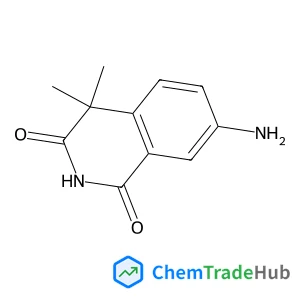
1,3(2H,4H)-Isoquinolinedione, 7-amino-4,4-dimethyl-
CAS Number:
14576-22-8
Molecular Formula:
C11H12N2O2
![N-[2-(4-Hydroxyphenoxy)-4-nitrophenyl]methanesulfonamide structure](https://static.chemtradehub.com/structs/109/109032-22-6-7c88.webp "N-[2-(4-Hydroxyphenoxy)-4-nitrophenyl]methanesulfonamide structure")
N-[2-(4-Hydroxyphenoxy)-4-nitrophenyl]methanesulfonamide
CAS Number:
109032-22-6
Molecular Formula:
C13H12N2O6S

cis-3-Amino-1-(trifluoromethyl)cyclobutanol hydrochloride (1:1)
CAS Number:
1408075-16-0
Molecular Formula:
C5H9ClF3NO
Recommended Suppliers



Disclaimer
This page provides academic journal information for reference and research purposes only. We are not affiliated with any journal publishers and do not handle publication submissions. For publication-related inquiries, please contact the respective journal publishers directly.
If you notice any inaccuracies in the information displayed, please contact us at support@chemtradehub.com. We will promptly review and address your concerns.