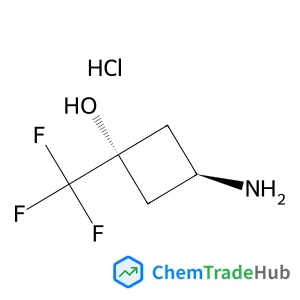
cis-3-Amino-1-(trifluoromethyl)cyclobutanol hydrochloride (1:1)
CAS Number:
1408075-16-0
Molecular Formula:
C5H9ClF3NO
Bao-Di Gou, Yu-Xi Gao, Gang Wu, Tian-Lan Zhang
An X-ray amorphous phase is frequently present at the early stage of calcium phosphate crystallization, and the relevant solution chemistry is essential for understanding the mechanism of reaction. Here, we report a quantitative study of a series of reaction systems at pseudo-equilibrium states. We determined the composition of solutions and the quantities of the precipitate samples, and characterized the long- and short-range order of the precipitate using X-ray diffraction and synchrotron X-ray absorption near-edge structure spectroscopy, respectively. We found that, in a particle with multiple structural units, only a fraction of the units was able to reach pseudo-equilibrium with the solution composition, which represents the average number of surficial clusters per unit. These findings enabled us to propose a general form of the equilibrium constant equation. The equation fits the pseudo-equilibrium data well, and it converts to the “solubility product (Ksp)” and the conventional “reaction quotient” in two limit cases, respectively. Further, using a cube model, we derived a “particle equation” that reveals the connection between the particle structure and the form of equilibrium constant equation. The dependency of the form of pseudo-equilibrium equation on the structure and size of the precipitate reveals a fundamental relation in chemistry, and its applicability remains to be examined in other reaction systems, such as those involving nanocrystals and porous materials.
Shangguan Yonggang, Qiang Zheng
DOI: 10.1039/C5PY01022E
Zicheng Ding, Chuandong Dou, Jun Liu, Lixiang Wang
DOI: 10.1039/C5PY01389E
Pradip Dey, Shabnam Hemmati-Sadeghi, Rainer Haag
DOI: 10.1039/C5PY01326G
Mei Tan, Yulin Cui, Aidi Zhu, Han Han, Mingyu Guo, Ming Jiang
DOI: 10.1039/C5PY01073J
H. Park, S. Walta, R. R. Rosencrantz, A. Körner, C. Schulte, L. Elling, W. Richtering, A. Böker
DOI: 10.1039/C5PY00797F
Philip Hodge, Abdel Chakiri
DOI: 10.1039/C5PY00272A
Nghia P. Truong, Michael R. Whittaker, John F. Quinn
DOI: 10.1039/C5PY01467K
4-Nitrophenyl phosphate disodium salt hexahydrate is primarily used as a substra...
2-(Trifluoromethyl)-1,3-oxazole-4-carboxylic Acid (CAS: 1060816-01-4) is widely ...
2-Fluoro-4-biphenylcarboxylic acid should be stored in a cool, dry place at room...
Prednisolone-21-Carboxylic Acid is primarily used in the pharmaceutical industry...
4-(Hydrazinomethyl)-1,2,3-benzenetriol (CAS: 3614-72-0) should be stored in a co...
4-Amino-1-methyl-1H-pyrazole-5-carboxylic acid hydrochloride (CAS: 92534-70-8) i...
Dehydropachymic acid (CAS: 77012-31-8) is regulated by various agencies. It fall...
The market and research trends for 6-[(2,2-Dimethylpropanoyl)amino]nicotinic aci...
1,10-Phenanthroline-2,9-dicarbaldehyde should be stored in a cool, dry place awa...
5-Carbamoyl-11-oxo-10,11-dihydro-5H-dibenzo[b,f]azepin-10-yl acetate can be synt...

Physical Chemistry Chemical Physics (PCCP) is an international journal co-owned by 19 physical chemistry and physics societies from around the world. This journal publishes original, cutting-edge research in physical chemistry, chemical physics and biophysical chemistry. To be suitable for publication in PCCP, articles must include significant innovation and/or insight into physical chemistry; this is the most important criterion that reviewers and Editors will judge against when evaluating submissions. The journal has a broad scope and welcomes contributions spanning experiment, theory, computation and data science. Topical coverage includes spectroscopy, dynamics, kinetics, statistical mechanics, thermodynamics, electrochemistry, catalysis, surface science, quantum mechanics, quantum computing and machine learning. Interdisciplinary research areas such as polymers and soft matter, materials, nanoscience, energy, surfaces/interfaces, and biophysical chemistry are welcomed if they demonstrate significant innovation and/or insight into physical chemistry. Joined experimental/theoretical studies are particularly appreciated when complementary and based on up-to-date approaches.
phosphoryl}methyl 4-methylbenzenesulfonate structure](https://static.chemtradehub.com/structs/864/864068-45-1-ba7c.webp "{[3-(Hexadecyloxy)propoxy](hydroxy)phosphoryl}methyl 4-methylbenzenesulfonate structure")
![1-[(4-Methylphenyl)sulfonyl]-3-(4,4,5,5-tetramethyl-1,3,2-dioxaborolan-2-yl)-1H-pyrrolo[2,3-b]pyridine-5-carbonitrile structure](https://static.chemtradehub.com/structs/143/1434747-57-5-fc0d.webp "1-[(4-Methylphenyl)sulfonyl]-3-(4,4,5,5-tetramethyl-1,3,2-dioxaborolan-2-yl)-1H-pyrrolo[2,3-b]pyridine-5-carbonitrile structure")