












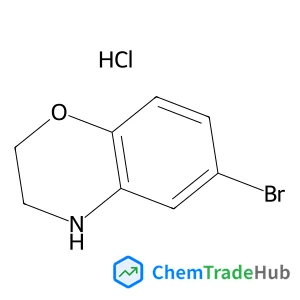
6-Bromo-3,4-dihydro-2H-1,4-benzoxazine hydrochloride (1:1)
CAS Number:
1260803-10-8
Molecular Formula:
C8H9BrClNO
Chen-An Chung, Jou Wei Su
The reaction of Criegee intermediate CH2OO with HCOOH is important in atmospheric chemistry, but its mechanism and kinetics are little investigated. We recorded time-resolved infrared absorption spectra of transient species produced upon irradiation at 308 nm of a flowing mixture of CH2I2/O2/N2/HCOOH at 298 K. Bands of CH2OO were observed initially upon irradiation; their decrease was accompanied with the appearance of several bands near 887, 925, 1052, 1115, 1170, 1342, 1391, and 1760 cm−1, assigned to the absorption of hydroperoxymethyl formate [HC(O)OCH2OOH, HPMF], that decreased in intensity at a later period with the appearance of absorption bands of the anti-conformer of formic acid anhydride [anti-(HCO)2O, FAN] near 998, 1101, 1767, and 1821 cm−1. The main contributions of the infrared absorption of HPMF are from an open-form conformer, but small contributions from the intramolecular hydrogen-bonded conformer that absorbs near 1070, 1170, and 1732 cm−1 were identified. Observed infrared spectra of both conformers of HPMF and anti-FAN agree satisfactorily with the anharmonic vibrational wavenumbers and IR intensities predicted with the B3LYP/aug-cc-pVTZ method. We derived a rate coefficient for CH2OO + HCOOH to be k = (1.4 ± 0.3) × 10−10 cm3 molecule−1 s−1 from formation of HPMF. We found also that anti-FAN was produced mainly from the open-form conformer with rate coefficient k = (1460 ± 30) s−1; the intramolecular hydrogen-bonded conformer of HPMF is stable.
Dawei Chen, Dongxia Wu, Guochen Cheng, Hanying Zhao
DOI: 10.1039/C5PY01299F
Khooi Y. Tan, Madeleine Ramstedt, Wilhelm T. S. Huck
DOI: 10.1039/C5PY01687H
J. Areephong, J. W. Kramer, H. A. Sprafke
DOI: 10.1039/C5PY01563D
Lei Guo, Yacheng Xing
DOI: 10.1039/C5PY01437A
Liang Zhu, Brian L. Chaloux, Michael A. Hickner
DOI: 10.1039/C7PY00026J
Jarret P. MacDonald, Michael P. Shaver
DOI: 10.1039/C5PY01606A
Tao Jiang, Youtian Tao, Cong Fan, Lingwei Xue, Zhiguo Zhang, Hai Li, Yongfang Li
DOI: 10.1039/C5PY01771H
Pradip Dey, Shabnam Hemmati-Sadeghi, Rainer Haag
DOI: 10.1039/C5PY01326G
Chengjun Kang, Rowena Crockett, Nicholas D. Spencer
DOI: 10.1039/C5PY01521A
Bernd Deffner, A. Dieter Schlüter
DOI: 10.1039/C5PY01317H
4-Nitrophenyl phosphate disodium salt hexahydrate is primarily used as a substra...
2-(Trifluoromethyl)-1,3-oxazole-4-carboxylic Acid (CAS: 1060816-01-4) is widely ...
2-Fluoro-4-biphenylcarboxylic acid should be stored in a cool, dry place at room...
Prednisolone-21-Carboxylic Acid is primarily used in the pharmaceutical industry...
4-(Hydrazinomethyl)-1,2,3-benzenetriol (CAS: 3614-72-0) should be stored in a co...
4-Amino-1-methyl-1H-pyrazole-5-carboxylic acid hydrochloride (CAS: 92534-70-8) i...
Dehydropachymic acid (CAS: 77012-31-8) is regulated by various agencies. It fall...
The market and research trends for 6-[(2,2-Dimethylpropanoyl)amino]nicotinic aci...
1,10-Phenanthroline-2,9-dicarbaldehyde should be stored in a cool, dry place awa...
5-Carbamoyl-11-oxo-10,11-dihydro-5H-dibenzo[b,f]azepin-10-yl acetate can be synt...

Physical Chemistry Chemical Physics (PCCP) is an international journal co-owned by 19 physical chemistry and physics societies from around the world. This journal publishes original, cutting-edge research in physical chemistry, chemical physics and biophysical chemistry. To be suitable for publication in PCCP, articles must include significant innovation and/or insight into physical chemistry; this is the most important criterion that reviewers and Editors will judge against when evaluating submissions. The journal has a broad scope and welcomes contributions spanning experiment, theory, computation and data science. Topical coverage includes spectroscopy, dynamics, kinetics, statistical mechanics, thermodynamics, electrochemistry, catalysis, surface science, quantum mechanics, quantum computing and machine learning. Interdisciplinary research areas such as polymers and soft matter, materials, nanoscience, energy, surfaces/interfaces, and biophysical chemistry are welcomed if they demonstrate significant innovation and/or insight into physical chemistry. Joined experimental/theoretical studies are particularly appreciated when complementary and based on up-to-date approaches.

phosphoryl}methyl 4-methylbenzenesulfonate structure](https://static.chemtradehub.com/structs/864/864068-45-1-ba7c.webp "{[3-(Hexadecyloxy)propoxy](hydroxy)phosphoryl}methyl 4-methylbenzenesulfonate structure")




