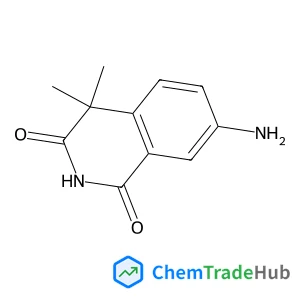
1,3(2H,4H)-Isoquinolinedione, 7-amino-4,4-dimethyl-
CAS Number:
14576-22-8
Molecular Formula:
C11H12N2O2
Li Jiang, Zhishan Fang, Haoran Lou, Chen Lin, Zhanhang Chen, Jing Li, Haiping He, Zhizhen Ye
Solution-processed all-inorganic CsPbX3(X = Br, I, and Cl) perovskites are proven to be promising materials for various optoelectronic applications. However, CsPbX3 films as optical gain media were confronted with unsatisfactory surface coverage and inferior photoluminescence performance when compared with their colloidal nanocrystal counterparts. Herein, we demonstrate a strategy for improving the optical properties via modification of both top and bottom surfaces of CsPbBr3 films. The treated perovskite films show ultra-smooth morphology and a carrier lifetime of 44 ns, more than one order of magnitude longer than the untreated one. Meanwhile, a mixed polymer layer on the top of the perovskite film could combine surface passivation with symmetric waveguide effects, leading to an outstanding net gain coefficient of 694 cm−1. These merits predict the great potential of all-inorganic perovskite films to support high efficiency charge transport or stimulated emission.
Shun Nishimura, Atsushi Takagaki, Kohki Ebitani
DOI: 10.1039/C3GC40405F
Olga Gómez-Jiménez-Aberasturi, Camilo Ramírez-López, Belén Maestro-Madurga
DOI: 10.1039/C2GC35992H
Yu-Jie Zhang, Zhi-Rong Tan, Yu-Qin Xing, Zhengwang Chen, Jia-Bin Qiu, Shi-Yong Liu
DOI: 10.1039/D2CC04625C
Andreas Dueholm Bertelsen, Alexander Reinhardt Hansen, Nils Lau Nyborg Broge, Aref Mamakhel, Martin Bondesgaard, Bo Brummerstedt Iversen
DOI: 10.1039/D2CC04827B
Xi-Meng Chen, Si-Han Jia, Jia-Xin Kang, Yichun Zhang, Yubin Ma, Yiming Ma, Xin Jiang, Xing-Chao Yu, Pengtao Qiu
DOI: 10.1039/D2CC00408A
Yang Liu, Yingqi Feng, Jinli Nie, Sijie Xie, Xin Pen, Huanliang Hong, Xiuwen Chen, Lu Chen, Yibiao Li
DOI: 10.1039/D3CC03279E
DOI: 10.1039/A606293H
Kaliyamoorthy Justice Babu, Ayushi Shukla, Gurpreet Kaur, Arshdeep Kaur, Himanshu Bhatt
DOI: 10.1039/D2CC05142G
Daniel Kocsi, Andreas Orthaber, K. Eszter Borbas
DOI: 10.1039/D2CC01229D
4-Nitrophenyl phosphate disodium salt hexahydrate is primarily used as a substra...
2-(Trifluoromethyl)-1,3-oxazole-4-carboxylic Acid (CAS: 1060816-01-4) is widely ...
2-Fluoro-4-biphenylcarboxylic acid should be stored in a cool, dry place at room...
Prednisolone-21-Carboxylic Acid is primarily used in the pharmaceutical industry...
4-(Hydrazinomethyl)-1,2,3-benzenetriol (CAS: 3614-72-0) should be stored in a co...
4-Amino-1-methyl-1H-pyrazole-5-carboxylic acid hydrochloride (CAS: 92534-70-8) i...
Dehydropachymic acid (CAS: 77012-31-8) is regulated by various agencies. It fall...
The market and research trends for 6-[(2,2-Dimethylpropanoyl)amino]nicotinic aci...
1,10-Phenanthroline-2,9-dicarbaldehyde should be stored in a cool, dry place awa...
5-Carbamoyl-11-oxo-10,11-dihydro-5H-dibenzo[b,f]azepin-10-yl acetate can be synt...

Physical Chemistry Chemical Physics (PCCP) is an international journal co-owned by 19 physical chemistry and physics societies from around the world. This journal publishes original, cutting-edge research in physical chemistry, chemical physics and biophysical chemistry. To be suitable for publication in PCCP, articles must include significant innovation and/or insight into physical chemistry; this is the most important criterion that reviewers and Editors will judge against when evaluating submissions. The journal has a broad scope and welcomes contributions spanning experiment, theory, computation and data science. Topical coverage includes spectroscopy, dynamics, kinetics, statistical mechanics, thermodynamics, electrochemistry, catalysis, surface science, quantum mechanics, quantum computing and machine learning. Interdisciplinary research areas such as polymers and soft matter, materials, nanoscience, energy, surfaces/interfaces, and biophysical chemistry are welcomed if they demonstrate significant innovation and/or insight into physical chemistry. Joined experimental/theoretical studies are particularly appreciated when complementary and based on up-to-date approaches.