













The ground state of KO revisited: the millimeter and submillimeter spectrum of potassium oxide
Literature Information
Publication Date
2019-09-19
DOI
10.1039/C9CP03465J
Impact Factor
3.676
Authors
Mark A. Burton, Benjamin T. Russ, Matthew P. Bucchino, Phillip M. Sheridan, Lucy M. Ziurys
View Original
Abstract
The millimeter/sub-millimeter spectrum of the KO radical has been recorded in the frequency range 90–534 GHz using direct absorption methods. The radical was synthesized by reacting potassium vapor, produced with a Broida-type oven, with either N2O or O2 mixed in argon carrier gas. Twenty-seven rotational transitions of KO were measured, each exhibiting a doublet structure with a relatively small splitting (∼100–200 MHz) that increased noticeably with frequency. A perturbation was apparent in the rotational lines at energies above ∼120 cm−1, which was more prominent in one doublet component. The data were successfully fit with a Hund's case (c) Hamiltonian, assuming that spectra arise from a 2Πi state, and rotational and effective lambda-doubling constants were determined. Higher order centrifugal distortion terms were needed to account for the perturbation. The spectra could also be fit as a 2Σ+ ground state, but less successfully, and the resulting rotational constant of B = 8235.4 MHz disagreed significantly with that predicted by theory. On the basis of the experimental data, the ground electronic state of KO has been assigned as 2Πi, although the 2Σ+ assignment cannot be entirely ruled out.
Recommended Journals
Related Literature
Force-induced cleavage of a labile bond for enhanced mechanochemical crosslinking
Shu Wang, Grant A. Knappe, Norman J. Wagner
2017-10-03
Communication
DOI: 10.1039/C7PY01431G
Strategies to combine ROP with ATRP or RAFT polymerization for the synthesis of biodegradable polymeric nanoparticles for biomedical applications
Mattia Sponchioni, Nicolò Manfredini, Matteo Maraldi, Davide Moscatelli
2018-07-09
Review Article
DOI: 10.1039/C8PY00649K
Macrocycle-based topological azo-polymers: facile synthesis and unusual photoresponsive properties‡
Wei Song, Ruiyu Jiang, Lei Zhu
2016-12-22
Paper
DOI: 10.1039/C6PY01743F
The effect of fluorination on chain transfer reactions in the radical polymerization of oligo ethylene glycol ethenesulfonate monomers
Hubertus Burchardt-Tofaute, Mukundan Thelakkat
2018-07-09
Paper
DOI: 10.1039/C8PY00623G
A new echelon of precision polypentenamers: highly isotactic branching on every five carbons
Stefan Brits, William J. Neary, Goutam Palui, Justin G. Kennemur
2018-01-02
Paper
DOI: 10.1039/C7PY01922J
Highly efficient access to well-defined linear polymers with substantial vinyl pendants via ATRP of divinyl monomers
Xiao-Yan Wang, Xiu-Li Sun, Zhi-Hao Chen, Feng Wang, Sunewang R. Wang, Yong Tang
2018-07-26
Paper
DOI: 10.1039/C8PY00797G
Synthesis of PEVE-b-P(CTFE-alt-EVE) block copolymers by sequential cationic and radical RAFT polymerization
Marc Guerre, Mineto Uchiyama, Gérald Lopez, Bruno Améduri, Masami Kamigaito, Vincent Ladmiral
2017-12-08
Paper
DOI: 10.1039/C7PY01924F
You might also like
Compound Q&A
What are the main uses of 4-Nitrophenyl phosphate disodium salt hexahydrate (CAS: 333338-18-4)?
4-Nitrophenyl phosphate disodium salt hexahydrate is primarily used as a substra...
333338-18-44-Nitrophenyl phosph...
Compound Q&A
What are the main uses of 2-(Trifluoromethyl)-1,3-oxazole-4-carboxylic Acid (CAS: 1060816-01-4)?
2-(Trifluoromethyl)-1,3-oxazole-4-carboxylic Acid (CAS: 1060816-01-4) is widely ...
1060816-01-42-(Trifluoromethyl)-...
Compound Q&A
How should 2-Fluoro-4-biphenylcarboxylic acid (CAS: 137045-30-8) be stored?
2-Fluoro-4-biphenylcarboxylic acid should be stored in a cool, dry place at room...
137045-30-82-Fluoro-4-biphenylc...
Compound Q&A
What industries use Prednisolone-21-Carboxylic Acid (CAS: 61549-70-0)?
Prednisolone-21-Carboxylic Acid is primarily used in the pharmaceutical industry...
61549-70-0Prednisolone-21-Carb...
Compound Q&A
How should 4-(Hydrazinomethyl)-1,2,3-benzenetriol (CAS: 3614-72-0) be stored?
4-(Hydrazinomethyl)-1,2,3-benzenetriol (CAS: 3614-72-0) should be stored in a co...
3614-72-04-(Hydrazinomethyl)-...
Compound Q&A
What industries use 4-Amino-1-methyl-1H-pyrazole-5-carboxylic acid hydrochloride (CAS: 92534-70-8)?
4-Amino-1-methyl-1H-pyrazole-5-carboxylic acid hydrochloride (CAS: 92534-70-8) i...
92534-70-84-Amino-1-methyl-1H-...
Compound Q&A
What regulatory guidelines apply to dehydropachymic acid (CAS: 77012-31-8)?
Dehydropachymic acid (CAS: 77012-31-8) is regulated by various agencies. It fall...
77012-31-8Dehydropachymic acid
Compound Q&A
What is the market or research trend for 6-[(2,2-Dimethylpropanoyl)amino]nicotinic acid (CAS: 898561-66-5)?
The market and research trends for 6-[(2,2-Dimethylpropanoyl)amino]nicotinic aci...
898561-66-56-[(2,2-Dimethylprop...
Compound Q&A
How should 1,10-Phenanthroline-2,9-dicarbaldehyde (CAS: 57709-62-3) be stored?
1,10-Phenanthroline-2,9-dicarbaldehyde should be stored in a cool, dry place awa...
57709-62-31,10-Phenanthroline-...
Compound Q&A
How is 5-Carbamoyl-11-oxo-10,11-dihydro-5H-dibenzo[b,f]azepin-10-yl acetate (CAS: 113952-21-9) typically synthesized?
5-Carbamoyl-11-oxo-10,11-dihydro-5H-dibenzo[b,f]azepin-10-yl acetate can be synt...
113952-21-95-Carbamoyl-11-oxo-1...
Source Journal
Physical Chemistry Chemical Physics

CiteScore:
5.5
Self-citation Rate:
10.3%
Articles per Year:
3036
Physical Chemistry Chemical Physics (PCCP) is an international journal co-owned by 19 physical chemistry and physics societies from around the world. This journal publishes original, cutting-edge research in physical chemistry, chemical physics and biophysical chemistry. To be suitable for publication in PCCP, articles must include significant innovation and/or insight into physical chemistry; this is the most important criterion that reviewers and Editors will judge against when evaluating submissions. The journal has a broad scope and welcomes contributions spanning experiment, theory, computation and data science. Topical coverage includes spectroscopy, dynamics, kinetics, statistical mechanics, thermodynamics, electrochemistry, catalysis, surface science, quantum mechanics, quantum computing and machine learning. Interdisciplinary research areas such as polymers and soft matter, materials, nanoscience, energy, surfaces/interfaces, and biophysical chemistry are welcomed if they demonstrate significant innovation and/or insight into physical chemistry. Joined experimental/theoretical studies are particularly appreciated when complementary and based on up-to-date approaches.
Recommended Compounds

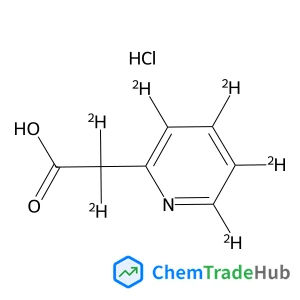
2,2-dideuterio-2-(3,4,5,6-tetradeuterio-2-pyridyl)acetic acid;hydrochloride
CAS Number:
1329799-67-8
Molecular Formula:
C7H2ClD6NO2
Recommended Suppliers







Disclaimer
This page provides academic journal information for reference and research purposes only. We are not affiliated with any journal publishers and do not handle publication submissions. For publication-related inquiries, please contact the respective journal publishers directly.
If you notice any inaccuracies in the information displayed, please contact us at support@chemtradehub.com. We will promptly review and address your concerns.