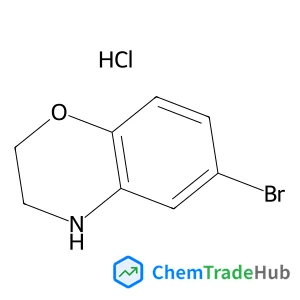
6-Bromo-3,4-dihydro-2H-1,4-benzoxazine hydrochloride (1:1)
CAS Number:
1260803-10-8
Molecular Formula:
C8H9BrClNO
Ayana Tagawa, Toshiyuki Shikata
We examined the dielectric (DE) and nuclear magnetic resonance (NMR) spectroscopic behaviour of N-methyl-2-pyrrolidone (NMP) and N,N-dimethylacetamide (DMAc), which are tertiary amide compounds that bear five-membered cyclic and open structures, respectively. They were examined to investigate the formation of anti-parallel dimers and tetramers in a dipole configuration in the pure liquid state and in benzene solution over a wide concentration range at 25 °C. Because the Kirkwood correlation factors of electric dipoles considerably decreased with increasing concentrations in both the NMP and DMAc systems and because the second DE relaxation modes were clearly observed to exhibit relaxation times that are longer than those of the first modes assigned to the rotational relaxation of monomeric molecules, anti-parallel dimers are formed due to dipole–dipole interactions with increasing concentrations. Assuming a chemical process between the monomers (MONs) and the anti-parallel dimer (DIM), 2MON ⇄ DIM, the equilibrium constants for the anti-parallel dimer formation were determined to be KDEd ∼ 1.2 M−1 for NMP and 0.35 M−1 for DMAc, based on the first DE relaxation strength. The fact that the evaluated KDEd values substantially increased with increasing concentrations in the range above ca. 1.0 M strongly suggested the formation of higher order intermolecular associations instead of dimers. Chemical shifts in the 1H-NMR spectra assigned to (N)CH3 and (5)CH2 protons of NMP and the two (Nα)CH3 and (Nβ)CH3 protons of DMAc dissolved in (d)Bz substantially changed with increasing concentrations due to the formation of intermolecular associations. The states occupied by MONs, DIMs and tetramers (TETs) were evaluated from chemical shift data as a function of the concentrations in the NMP and DMAc systems. Then, the equilibrium constants for the dimer and tetramer formation (2DIM ⇄ TET) were determined to be KNMRd ∼ 1.2 M−1 and KNMRt ∼ 0.2 M−1 for NMP and KNMRd ∼ 0.35 M−1 and KNMRt ∼ 0.25 M−1 for DMAc. The reason for the differences in the equilibrium constants between NMP and DMAc may be related to the difference in motional freedom between the cyclic and open structures. The formation of anti-parallel DIMs and TETs was also confirmed by semi-empirical quantum chemical calculations for both NMP and DMAc molecules.
Siqin Tao, Wei Zhong, Yuxiao Chen, Feng Chen, Ping Wang
DOI: 10.1039/D2CY01315K
Faiza Habib, Derek A. Tocher, Claire J. Carmalt
DOI: 10.1039/D3CE00592E
Urbi Pal, Bingyu Lu, Baharak Sayahpour, Binayak Roy
DOI: 10.1039/D1EE02929K
Babak Kaboudin, Ramin Mostafalu, Tsutomu Yokomatsu
DOI: 10.1039/C3GC40753E
Juan F. Torres, Kaoru Tsuda, Yasushi Murakami, Yifan Guo, Sahar Hosseini, Charles-Alexis Asselineau, Mahdiar Taheri, Kurt Drewes, Wojciech Lipiński, Joe Coventry
DOI: 10.1039/D1EE03028K
Mingyue Gao, Yanchun Xue, Yutang Zhang, Chengxing Zhu, Haiwei Yu, Xingmei Guo, Shasha Sun, Shenglin Xiong, Qinghong Kong, Junhao Zhang
DOI: 10.1039/D2QI00695B
Alexandria N. Leveille, Marissa M. Allegrezza, Kalen Laybourn, Anita E. Mattson
DOI: 10.1039/D2CC02023H
Kori M. Sye, Clare A. Leahy, Josh Vura-Weis
DOI: 10.1039/D2CY01081J
Jewel Ann Maria Xavier, Clara Viñas, Francesc Teixidor
DOI: 10.1039/D2CC00424K
4-Nitrophenyl phosphate disodium salt hexahydrate is primarily used as a substra...
2-(Trifluoromethyl)-1,3-oxazole-4-carboxylic Acid (CAS: 1060816-01-4) is widely ...
2-Fluoro-4-biphenylcarboxylic acid should be stored in a cool, dry place at room...
Prednisolone-21-Carboxylic Acid is primarily used in the pharmaceutical industry...
4-(Hydrazinomethyl)-1,2,3-benzenetriol (CAS: 3614-72-0) should be stored in a co...
4-Amino-1-methyl-1H-pyrazole-5-carboxylic acid hydrochloride (CAS: 92534-70-8) i...
Dehydropachymic acid (CAS: 77012-31-8) is regulated by various agencies. It fall...
The market and research trends for 6-[(2,2-Dimethylpropanoyl)amino]nicotinic aci...
1,10-Phenanthroline-2,9-dicarbaldehyde should be stored in a cool, dry place awa...
5-Carbamoyl-11-oxo-10,11-dihydro-5H-dibenzo[b,f]azepin-10-yl acetate can be synt...

Physical Chemistry Chemical Physics (PCCP) is an international journal co-owned by 19 physical chemistry and physics societies from around the world. This journal publishes original, cutting-edge research in physical chemistry, chemical physics and biophysical chemistry. To be suitable for publication in PCCP, articles must include significant innovation and/or insight into physical chemistry; this is the most important criterion that reviewers and Editors will judge against when evaluating submissions. The journal has a broad scope and welcomes contributions spanning experiment, theory, computation and data science. Topical coverage includes spectroscopy, dynamics, kinetics, statistical mechanics, thermodynamics, electrochemistry, catalysis, surface science, quantum mechanics, quantum computing and machine learning. Interdisciplinary research areas such as polymers and soft matter, materials, nanoscience, energy, surfaces/interfaces, and biophysical chemistry are welcomed if they demonstrate significant innovation and/or insight into physical chemistry. Joined experimental/theoretical studies are particularly appreciated when complementary and based on up-to-date approaches.
phosphoryl}methyl 4-methylbenzenesulfonate structure](https://static.chemtradehub.com/structs/864/864068-45-1-ba7c.webp "{[3-(Hexadecyloxy)propoxy](hydroxy)phosphoryl}methyl 4-methylbenzenesulfonate structure")