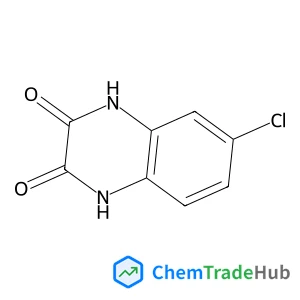
6-CHLORO-2,3-DIOXO-1,2,3,4-TETRAHYDROQUINOXALINE, 97
CAS Number:
169-14-2
Molecular Formula:
C8H5ClN2O2
Marianna Ambrico, Paolo F. Ambrico, Luisa De Marco, Rosabianca Iacobellis, Arianna D’Abramo, Teresa Ligonzo
The present study involved an investigation on the reasoning behind the dependence of the perovskite solar cells photovoltaic efficiencies on the relative position of the undoped spiro-OMeTAD hole-transport material with respect to the perovskite in the device. We adopted impedance spectroscopy to investigate the modification of the carrier transport mechanisms across the spiro-OMeTAD/perovskite interface constituting the active part where the main device processes occur. We investigated two interface structures, referred to as the direct (or regular, n–i–p) and the inverted (p–i–n) configuration. This work also intended to further stress the possible adoption of alternative device structures working with undoped hole-transport materials.

Organic Process Research & Development

Russian Journal of Coordination Chemistry

Crystallography Reports

Journal of Peptide Science

Acta Materialia

Chemistry Education Research and Practice

Saudi Pharmaceutical Journal

Current Opinion in Solid State & Materials Science

Russian Journal of Bioorganic Chemistry

Russian Journal of General Chemistry
F. Delmaire, M. Rigole, E. A. Zhilinskaya, A. Aboukaïs, R. Hubaut, G. Mairesse
DOI: 10.1039/B003644G
DOI: 10.1039/A808614A
Paul M. S. Monk, Steven Bleazard, Safina P. Akhtar, Julie Boutevin
DOI: 10.1039/B005430P
Raphaël Méreau, Marie-Thérèse Rayez, Françoise Caralp, Jean-Claude Rayez
DOI: 10.1039/B003993O
Jan Helbing, Majed Chergui, Sebastian Fernandez-Alberti, Julian Echave, Nadine Halberstadt, J. Alberto Beswick
DOI: 10.1039/B003181J
K. Hildenbrand, S. Naumov
DOI: 10.1039/B004617P
Heinz-Jürgen Benkelberg, Olaf Böge, Ralph Seuwen, Peter Warneck
DOI: 10.1039/B002053M
Thomas Ruchti, Berton E. Callicoatt, Kenneth C. Janda
DOI: 10.1039/B002051F
Wolfgang F. Hölderich, Nadja Röhrlich, Peter Bartl, Laurent Chassot
DOI: 10.1039/B003425H
When handling 4-Methyl-6-(trifluoromethyl)quinoline (CAS: 40716-16-3), safety go...
4-(3,5-Difluorophenyl)aniline is an aromatic organic compound with the CAS numbe...
5-{[4-(Trifluoromethyl)phenyl]sulfanyl}-1,2,3-thiadiazole-4-carboxylic acid can ...
The market for 4-Benzylaniline hydrochloride (CAS: 6317-57-3) is steadily growin...
[3-(Diethylsulfamoyl)phenyl]boronic acid is generally considered safe when handl...
3-Bromo-2,5-dimethoxyaniline is mainly used in the pharmaceutical and chemical i...
N-Methyl-1-(5-methyl-1H-indol-3-yl)methanamine (CAS: 915922-67-7) is subject to ...
This compound is primarily used in the pharmaceutical industry for the synthesis...
2-Methyl-2-propanyl [(1S,3R)-3-aminocyclohexyl]carbamate (CAS: 1298101-47-9) sho...
Ethyl 2-bromo-4,4,4-trifluorobutanoate (CAS: 367-33-9) is utilized in the pharma...

Physical Chemistry Chemical Physics (PCCP) is an international journal co-owned by 19 physical chemistry and physics societies from around the world. This journal publishes original, cutting-edge research in physical chemistry, chemical physics and biophysical chemistry. To be suitable for publication in PCCP, articles must include significant innovation and/or insight into physical chemistry; this is the most important criterion that reviewers and Editors will judge against when evaluating submissions. The journal has a broad scope and welcomes contributions spanning experiment, theory, computation and data science. Topical coverage includes spectroscopy, dynamics, kinetics, statistical mechanics, thermodynamics, electrochemistry, catalysis, surface science, quantum mechanics, quantum computing and machine learning. Interdisciplinary research areas such as polymers and soft matter, materials, nanoscience, energy, surfaces/interfaces, and biophysical chemistry are welcomed if they demonstrate significant innovation and/or insight into physical chemistry. Joined experimental/theoretical studies are particularly appreciated when complementary and based on up-to-date approaches.