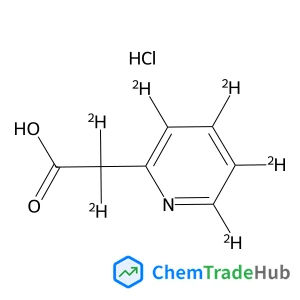
2,2-dideuterio-2-(3,4,5,6-tetradeuterio-2-pyridyl)acetic acid;hydrochloride
CAS Number:
1329799-67-8
Molecular Formula:
C7H2ClD6NO2
Zhuang Luo, Yandong Guo, Dewei Rao
The electronic structures of phosphorene-like SnS/SnSe nanoribbons and the transport properties of a SnS–SnSe nanoribbon lateral heterostructure are investigated by using first-principles calculations combined with nonequilibrium Green's function (NEGF) theory. It is demonstrated that SnS and SnSe nanoribbons with armchair edges (A-SnSNRs and A-SnSeNRs) are semiconductors, independent of the width of the ribbon. Their bandgaps have an indirect-to-direct transition, which varies with the ribbon width. In contrast, Z-SnSNRs and Z-SnSeNRs are metals. The transmission gap of armchair SnSNR–SnSeNR is different from the potential barrier of SnSNR and SnSeNR. The I–V curves of zigzag SnSNR–SnSeNR exhibit a negative differential resistive (NDR) effect due to the bias-dependent transmission in the voltage window and are independent of the ribbon width. However, for armchair SnSNR–SnSeNR, which has a low current under low biases, it is only about 10−6 μA. All the results suggest that phosphorene-like MX (M = Sn/Ge, X = S/Se) materials are promising candidates for next-generation nanodevices.

Nature Medicine

Journal of Saudi Chemical Society

Crystallography Reports

Current Opinion in Solid State & Materials Science

Drug Discovery Today

Russian Journal of Bioorganic Chemistry

Acta Materialia

Organic Process Research & Development

Current Opinion in Colloid & Interface Science

Saudi Pharmaceutical Journal
Zhijia Liu, Ping Yao
DOI: 10.1039/C3PY01083J
Dan Li, Qing Zheng, Yanwei Wang, Hong Chen
DOI: 10.1039/C3PY00739A
Xiqi Zhang, Bin Yang, Meiying Liu, Wanyun Liu, Yiwang Chen, Yen Wei
DOI: 10.1039/C3PY01226C
Xiang Luo, Shijie Xie, Jun Liu, Haibin Hu, Jing Jiang, Wei Huang, Haiyang Gao, Dongshan Zhou, Zhongyuan Lü, Deyue Yan
DOI: 10.1039/C3PY00896G
Wolfgang Ensinger
DOI: 10.1039/C3PY01062G
Kaidian Zou, Qiuming Liu, Jing Chen, Jianzhong Du
DOI: 10.1039/C3PY00966A
Guowei Wang, Junlian Huang
DOI: 10.1039/C3PY00872J
Yizhi Qi
DOI: 10.1039/C3PY01089A
Tsao-Cheng Huang, Lu-Chen Yeh, Hsiu-Ying Huang, Zheng-Yong Nian, Yi-Chun Yeh, Yi-Chen Chou, Jui-Ming Yeh, Mei-Hui Tsai
DOI: 10.1039/C3PY00787A
Yasushi Ishido, Arihiro Kanazawa, Shokyoku Kanaoka, Sadahito Aoshima
DOI: 10.1039/C3PY00842H
4-Nitrophenyl phosphate disodium salt hexahydrate is primarily used as a substra...
2-(Trifluoromethyl)-1,3-oxazole-4-carboxylic Acid (CAS: 1060816-01-4) is widely ...
2-Fluoro-4-biphenylcarboxylic acid should be stored in a cool, dry place at room...
Prednisolone-21-Carboxylic Acid is primarily used in the pharmaceutical industry...
4-(Hydrazinomethyl)-1,2,3-benzenetriol (CAS: 3614-72-0) should be stored in a co...
4-Amino-1-methyl-1H-pyrazole-5-carboxylic acid hydrochloride (CAS: 92534-70-8) i...
Dehydropachymic acid (CAS: 77012-31-8) is regulated by various agencies. It fall...
The market and research trends for 6-[(2,2-Dimethylpropanoyl)amino]nicotinic aci...
1,10-Phenanthroline-2,9-dicarbaldehyde should be stored in a cool, dry place awa...
5-Carbamoyl-11-oxo-10,11-dihydro-5H-dibenzo[b,f]azepin-10-yl acetate can be synt...

Physical Chemistry Chemical Physics (PCCP) is an international journal co-owned by 19 physical chemistry and physics societies from around the world. This journal publishes original, cutting-edge research in physical chemistry, chemical physics and biophysical chemistry. To be suitable for publication in PCCP, articles must include significant innovation and/or insight into physical chemistry; this is the most important criterion that reviewers and Editors will judge against when evaluating submissions. The journal has a broad scope and welcomes contributions spanning experiment, theory, computation and data science. Topical coverage includes spectroscopy, dynamics, kinetics, statistical mechanics, thermodynamics, electrochemistry, catalysis, surface science, quantum mechanics, quantum computing and machine learning. Interdisciplinary research areas such as polymers and soft matter, materials, nanoscience, energy, surfaces/interfaces, and biophysical chemistry are welcomed if they demonstrate significant innovation and/or insight into physical chemistry. Joined experimental/theoretical studies are particularly appreciated when complementary and based on up-to-date approaches.
![(3R,5R)-1-[(Benzyloxy)carbonyl]-5-methyl-3-piperidinecarboxylic acid structure](https://static.chemtradehub.com/structs/126/1269757-29-0-c552.webp "(3R,5R)-1-[(Benzyloxy)carbonyl]-5-methyl-3-piperidinecarboxylic acid structure")
![[(1S,2S,3R,4S,7R,9S,10S,12R,15S)-4,12-Diacetyloxy-15-[(2R,3S)-3-benzamido-3-phenyl-2-(2,2,2-trichloroethoxycarbonyloxy)propanoyl]oxy-1,9-dihydroxy-10,14,17,17-tetramethyl-11-oxo-6-oxatetracyclo[11.3.1.03,10.04,7]heptadec-13-en-2-yl] benzoate structure](https://static.chemtradehub.com/structs/100/100431-55-8-7104.webp "[(1S,2S,3R,4S,7R,9S,10S,12R,15S)-4,12-Diacetyloxy-15-[(2R,3S)-3-benzamido-3-phenyl-2-(2,2,2-trichloroethoxycarbonyloxy)propanoyl]oxy-1,9-dihydroxy-10,14,17,17-tetramethyl-11-oxo-6-oxatetracyclo[11.3.1.03,10.04,7]heptadec-13-en-2-yl] benzoate structure")