


A comparison between hydrogen and halogen bonding: the hypohalous acid–water dimers, HOX⋯H2O (X = F, Cl, Br)
Literature Information
Publication Date
2019-02-20
DOI
10.1039/C9CP00422J
Impact Factor
3.676
Authors
Mark E. Wolf, Boyi Zhang, Justin M. Turney, Henry F. Schaefer, III
View Original
Abstract
Hypohalous acids (HOX) are a class of molecules that play a key role in the atmospheric seasonal depletion of ozone and have the ability to form both hydrogen and halogen bonds. The interactions between the HOX monomers (X = F, Cl, Br) and water have been studied at the CCSD(T)/aug-cc-pVTZ level of theory with the spin free X2C-1e method to account for scalar relativistic effects. Focal point analysis was used to determine CCSDT(Q)/CBS dissociation energies. The anti hydrogen bonded dimers were found with interaction energies of −5.62 kcal mol−1, −5.56 kcal mol−1, and −4.97 kcal mol−1 for X = F, Cl, and Br, respectively. The weaker halogen bonded dimers were found to have interaction energies of −1.71 kcal mol−1 and −3.03 kcal mol−1 for X = Cl and Br, respectively. Natural bond orbital analysis and symmetry adapted perturbation theory were used to discern the nature of the halogen and hydrogen bonds and trends due to halogen substitution. The halogen bonds were determined to be weaker than the analogous hydrogen bonds in all cases but close enough in energy to be relevant, significantly more so with increasing halogen size.
Recommended Journals

Russian Journal of Applied Chemistry

Journal of Saudi Chemical Society

Current Opinion in Colloid & Interface Science

Russian Journal of Coordination Chemistry

Russian Journal of Bioorganic Chemistry

Russian Journal of Organic Chemistry

Nature Medicine

Acta Materialia

Drug Discovery Today

Russian Journal of General Chemistry
Related Literature
Sedimentation of colloidal particles near a wall: Stokesian dynamics simulations
Paper
DOI: 10.1039/A809571J
Reaction control of tetraethyl orthosilicate (TEOS)/O3 and tetramethyl orthosilicate (TMOS)/O3 counter diffusion chemical vapour deposition for preparation of molecular-sieve membranes
Takeo Yamaguchi, Xin Ying, Yasuhiko Tokimasa, Balagopal N. Nair, Takashi Sugawara, Shin-ichi Nakao
2000-09-15
Paper
DOI: 10.1039/B004642F
Effect of 1-alkanols on the native conformation of Lysozyme
Vania Calandrini, Giuseppe Onori, Aldo Santucci
2000-08-25
Paper
DOI: 10.1039/B003746J
RAIRS of small alkynes on Pd(100)
John P. Camplin, Jemimah K. Eve, Elaine M. McCash
2000-09-06
Paper
DOI: 10.1039/B004344N
Effects of carboxylic acid adsorbates on CO adsorption and crotonaldehyde hydrogenation over Cu/Al2O3 catalyst
Halim A. Abdullah, Colin H. Rochester, James A. Anderson, Jillian E. Bailie, Neville V. Richardson, Graham J. Hutchings
2000-08-04
Paper
DOI: 10.1039/B003429K
Tailoring the optical properties of metal-oxide electrochromic mixtures
Paul M. S. Monk, Steven Bleazard, Safina P. Akhtar, Julie Boutevin
2000-09-05
Paper
DOI: 10.1039/B005430P
You might also like
Compound Q&A
What precautions should be taken when handling 4-Methyl-6-(trifluoromethyl)quinoline (CAS: 40716-16-3)?
When handling 4-Methyl-6-(trifluoromethyl)quinoline (CAS: 40716-16-3), safety go...
40716-16-34-Methyl-6-(trifluor...
Compound Q&A
What is 4-(3,5-Difluorophenyl)aniline (CAS: 405058-00-6)?
4-(3,5-Difluorophenyl)aniline is an aromatic organic compound with the CAS numbe...
405058-00-64-(3,5-Difluoropheny...
Compound Q&A
How is 5-{[4-(Trifluoromethyl)phenyl]sulfanyl}-1,2,3-thiadiazole-4-carboxylic acid (CAS: 338982-07-3) typically synthesized?
5-{[4-(Trifluoromethyl)phenyl]sulfanyl}-1,2,3-thiadiazole-4-carboxylic acid can ...
338982-07-35-{[4-(Trifluorometh...
Compound Q&A
What is the market or research trend for 4-Benzylaniline hydrochloride (CAS: 6317-57-3)?
The market for 4-Benzylaniline hydrochloride (CAS: 6317-57-3) is steadily growin...
6317-57-34-Benzylaniline hydr...
Compound Q&A
Is [3-(Diethylsulfamoyl)phenyl]boronic acid (CAS: 871329-58-7) safe?
[3-(Diethylsulfamoyl)phenyl]boronic acid is generally considered safe when handl...
871329-58-7[3-(Diethylsulfamoyl...
Compound Q&A
What are the main uses of 3-Bromo-2,5-dimethoxyaniline (CAS: 115929-62-9)?
3-Bromo-2,5-dimethoxyaniline is mainly used in the pharmaceutical and chemical i...
115929-62-93-Bromo-2,5-dimethox...
Compound Q&A
What regulatory guidelines apply to N-Methyl-1-(5-methyl-1H-indol-3-yl)methanamine (CAS: 915922-67-7)?
N-Methyl-1-(5-methyl-1H-indol-3-yl)methanamine (CAS: 915922-67-7) is subject to ...
915922-67-7N-Methyl-1-(5-methyl...
Compound Q&A
What industries use Carbamic acid, N-[(5S)-5,6-diamino-6-oxohexyl]-, 1,1-dimethylethyl ester (CAS: 24828-96-4)?
This compound is primarily used in the pharmaceutical industry for the synthesis...
24828-96-4Carbamic acid, N-[(5...
Compound Q&A
How should 2-Methyl-2-propanyl [(1S,3R)-3-aminocyclohexyl]carbamate (CAS: 1298101-47-9) be stored?
2-Methyl-2-propanyl [(1S,3R)-3-aminocyclohexyl]carbamate (CAS: 1298101-47-9) sho...
1298101-47-92-Methyl-2-propanyl ...
Compound Q&A
What industries use Ethyl 2-bromo-4,4,4-trifluorobutanoate (CAS: 367-33-9)?
Ethyl 2-bromo-4,4,4-trifluorobutanoate (CAS: 367-33-9) is utilized in the pharma...
367-33-9Ethyl 2-bromo-4,4,4-...
Source Journal
Physical Chemistry Chemical Physics

CiteScore:
5.5
Self-citation Rate:
10.3%
Articles per Year:
3036
Physical Chemistry Chemical Physics (PCCP) is an international journal co-owned by 19 physical chemistry and physics societies from around the world. This journal publishes original, cutting-edge research in physical chemistry, chemical physics and biophysical chemistry. To be suitable for publication in PCCP, articles must include significant innovation and/or insight into physical chemistry; this is the most important criterion that reviewers and Editors will judge against when evaluating submissions. The journal has a broad scope and welcomes contributions spanning experiment, theory, computation and data science. Topical coverage includes spectroscopy, dynamics, kinetics, statistical mechanics, thermodynamics, electrochemistry, catalysis, surface science, quantum mechanics, quantum computing and machine learning. Interdisciplinary research areas such as polymers and soft matter, materials, nanoscience, energy, surfaces/interfaces, and biophysical chemistry are welcomed if they demonstrate significant innovation and/or insight into physical chemistry. Joined experimental/theoretical studies are particularly appreciated when complementary and based on up-to-date approaches.
Recommended Compounds
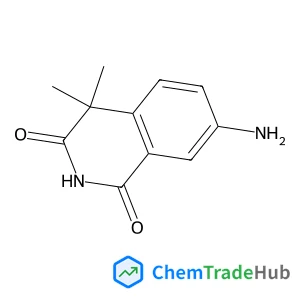
1,3(2H,4H)-Isoquinolinedione, 7-amino-4,4-dimethyl-
CAS Number:
14576-22-8
Molecular Formula:
C11H12N2O2
Recommended Suppliers





Disclaimer
This page provides academic journal information for reference and research purposes only. We are not affiliated with any journal publishers and do not handle publication submissions. For publication-related inquiries, please contact the respective journal publishers directly.
If you notice any inaccuracies in the information displayed, please contact us at support@chemtradehub.com. We will promptly review and address your concerns.