












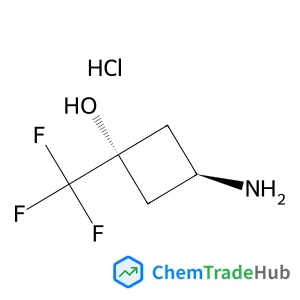
cis-3-Amino-1-(trifluoromethyl)cyclobutanol hydrochloride (1:1)
CAS Number:
1408075-16-0
Molecular Formula:
C5H9ClF3NO
Hubertus Burchardt-Tofaute, Mukundan Thelakkat
We synthesized graft copolymers comprising a poly(ethenesulfonate) (PES) backbone with oligo ethylene glycol or oligo perfluoropolyether side-chains for the first time. The effect of fluorination on the polymerization of oligo ethylene glycol ethenesulfonate (EGES) monomers, containing one (EG1ES) or three (EG3ES) ethylene glycol units, was studied. In a conventional free radical polymerization, EGES monomers formed only oligomers. In contrast, the fluorinated oligo ethylene glycol ethenesulfonate (FEGES) monomers, containing two (FEG2ES) or three (FEG3ES) fluorinated ethylene glycol units, showed high conversions and high molecular weights. The reason for this drastic effect was the suppression of chain transfer reactions from methylene ether and methoxy groups, as we deduced from end-group analysis by matrix-assisted laser desorption/ionization time-of-flight mass spectrometry (MALDI-ToF MS). This technique was not only used for a detailed end-group analysis, but also to determine the absolute molecular weight of PESs. Furthermore, we tested the reversible addition–fragmentation chain transfer (RAFT) polymerization of the FEGES monomers. Whereas the RAFT polymerization of FEG2ES was dominated by recombination processes, we achieved high end-group fidelity for PFEG3ES with an ethyldithiocarbonate chain transfer agent. PFEG2ES synthesized by RAFT was semi-crystalline, while PFEG3ES was fully amorphous at room temperature, as proved by differential scanning calorimetry (DSC), dynamic mechanical analysis (DMA) and wide-angle X-ray scattering (WAXS). Their low crystallinity, their adequate thermal stability and their reduced flammability due to the fluorination make PFEGES polymers potential materials as solid polymer electrolytes for battery applications.
Prajal Chettri, Kalathur Mohan Ganesh, Sahashransu Satyajeet Mahapatra, A. S. Vishwanathan, Shailesh Srivastava
DOI: 10.1039/D3AY01612A
Ana Sonzogni, Guadalupe Rivero, Verónica Gonzalez, Gustavo Abraham, Roque Minari
DOI: 10.1039/D3BM01422C
Somayeh Mojtabavi, Seyed Ali Asghar Fakhrmousavi, Mehrdad Faizi, Hamid Forootanfar, Nasrin Samadi, Mohammad Ali Faramarzi
DOI: 10.1039/D3BM01406A
Pei Zeng, Huan Zhang, Qi Guan, Qianqian Zhang, Xianzai Yan, Lili Yu, Luying Duan, Chunrong Wang
DOI: 10.1039/D3AY01515G
Arina S. Ivkina, Mikhail V. Zyuzin, Sergei A. Shipilovskikh
DOI: 10.1039/D3BM01651J
Clément Praud, Victor Ribay, Arnab Dey, Benoît Charrier, Joris Mandral, Jonathan Farjon, Jean-Nicolas Dumez, Patrick Giraudeau
DOI: 10.1039/D3AY01681A
Varsha UshaVipinachandran, Susanta Kumar Bhunia
DOI: 10.1039/D3AY01749D
4-Nitrophenyl phosphate disodium salt hexahydrate is primarily used as a substra...
2-(Trifluoromethyl)-1,3-oxazole-4-carboxylic Acid (CAS: 1060816-01-4) is widely ...
2-Fluoro-4-biphenylcarboxylic acid should be stored in a cool, dry place at room...
Prednisolone-21-Carboxylic Acid is primarily used in the pharmaceutical industry...
4-(Hydrazinomethyl)-1,2,3-benzenetriol (CAS: 3614-72-0) should be stored in a co...
4-Amino-1-methyl-1H-pyrazole-5-carboxylic acid hydrochloride (CAS: 92534-70-8) i...
Dehydropachymic acid (CAS: 77012-31-8) is regulated by various agencies. It fall...
The market and research trends for 6-[(2,2-Dimethylpropanoyl)amino]nicotinic aci...
1,10-Phenanthroline-2,9-dicarbaldehyde should be stored in a cool, dry place awa...
5-Carbamoyl-11-oxo-10,11-dihydro-5H-dibenzo[b,f]azepin-10-yl acetate can be synt...

Polymer Chemistry welcomes submissions in all areas of polymer science that have a strong focus on macromolecular chemistry. Manuscripts may cover a broad range of fields, yet no direct application focus is required.
![[(1S,2S,3R,4S,7R,9S,10S,12R,15S)-4,12-Diacetyloxy-15-[(2R,3S)-3-benzamido-3-phenyl-2-(2,2,2-trichloroethoxycarbonyloxy)propanoyl]oxy-1,9-dihydroxy-10,14,17,17-tetramethyl-11-oxo-6-oxatetracyclo[11.3.1.03,10.04,7]heptadec-13-en-2-yl] benzoate structure](https://static.chemtradehub.com/structs/100/100431-55-8-7104.webp "[(1S,2S,3R,4S,7R,9S,10S,12R,15S)-4,12-Diacetyloxy-15-[(2R,3S)-3-benzamido-3-phenyl-2-(2,2,2-trichloroethoxycarbonyloxy)propanoyl]oxy-1,9-dihydroxy-10,14,17,17-tetramethyl-11-oxo-6-oxatetracyclo[11.3.1.03,10.04,7]heptadec-13-en-2-yl] benzoate structure")

![(3R,5R)-1-[(Benzyloxy)carbonyl]-5-methyl-3-piperidinecarboxylic acid structure](https://static.chemtradehub.com/structs/126/1269757-29-0-c552.webp "(3R,5R)-1-[(Benzyloxy)carbonyl]-5-methyl-3-piperidinecarboxylic acid structure")





