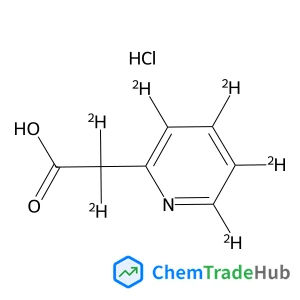
2,2-dideuterio-2-(3,4,5,6-tetradeuterio-2-pyridyl)acetic acid;hydrochloride
CAS Number:
1329799-67-8
Molecular Formula:
C7H2ClD6NO2
Tingting Sui, Yafei Lian, Mingxia Xu, Lisong Zhang, Yanlu Li, Xian Zhao, Xinguang Xu, Xun Sun
The hydrogen vacancy (VH) is the most common point defect that may lead to optical damage of potassium dihydrogen phosphate (KDP) and its analog ammonium dihydrogen phosphate (ADP), further limiting their practical application in high-power laser systems. In this work, we have grown KDP and ADP crystals by using a rapid growth method, and investigated the physical origin of the different stability of VH as well as the defect-induced electronic structure and optical absorption in KDP and ADP crystals. The inclusion of van der Waals correction to density functional theory calculations is found to have little influence on VH energetics of KDP whereas it largely reduces the charge transition level ε(+/−) of VH by >2 eV in ADP. It is found that hydrogen vacancies mainly contribute to the redshift of the measured absorption edges of both KDP and ADP crystals. Owing to the varied lattice environments and locations, the VH defects exhibit different stability, and electronic and optical properties in KDP and ADP crystals. Notably, the extra optical absorption caused by the positively-charged VH in KDP could be largely reduced by decreasing the defect concentration, whereas ADP exhibits defect-location dependence – the optical damage center of the VH in the NH4+ group could not be eliminated because of electron capture of its neighboring N atoms. The calculation results help us to better understand the origin of laser damage in KDP and ADP crystals.

Organic Process Research & Development

Current Opinion in Solid State & Materials Science

Russian Journal of Bioorganic Chemistry

Chemistry Education Research and Practice

Russian Journal of Organic Chemistry

Saudi Pharmaceutical Journal

Journal of Peptide Science

Acta Materialia

Russian Journal of General Chemistry

Nature Medicine
Antonio Riganelli, Frederico V. Prudente, António J. C. Varandas
DOI: 10.1039/B001746I
DOI: 10.1039/A807847E
Daniel R. Tackley, Geoffrey Dent, W. Ewen Smith
DOI: 10.1039/B005091L
DOI: 10.1039/B002675L
Luis A. M. M. Barbosa, Georgii M. Zhidomirov, Rutger A. van Santen
DOI: 10.1039/B004090H
Christopher Breen, Jeffrey Forsyth, Jack Yarwood, Trevor Hughes
DOI: 10.1039/B003587O
Akifumi Yamada
DOI: 10.1039/B003472J
J. A. Beukes, B. D'Anna, V. Bakken, C. J. Nielsen
DOI: 10.1039/B004546M
When handling 4-Methyl-6-(trifluoromethyl)quinoline (CAS: 40716-16-3), safety go...
4-(3,5-Difluorophenyl)aniline is an aromatic organic compound with the CAS numbe...
5-{[4-(Trifluoromethyl)phenyl]sulfanyl}-1,2,3-thiadiazole-4-carboxylic acid can ...
The market for 4-Benzylaniline hydrochloride (CAS: 6317-57-3) is steadily growin...
[3-(Diethylsulfamoyl)phenyl]boronic acid is generally considered safe when handl...
3-Bromo-2,5-dimethoxyaniline is mainly used in the pharmaceutical and chemical i...
N-Methyl-1-(5-methyl-1H-indol-3-yl)methanamine (CAS: 915922-67-7) is subject to ...
This compound is primarily used in the pharmaceutical industry for the synthesis...
2-Methyl-2-propanyl [(1S,3R)-3-aminocyclohexyl]carbamate (CAS: 1298101-47-9) sho...
Ethyl 2-bromo-4,4,4-trifluorobutanoate (CAS: 367-33-9) is utilized in the pharma...

Physical Chemistry Chemical Physics (PCCP) is an international journal co-owned by 19 physical chemistry and physics societies from around the world. This journal publishes original, cutting-edge research in physical chemistry, chemical physics and biophysical chemistry. To be suitable for publication in PCCP, articles must include significant innovation and/or insight into physical chemistry; this is the most important criterion that reviewers and Editors will judge against when evaluating submissions. The journal has a broad scope and welcomes contributions spanning experiment, theory, computation and data science. Topical coverage includes spectroscopy, dynamics, kinetics, statistical mechanics, thermodynamics, electrochemistry, catalysis, surface science, quantum mechanics, quantum computing and machine learning. Interdisciplinary research areas such as polymers and soft matter, materials, nanoscience, energy, surfaces/interfaces, and biophysical chemistry are welcomed if they demonstrate significant innovation and/or insight into physical chemistry. Joined experimental/theoretical studies are particularly appreciated when complementary and based on up-to-date approaches.
![1-[(4-Methylphenyl)sulfonyl]-3-(4,4,5,5-tetramethyl-1,3,2-dioxaborolan-2-yl)-1H-pyrrolo[2,3-b]pyridine-5-carbonitrile structure](https://static.chemtradehub.com/structs/143/1434747-57-5-fc0d.webp "1-[(4-Methylphenyl)sulfonyl]-3-(4,4,5,5-tetramethyl-1,3,2-dioxaborolan-2-yl)-1H-pyrrolo[2,3-b]pyridine-5-carbonitrile structure")
![(3R,5R)-1-[(Benzyloxy)carbonyl]-5-methyl-3-piperidinecarboxylic acid structure](https://static.chemtradehub.com/structs/126/1269757-29-0-c552.webp "(3R,5R)-1-[(Benzyloxy)carbonyl]-5-methyl-3-piperidinecarboxylic acid structure")