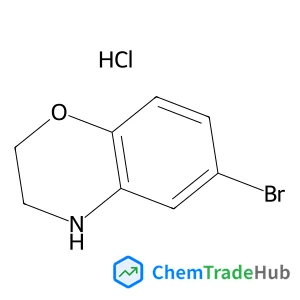
6-Bromo-3,4-dihydro-2H-1,4-benzoxazine hydrochloride (1:1)
CAS Number:
1260803-10-8
Molecular Formula:
C8H9BrClNO
Chuande Zhao, Yu Chi, Qiang Peng, Fang Yang, Jianhua Zhou, Xinfeng Wang, Kun Yu, Guijuan Fan, Jie Sun
5,5′-Bitetrazole-1,1′-dioxydihydroxylamine salt (TKX-50), a high-energy energetic material, possesses good safety and energy properties. The energy characteristic data of TKX-50 are commonly generated via theoretical simulation and experimental measurements. Interestingly, the detonation velocity of TKX-50 is higher than HMX, but the specific kinetic energy of TKX-50 is the opposite. Thus, a systematic study on the decomposition mechanism of TKX-50 is important to establish the reasons for this variation in specific kinetic energy. Although the thermal decomposition mechanism of TKX-50 has been reported, the specific compositional changes of its gas products under different heating conditions remain unknown, hindering a comprehensive understanding of the mechanism from the perspective of gas products. Herein, the gas products of TKX-50 and HMX in thermal decomposition and thermal explosion are investigated and compared. It was found that more TKX-50 is converted to ABTOX for further decomposition when the heating rate increases. ABTOX can decompose to C2N2, which is prone to polymerization, generating a solid residue under high temperature and pressure. Although polymerized C2N2 decomposes and burns during the explosion, it delays the time of TKX-50 reaching its maximum amount of outgassing, thereby affecting its specific kinetic energy. Furthermore, in the thermal explosion, compared with HMX, TKX-50 generates less H2 and CO. Since the combustion heat of hydrogen is much higher than that of carbon, the more hydrogen generated, the higher the detonation heat obtained. Therefore, TKX-50 has a lower detonation heat, which also affects its specific kinetic energy.
Yasunobu Kawamoto, Kenji Honma
DOI: 10.1039/B004714G
Christopher Breen, Jeffrey Forsyth, Jack Yarwood, Trevor Hughes
DOI: 10.1039/B003587O
DOI: 10.1039/A809794A
DOI: 10.1039/B002675L
Paul M. S. Monk, Steven Bleazard, Safina P. Akhtar, Julie Boutevin
DOI: 10.1039/B005430P
DOI: 10.1039/A809571J
DOI: 10.1039/B004184J
Vincenzo Aquilanti, Daniela Ascenzi, Elisabetta Braca
DOI: 10.1039/B001696I
Jan B. F. N. Engberts, Jan Kevelam
DOI: 10.1039/B004501M
Juan David Serna-Salazar, Jorge Mahecha-Gómez
DOI: 10.1039/B001750G
When handling 4-Methyl-6-(trifluoromethyl)quinoline (CAS: 40716-16-3), safety go...
4-(3,5-Difluorophenyl)aniline is an aromatic organic compound with the CAS numbe...
5-{[4-(Trifluoromethyl)phenyl]sulfanyl}-1,2,3-thiadiazole-4-carboxylic acid can ...
The market for 4-Benzylaniline hydrochloride (CAS: 6317-57-3) is steadily growin...
[3-(Diethylsulfamoyl)phenyl]boronic acid is generally considered safe when handl...
3-Bromo-2,5-dimethoxyaniline is mainly used in the pharmaceutical and chemical i...
N-Methyl-1-(5-methyl-1H-indol-3-yl)methanamine (CAS: 915922-67-7) is subject to ...
This compound is primarily used in the pharmaceutical industry for the synthesis...
2-Methyl-2-propanyl [(1S,3R)-3-aminocyclohexyl]carbamate (CAS: 1298101-47-9) sho...
Ethyl 2-bromo-4,4,4-trifluorobutanoate (CAS: 367-33-9) is utilized in the pharma...

Physical Chemistry Chemical Physics (PCCP) is an international journal co-owned by 19 physical chemistry and physics societies from around the world. This journal publishes original, cutting-edge research in physical chemistry, chemical physics and biophysical chemistry. To be suitable for publication in PCCP, articles must include significant innovation and/or insight into physical chemistry; this is the most important criterion that reviewers and Editors will judge against when evaluating submissions. The journal has a broad scope and welcomes contributions spanning experiment, theory, computation and data science. Topical coverage includes spectroscopy, dynamics, kinetics, statistical mechanics, thermodynamics, electrochemistry, catalysis, surface science, quantum mechanics, quantum computing and machine learning. Interdisciplinary research areas such as polymers and soft matter, materials, nanoscience, energy, surfaces/interfaces, and biophysical chemistry are welcomed if they demonstrate significant innovation and/or insight into physical chemistry. Joined experimental/theoretical studies are particularly appreciated when complementary and based on up-to-date approaches.

![1-[(4-Methylphenyl)sulfonyl]-3-(4,4,5,5-tetramethyl-1,3,2-dioxaborolan-2-yl)-1H-pyrrolo[2,3-b]pyridine-5-carbonitrile structure](https://static.chemtradehub.com/structs/143/1434747-57-5-fc0d.webp "1-[(4-Methylphenyl)sulfonyl]-3-(4,4,5,5-tetramethyl-1,3,2-dioxaborolan-2-yl)-1H-pyrrolo[2,3-b]pyridine-5-carbonitrile structure")