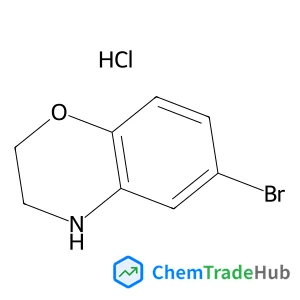
6-Bromo-3,4-dihydro-2H-1,4-benzoxazine hydrochloride (1:1)
CAS Number:
1260803-10-8
Molecular Formula:
C8H9BrClNO
Hikaru Sotome, Daichi Kitagawa, Tatsumoto Nakahama, Syoji Ito, Seiya Kobatake, Masahiro Irie, Hiroshi Miyasaka
Photocyclization reaction dynamics of an inverse type diarylethene derivative was investigated in alkane solutions by means of ultrafast laser spectroscopies. Femtosecond transient absorption spectroscopy showed that the Franck–Condon state formed by photoexcitation is geometrically relaxed to a transient species within 100 fs and subsequently the cyclization process takes place with a time constant of 36 ps. This time constant is much longer than those in normal type derivatives. Steady-state and time-resolved fluorescence measurements with the aid of quantum chemical calculations revealed that there exist three kinds of conformers, one parallel and two anti-parallel forms, in the ground state. One of the anti-parallel conformers undergoes the cyclization reaction, while the other two conformers are nonreactive species and their major relaxation processes are radiative decay and intersystem crossing into the triplet states. The triplet states thus formed no longer undergo the cyclization reaction in the late time region.

Chemical Communications

Saudi Pharmaceutical Journal

Russian Journal of General Chemistry

Russian Journal of Bioorganic Chemistry

Organic Process Research & Development

Current Opinion in Solid State & Materials Science

Drug Discovery Today

Nature Medicine

Journal of Saudi Chemical Society

Russian Journal of Coordination Chemistry
Robert Pola, Alena Braunová, Richard Laga, Michal Pechar, Karel Ulbrich
DOI: 10.1039/C3PY01376F
Shi-qiang Gong, D. Jeevanie Epasinghe, Wei Zhang, Bin Zhou, Li-na Niu, Heonjune Ryou, Ashraf A. Eid, Andrea Frassetto, Cynthia K. Y. Yiu, Dwayne D. Arola, Jing Mao, David H. Pashley, Franklin R. Tay
DOI: 10.1039/C3PY00635B
Florian D. Jochum, Patrick Theato
DOI: 10.1039/C3PY00880K
Guijun Yu, Peiyi Wu
DOI: 10.1039/C3PY00878A
Daniel J. Phillips, Joseph P. Patterson, Rachel K. O'Reilly, Matthew I. Gibson
DOI: 10.1039/C3PY00991B
Toshifumi Satoh, Naoki Nishikawa, Daisuke Kawato, Daichi Suemasa, Sungmin Jung, Young Yong Kim, Moonhor Ree, Toyoji Kakuchi
DOI: 10.1039/C3PY00985H
Mohamad-Ali Tehfe, Frédéric Dumur, Pu Xiao, Marie Delgove, Bernadette Graff, Jean-Pierre Fouassier, Didier Gigmes, Jacques Lalevée
DOI: 10.1039/C3PY00922J
Ting Ye, Suting Yan, Yumei Hu, Li Ding, Weitai Wu
DOI: 10.1039/C3PY00778B
L. Sambe, F. Stoffelbach, J. Lyskawa, F. Delattre, M. Bria, F. X. Sauvage, M. Sliwa, V. Humblot, B. Charleux, G. Cooke, P. Woisel
DOI: 10.1039/C3PY01093G
Susanne Boye, Mihaela Cernescu, Hartmut Komber, Bernhard Brutschy, Dietmar Appelhans
DOI: 10.1039/C3PY01152F
4-Nitrophenyl phosphate disodium salt hexahydrate is primarily used as a substra...
2-(Trifluoromethyl)-1,3-oxazole-4-carboxylic Acid (CAS: 1060816-01-4) is widely ...
2-Fluoro-4-biphenylcarboxylic acid should be stored in a cool, dry place at room...
Prednisolone-21-Carboxylic Acid is primarily used in the pharmaceutical industry...
4-(Hydrazinomethyl)-1,2,3-benzenetriol (CAS: 3614-72-0) should be stored in a co...
4-Amino-1-methyl-1H-pyrazole-5-carboxylic acid hydrochloride (CAS: 92534-70-8) i...
Dehydropachymic acid (CAS: 77012-31-8) is regulated by various agencies. It fall...
The market and research trends for 6-[(2,2-Dimethylpropanoyl)amino]nicotinic aci...
1,10-Phenanthroline-2,9-dicarbaldehyde should be stored in a cool, dry place awa...
5-Carbamoyl-11-oxo-10,11-dihydro-5H-dibenzo[b,f]azepin-10-yl acetate can be synt...

Physical Chemistry Chemical Physics (PCCP) is an international journal co-owned by 19 physical chemistry and physics societies from around the world. This journal publishes original, cutting-edge research in physical chemistry, chemical physics and biophysical chemistry. To be suitable for publication in PCCP, articles must include significant innovation and/or insight into physical chemistry; this is the most important criterion that reviewers and Editors will judge against when evaluating submissions. The journal has a broad scope and welcomes contributions spanning experiment, theory, computation and data science. Topical coverage includes spectroscopy, dynamics, kinetics, statistical mechanics, thermodynamics, electrochemistry, catalysis, surface science, quantum mechanics, quantum computing and machine learning. Interdisciplinary research areas such as polymers and soft matter, materials, nanoscience, energy, surfaces/interfaces, and biophysical chemistry are welcomed if they demonstrate significant innovation and/or insight into physical chemistry. Joined experimental/theoretical studies are particularly appreciated when complementary and based on up-to-date approaches.
![(2E)-3-(3-Chlorophenyl)-N-{2-[4-(methylsulfonyl)-1-piperazinyl]-2-oxoethyl}acrylamide structure](https://static.chemtradehub.com/structs/250/2505001-54-5-c1e9.webp "(2E)-3-(3-Chlorophenyl)-N-{2-[4-(methylsulfonyl)-1-piperazinyl]-2-oxoethyl}acrylamide structure")
![(3R,5R)-1-[(Benzyloxy)carbonyl]-5-methyl-3-piperidinecarboxylic acid structure](https://static.chemtradehub.com/structs/126/1269757-29-0-c552.webp "(3R,5R)-1-[(Benzyloxy)carbonyl]-5-methyl-3-piperidinecarboxylic acid structure")