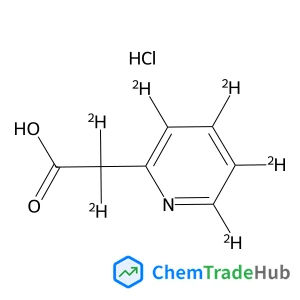
2,2-dideuterio-2-(3,4,5,6-tetradeuterio-2-pyridyl)acetic acid;hydrochloride
CAS Number:
1329799-67-8
Molecular Formula:
C7H2ClD6NO2
Daniel Nürenberg, Helmut Zacharias
The chirality-induced spin selectivity (CISS) in layers of helical molecules has gained considerable attention in the emerging field of spintronics, because the effect enables spin-filter devices under ambient conditions. Several theoretical studies have been carried out to explain this effect on a microscopic scale, but the origin of the effect is still controversial. In particular, the role of spin-flip scattering during electron transport is an open issue. In this study, we describe the electron and spin transport by macroscopic rate equations including spin-dependent losses and spin-flip scattering. We reduce the problem to the solution of the Riccati differential equation to obtain analytical expressions. The results allow the strength and scalability of CISS based spin-filters to be determined and interpreted from experimental data or quantum mechanical models. For the helical systems studied experimentally so far, it turns out that spin-flip scattering plays a minor role.

New Journal of Chemistry

Chemistry Education Research and Practice

Journal of Natural Medicines

Russian Journal of Coordination Chemistry

Drug Discovery Today

Crystallography Reports

Chemical Communications

Russian Journal of Bioorganic Chemistry

Current Opinion in Colloid & Interface Science

Organic Process Research & Development
L. Giglio, U. Mazzucato, G. Musumarra, A. Spalletti
DOI: 10.1039/B004141F
DOI: 10.1039/A809431D
Juan David Serna-Salazar, Jorge Mahecha-Gómez
DOI: 10.1039/B001750G
Antonio Riganelli, Frederico V. Prudente, António J. C. Varandas
DOI: 10.1039/B001746I
Mattias Hallquist, Noemi B. Petrucci, Christopher Kreuzer, Victor P. Ostanin, R. Anthony Cox
DOI: 10.1039/B003028G
Paul M. S. Monk, Steven Bleazard, Safina P. Akhtar, Julie Boutevin
DOI: 10.1039/B005430P
Prantik Mondal, Thomas Becker, Richard Hoogenboom, Andrew B. Lowe, Nikhil K. Singha
DOI: 10.1039/D0PY01522A
F. Delmaire, M. Rigole, E. A. Zhilinskaya, A. Aboukaïs, R. Hubaut, G. Mairesse
DOI: 10.1039/B003644G
DOI: 10.1039/A809571J
When handling 4-Methyl-6-(trifluoromethyl)quinoline (CAS: 40716-16-3), safety go...
4-(3,5-Difluorophenyl)aniline is an aromatic organic compound with the CAS numbe...
5-{[4-(Trifluoromethyl)phenyl]sulfanyl}-1,2,3-thiadiazole-4-carboxylic acid can ...
The market for 4-Benzylaniline hydrochloride (CAS: 6317-57-3) is steadily growin...
[3-(Diethylsulfamoyl)phenyl]boronic acid is generally considered safe when handl...
3-Bromo-2,5-dimethoxyaniline is mainly used in the pharmaceutical and chemical i...
N-Methyl-1-(5-methyl-1H-indol-3-yl)methanamine (CAS: 915922-67-7) is subject to ...
This compound is primarily used in the pharmaceutical industry for the synthesis...
2-Methyl-2-propanyl [(1S,3R)-3-aminocyclohexyl]carbamate (CAS: 1298101-47-9) sho...
Ethyl 2-bromo-4,4,4-trifluorobutanoate (CAS: 367-33-9) is utilized in the pharma...

Physical Chemistry Chemical Physics (PCCP) is an international journal co-owned by 19 physical chemistry and physics societies from around the world. This journal publishes original, cutting-edge research in physical chemistry, chemical physics and biophysical chemistry. To be suitable for publication in PCCP, articles must include significant innovation and/or insight into physical chemistry; this is the most important criterion that reviewers and Editors will judge against when evaluating submissions. The journal has a broad scope and welcomes contributions spanning experiment, theory, computation and data science. Topical coverage includes spectroscopy, dynamics, kinetics, statistical mechanics, thermodynamics, electrochemistry, catalysis, surface science, quantum mechanics, quantum computing and machine learning. Interdisciplinary research areas such as polymers and soft matter, materials, nanoscience, energy, surfaces/interfaces, and biophysical chemistry are welcomed if they demonstrate significant innovation and/or insight into physical chemistry. Joined experimental/theoretical studies are particularly appreciated when complementary and based on up-to-date approaches.