


The band structure and optical absorption of hematite (α-Fe2O3): a first-principles GW-BSE study
Literature Information
Publication Date
2019-01-16
DOI
10.1039/C8CP07132B
Impact Factor
3.676
Authors
View Original
Abstract
Hematite (α-Fe2O3) is a widely investigated photocatalyst material for the oxygen evolution reaction, a key step in photoelectrochemical water splitting. Having a suitable band gap for light absorption, being chemically stable and based on earth abundant elements, hematite is a promising candidate for the fabrication of devices able to split water using sunlight. What limits its performance is the high rate of bulk recombination following the optical excitation, so that few charge carriers are able to reach the surface to perform the redox reactions. In an effort to better understand the light absorption properties of hematite, in this work we perform a theoretical first-principles investigation of its band structure and optical absorption properties. We use state-of-the-art many-body perturbation theory, including the effects of electron–hole interaction by solving the Bethe–Salpeter equation. Our approach provides good agreement with the available photoemission and absorption measurements and shows that the onset of light absorption is mostly due to ligand-to-metal charge transfer excitations, giving rise to fairly localized excitons. This is at variance with the previously accepted view that these excitations are due to Fe d–d transitions.
Recommended Journals

Chemistry Education Research and Practice

New Journal of Chemistry

Russian Journal of General Chemistry

Organic Process Research & Development

Russian Journal of Applied Chemistry

Russian Journal of Organic Chemistry

Journal of Natural Medicines

Nature Medicine

Russian Journal of Coordination Chemistry

Current Opinion in Colloid & Interface Science
Related Literature
Benzene cation radical in mesoporous silicate: EPR detection of unusually stabilized Jahn–Teller distortion
Paper
DOI: 10.1039/A901061K
Noble gas–metal chemical bonding: the microwave spectra, structures and hyperfine constants of Ar–AuF and Ar–AuBr
Corey J. Evans, Daryl S. Rubinoff, Michael C. L. Gerry
2000-08-31
Paper
DOI: 10.1039/B004352O
Sedimentation of colloidal particles near a wall: Stokesian dynamics simulations
Paper
DOI: 10.1039/A809571J
Single crystal Raman microscopic study of the asbestos mineral chrysotile
Paper
DOI: 10.1039/A809238I
Use of a surface acoustic wave device for investigation of water adsorption on NaCl
Mattias Hallquist, Noemi B. Petrucci, Christopher Kreuzer, Victor P. Ostanin, R. Anthony Cox
2000-09-13
Paper
DOI: 10.1039/B003028G
Reactivity of pyrrhotite (Fe9S10) surfaces: Spectroscopic studies
Yuri Mikhlin, Vladimir Varnek, Igor Asanov, Yevgeni Tomashevich, Alexander Okotrub, Alexander Livshits, Gennady Selyutin, Gennady Pashkov
2000-09-14
Paper
DOI: 10.1039/B005372O
The kinetics of phase transitions in underpotentially deposited Cu adlayers on Au(111)
X. H. Xia, L. Nagle, R. Schuster, O. M. Magnussen, R. J. Behm
2000-09-07
Paper
DOI: 10.1039/B003585H
You might also like
Compound Q&A
What precautions should be taken when handling 4-Methyl-6-(trifluoromethyl)quinoline (CAS: 40716-16-3)?
When handling 4-Methyl-6-(trifluoromethyl)quinoline (CAS: 40716-16-3), safety go...
40716-16-34-Methyl-6-(trifluor...
Compound Q&A
What is 4-(3,5-Difluorophenyl)aniline (CAS: 405058-00-6)?
4-(3,5-Difluorophenyl)aniline is an aromatic organic compound with the CAS numbe...
405058-00-64-(3,5-Difluoropheny...
Compound Q&A
How is 5-{[4-(Trifluoromethyl)phenyl]sulfanyl}-1,2,3-thiadiazole-4-carboxylic acid (CAS: 338982-07-3) typically synthesized?
5-{[4-(Trifluoromethyl)phenyl]sulfanyl}-1,2,3-thiadiazole-4-carboxylic acid can ...
338982-07-35-{[4-(Trifluorometh...
Compound Q&A
What is the market or research trend for 4-Benzylaniline hydrochloride (CAS: 6317-57-3)?
The market for 4-Benzylaniline hydrochloride (CAS: 6317-57-3) is steadily growin...
6317-57-34-Benzylaniline hydr...
Compound Q&A
Is [3-(Diethylsulfamoyl)phenyl]boronic acid (CAS: 871329-58-7) safe?
[3-(Diethylsulfamoyl)phenyl]boronic acid is generally considered safe when handl...
871329-58-7[3-(Diethylsulfamoyl...
Compound Q&A
What are the main uses of 3-Bromo-2,5-dimethoxyaniline (CAS: 115929-62-9)?
3-Bromo-2,5-dimethoxyaniline is mainly used in the pharmaceutical and chemical i...
115929-62-93-Bromo-2,5-dimethox...
Compound Q&A
What regulatory guidelines apply to N-Methyl-1-(5-methyl-1H-indol-3-yl)methanamine (CAS: 915922-67-7)?
N-Methyl-1-(5-methyl-1H-indol-3-yl)methanamine (CAS: 915922-67-7) is subject to ...
915922-67-7N-Methyl-1-(5-methyl...
Compound Q&A
What industries use Carbamic acid, N-[(5S)-5,6-diamino-6-oxohexyl]-, 1,1-dimethylethyl ester (CAS: 24828-96-4)?
This compound is primarily used in the pharmaceutical industry for the synthesis...
24828-96-4Carbamic acid, N-[(5...
Compound Q&A
How should 2-Methyl-2-propanyl [(1S,3R)-3-aminocyclohexyl]carbamate (CAS: 1298101-47-9) be stored?
2-Methyl-2-propanyl [(1S,3R)-3-aminocyclohexyl]carbamate (CAS: 1298101-47-9) sho...
1298101-47-92-Methyl-2-propanyl ...
Compound Q&A
What industries use Ethyl 2-bromo-4,4,4-trifluorobutanoate (CAS: 367-33-9)?
Ethyl 2-bromo-4,4,4-trifluorobutanoate (CAS: 367-33-9) is utilized in the pharma...
367-33-9Ethyl 2-bromo-4,4,4-...
Source Journal
Physical Chemistry Chemical Physics

CiteScore:
5.5
Self-citation Rate:
10.3%
Articles per Year:
3036
Physical Chemistry Chemical Physics (PCCP) is an international journal co-owned by 19 physical chemistry and physics societies from around the world. This journal publishes original, cutting-edge research in physical chemistry, chemical physics and biophysical chemistry. To be suitable for publication in PCCP, articles must include significant innovation and/or insight into physical chemistry; this is the most important criterion that reviewers and Editors will judge against when evaluating submissions. The journal has a broad scope and welcomes contributions spanning experiment, theory, computation and data science. Topical coverage includes spectroscopy, dynamics, kinetics, statistical mechanics, thermodynamics, electrochemistry, catalysis, surface science, quantum mechanics, quantum computing and machine learning. Interdisciplinary research areas such as polymers and soft matter, materials, nanoscience, energy, surfaces/interfaces, and biophysical chemistry are welcomed if they demonstrate significant innovation and/or insight into physical chemistry. Joined experimental/theoretical studies are particularly appreciated when complementary and based on up-to-date approaches.
Recommended Compounds
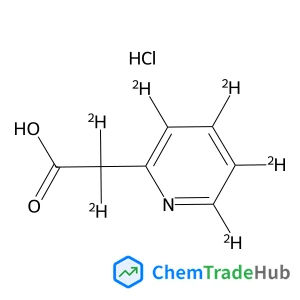
2,2-dideuterio-2-(3,4,5,6-tetradeuterio-2-pyridyl)acetic acid;hydrochloride
CAS Number:
1329799-67-8
Molecular Formula:
C7H2ClD6NO2
Recommended Suppliers






Disclaimer
This page provides academic journal information for reference and research purposes only. We are not affiliated with any journal publishers and do not handle publication submissions. For publication-related inquiries, please contact the respective journal publishers directly.
If you notice any inaccuracies in the information displayed, please contact us at support@chemtradehub.com. We will promptly review and address your concerns.