












Vacancy induced formation of nanoporous silicon, carbon and silicon carbide
Literature Information
Publication Date
2019-02-28
DOI
10.1039/C8CP06649C
Impact Factor
3.676
Authors
G. Opletal, B. Sun, T. C. Petersen, S. P. Russo, A. S. Barnard
View Original
Abstract
Nanoporous semiconductors are used in a range of applications from sensing and gas separation, to photovoltaics, rechargeable batteries, energetic materials and micro electro mechanical systems. In most cases porosity occurs in conjunction with the competing process of amorphisation, creating a complicated material that responds differently to strain and density changes, depending on the composition. In this paper we use simple computational workflow involving Monte Carlo simulation, numerical characterisation and statistical analysis to explore the development of amorphous and nanoporous carbon, silicon and silicon carbide. We show that amorphous regions in Si and SiC form in advance of nanopores, and are essential in stabilising the nanopores once developed. Carbon prefers a porous structure at lower strains than amorphisation and exhibits a bimodal change in the structure which correlates with the change in C–C bond angles from tetrahedral sp3-like bonds to hexagonal sp2-like bonds as the strain increases. These results highlight how both of these processes can be analysed simultaneously using reliable interatomic forcefields or density functionals, provided sufficient samples are included to support the statistics.
Related Literature
Chirality and intermolecular forces: studies using R2PI experiments in supersonic beams
S. Piccirillo, T. M. Di Palma, M. Speranza
2000-08-01
Paper
DOI: 10.1039/B004138F
Photodissociation of p-ethyl- and p-(α-hydroxyethyl)toluene in solution
M. Fujiwara, K. Mishima
2000-08-09
Paper
DOI: 10.1039/B004079G
Product distributions from the OH radical-induced oxidation of but-1-ene, methyl-substituted but-1-enes and isoprene in NOx-free air
Heinz-Jürgen Benkelberg, Olaf Böge, Ralph Seuwen, Peter Warneck
2000-08-31
Paper
DOI: 10.1039/B002053M
Lamb-dip millimeter-wave spectrum, structure and dipole moment of HCCCCF
Paper
DOI: 10.1039/A900920E
Charge transfer and fragmentation of liquid helium droplets doped with xenon
Thomas Ruchti, Berton E. Callicoatt, Kenneth C. Janda
2000-07-12
Paper
DOI: 10.1039/B002051F
Titration microcalorimetry of micelle formation in aqueous solutions containing alkylpolyoxyethylene glycol ethers, C12H25(OCH2CH2)mOH where m=3, 4 and 5, and octadecyltrimethylammonium bromide
Jan B. F. N. Engberts, Jan Kevelam
2000-09-06
Paper
DOI: 10.1039/B004501M
You might also like
Compound Q&A
What are the main uses of 4-Nitrophenyl phosphate disodium salt hexahydrate (CAS: 333338-18-4)?
4-Nitrophenyl phosphate disodium salt hexahydrate is primarily used as a substra...
333338-18-44-Nitrophenyl phosph...
Compound Q&A
What are the main uses of 2-(Trifluoromethyl)-1,3-oxazole-4-carboxylic Acid (CAS: 1060816-01-4)?
2-(Trifluoromethyl)-1,3-oxazole-4-carboxylic Acid (CAS: 1060816-01-4) is widely ...
1060816-01-42-(Trifluoromethyl)-...
Compound Q&A
How should 2-Fluoro-4-biphenylcarboxylic acid (CAS: 137045-30-8) be stored?
2-Fluoro-4-biphenylcarboxylic acid should be stored in a cool, dry place at room...
137045-30-82-Fluoro-4-biphenylc...
Compound Q&A
What industries use Prednisolone-21-Carboxylic Acid (CAS: 61549-70-0)?
Prednisolone-21-Carboxylic Acid is primarily used in the pharmaceutical industry...
61549-70-0Prednisolone-21-Carb...
Compound Q&A
How should 4-(Hydrazinomethyl)-1,2,3-benzenetriol (CAS: 3614-72-0) be stored?
4-(Hydrazinomethyl)-1,2,3-benzenetriol (CAS: 3614-72-0) should be stored in a co...
3614-72-04-(Hydrazinomethyl)-...
Compound Q&A
What industries use 4-Amino-1-methyl-1H-pyrazole-5-carboxylic acid hydrochloride (CAS: 92534-70-8)?
4-Amino-1-methyl-1H-pyrazole-5-carboxylic acid hydrochloride (CAS: 92534-70-8) i...
92534-70-84-Amino-1-methyl-1H-...
Compound Q&A
What regulatory guidelines apply to dehydropachymic acid (CAS: 77012-31-8)?
Dehydropachymic acid (CAS: 77012-31-8) is regulated by various agencies. It fall...
77012-31-8Dehydropachymic acid
Compound Q&A
What is the market or research trend for 6-[(2,2-Dimethylpropanoyl)amino]nicotinic acid (CAS: 898561-66-5)?
The market and research trends for 6-[(2,2-Dimethylpropanoyl)amino]nicotinic aci...
898561-66-56-[(2,2-Dimethylprop...
Compound Q&A
How should 1,10-Phenanthroline-2,9-dicarbaldehyde (CAS: 57709-62-3) be stored?
1,10-Phenanthroline-2,9-dicarbaldehyde should be stored in a cool, dry place awa...
57709-62-31,10-Phenanthroline-...
Compound Q&A
How is 5-Carbamoyl-11-oxo-10,11-dihydro-5H-dibenzo[b,f]azepin-10-yl acetate (CAS: 113952-21-9) typically synthesized?
5-Carbamoyl-11-oxo-10,11-dihydro-5H-dibenzo[b,f]azepin-10-yl acetate can be synt...
113952-21-95-Carbamoyl-11-oxo-1...
Source Journal
Physical Chemistry Chemical Physics

CiteScore:
5.5
Self-citation Rate:
10.3%
Articles per Year:
3036
Physical Chemistry Chemical Physics (PCCP) is an international journal co-owned by 19 physical chemistry and physics societies from around the world. This journal publishes original, cutting-edge research in physical chemistry, chemical physics and biophysical chemistry. To be suitable for publication in PCCP, articles must include significant innovation and/or insight into physical chemistry; this is the most important criterion that reviewers and Editors will judge against when evaluating submissions. The journal has a broad scope and welcomes contributions spanning experiment, theory, computation and data science. Topical coverage includes spectroscopy, dynamics, kinetics, statistical mechanics, thermodynamics, electrochemistry, catalysis, surface science, quantum mechanics, quantum computing and machine learning. Interdisciplinary research areas such as polymers and soft matter, materials, nanoscience, energy, surfaces/interfaces, and biophysical chemistry are welcomed if they demonstrate significant innovation and/or insight into physical chemistry. Joined experimental/theoretical studies are particularly appreciated when complementary and based on up-to-date approaches.
Recommended Compounds
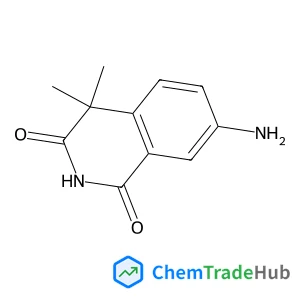
1,3(2H,4H)-Isoquinolinedione, 7-amino-4,4-dimethyl-
CAS Number:
14576-22-8
Molecular Formula:
C11H12N2O2
Recommended Suppliers





Disclaimer
This page provides academic journal information for reference and research purposes only. We are not affiliated with any journal publishers and do not handle publication submissions. For publication-related inquiries, please contact the respective journal publishers directly.
If you notice any inaccuracies in the information displayed, please contact us at support@chemtradehub.com. We will promptly review and address your concerns.