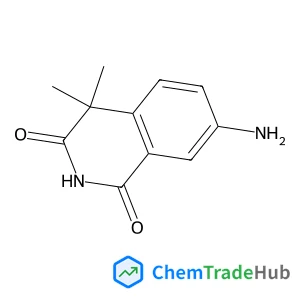
1,3(2H,4H)-Isoquinolinedione, 7-amino-4,4-dimethyl-
CAS Number:
14576-22-8
Molecular Formula:
C11H12N2O2
Piero Ferrari, Peter Lievens, Ewald Janssens
The relative stability of small cationic platinum clusters is investigated by photofragmentation experiments. Mass spectra show a smooth intensity distribution except for a local intensity minimum at Pt5+, revealing enhanced stability of the platinum tetramer Pt4+. The possibility that radiative cooling competes with statistical fragmentation after photoexcitation is examined and it is shown that clusters in the N = 3–8 size range do not radiate on the time scale of the experiment. In the absence of radiative cooling, the mass spectra of photofragmented clusters can be well explained by dissociation energies computed using density functional theory. The large calculated HOMO–LUMO gap for Pt4+ (∼1.2 eV) is attributed to its highly symmetric structure and provides an explanation for the surprisingly low reactivity of this cluster in different gas-phase reactions.

New Journal of Chemistry

Journal of Peptide Science

Drug Discovery Today

Chemical Communications

Russian Journal of Bioorganic Chemistry

Acta Materialia

Current Opinion in Colloid & Interface Science

Russian Journal of Organic Chemistry

Current Opinion in Solid State & Materials Science

Russian Journal of General Chemistry
Xiang Luo, Shijie Xie, Jun Liu, Haibin Hu, Jing Jiang, Wei Huang, Haiyang Gao, Dongshan Zhou, Zhongyuan Lü, Deyue Yan
DOI: 10.1039/C3PY00896G
Jean-Daniel Marty, Mathias Destarac
DOI: 10.1039/C3PY01109G
Hartmut Komber, Stefan Müllers, Alexander Held, Michael Walter
DOI: 10.1039/C3PY00853C
Naoya Sakai, Mingoo Jin, Shin-ichiro Sato, Toshifumi Satoh, Toyoji Kakuchi
DOI: 10.1039/C3PY00972F
Yiliu Liu, Zehuan Huang, Kai Liu, Hans Kelgtermans, Wim Dehaen, Zhiqiang Wang, Xi Zhang
DOI: 10.1039/C3PY01036H
Rong Jin, Chao Lin, Aoneng Cao
DOI: 10.1039/C3PY00864A
Ting Ye, Suting Yan, Yumei Hu, Li Ding, Weitai Wu
DOI: 10.1039/C3PY00778B
Xiqi Zhang, Bin Yang, Meiying Liu, Wanyun Liu, Yiwang Chen, Yen Wei
DOI: 10.1039/C3PY00984J
Liulin Yang, Xiaoguang Liu, Xinxin Tan, Hui Yang, Zhiqiang Wang, Xi Zhang
DOI: 10.1039/C3PY01161E
4-Nitrophenyl phosphate disodium salt hexahydrate is primarily used as a substra...
2-(Trifluoromethyl)-1,3-oxazole-4-carboxylic Acid (CAS: 1060816-01-4) is widely ...
2-Fluoro-4-biphenylcarboxylic acid should be stored in a cool, dry place at room...
Prednisolone-21-Carboxylic Acid is primarily used in the pharmaceutical industry...
4-(Hydrazinomethyl)-1,2,3-benzenetriol (CAS: 3614-72-0) should be stored in a co...
4-Amino-1-methyl-1H-pyrazole-5-carboxylic acid hydrochloride (CAS: 92534-70-8) i...
Dehydropachymic acid (CAS: 77012-31-8) is regulated by various agencies. It fall...
The market and research trends for 6-[(2,2-Dimethylpropanoyl)amino]nicotinic aci...
1,10-Phenanthroline-2,9-dicarbaldehyde should be stored in a cool, dry place awa...
5-Carbamoyl-11-oxo-10,11-dihydro-5H-dibenzo[b,f]azepin-10-yl acetate can be synt...

Physical Chemistry Chemical Physics (PCCP) is an international journal co-owned by 19 physical chemistry and physics societies from around the world. This journal publishes original, cutting-edge research in physical chemistry, chemical physics and biophysical chemistry. To be suitable for publication in PCCP, articles must include significant innovation and/or insight into physical chemistry; this is the most important criterion that reviewers and Editors will judge against when evaluating submissions. The journal has a broad scope and welcomes contributions spanning experiment, theory, computation and data science. Topical coverage includes spectroscopy, dynamics, kinetics, statistical mechanics, thermodynamics, electrochemistry, catalysis, surface science, quantum mechanics, quantum computing and machine learning. Interdisciplinary research areas such as polymers and soft matter, materials, nanoscience, energy, surfaces/interfaces, and biophysical chemistry are welcomed if they demonstrate significant innovation and/or insight into physical chemistry. Joined experimental/theoretical studies are particularly appreciated when complementary and based on up-to-date approaches.
phosphoryl}methyl 4-methylbenzenesulfonate structure](https://static.chemtradehub.com/structs/864/864068-45-1-ba7c.webp "{[3-(Hexadecyloxy)propoxy](hydroxy)phosphoryl}methyl 4-methylbenzenesulfonate structure")
![1-[(4-Methylphenyl)sulfonyl]-3-(4,4,5,5-tetramethyl-1,3,2-dioxaborolan-2-yl)-1H-pyrrolo[2,3-b]pyridine-5-carbonitrile structure](https://static.chemtradehub.com/structs/143/1434747-57-5-fc0d.webp "1-[(4-Methylphenyl)sulfonyl]-3-(4,4,5,5-tetramethyl-1,3,2-dioxaborolan-2-yl)-1H-pyrrolo[2,3-b]pyridine-5-carbonitrile structure")