


Highly localized H2O librational motion as a far-infrared spectroscopic probe for microsolvation of organic molecules
Literature Information
Publication Date
2019-01-09
DOI
10.1039/C8CP05985C
Impact Factor
3.676
Authors
D. Mihrin, J. Andersen, P. W. Jakobsen, R. Wugt Larsen
View Original
Abstract
The most prominent spectroscopic observable for the hydrogen bonding between individual molecules in liquid water is the broad absorption band detected in the spectral region between 300 and 900 cm−1. The present work demonstrates how the associated large-amplitude out-of-plane OH librational motion of H2O molecules also directly reflects the microsolvation of organic compounds. This highly localized OH librational motion of the first solvating H2O molecule causes a significant change of dipole moment and gives rise to a strong characteristic band in the far-infrared spectral region, which is correlated quantitatively with the complexation energy. The out-of-plane OH librational band origins ranging from 324.5 to 658.9 cm−1 have been assigned experimentally for a series of four binary hydrogen-bonded H2O complexes embedded in solid neon involving S-, O- and N-containing compounds with increasing hydrogen bond acceptor capability. The hydrogen bond energies for altogether eight binary H2O complexes relative to the experimental value of 13.2 ± 0.12 kJ mol−1 for the prototypical (H2O)2 system [Rocher-Casterline et al., J. Chem. Phys., 2011, 134, 211101] are revealed directly by these far-infrared spectroscopic observables. The far-infrared spectral signatures are able to capture even minor differences in the hydrogen bond acceptor capability of O atoms with slightly different alkyl substituents in the order H–O–C(CH3)3 > CH3–O–CH3 > H–O–CH(CH3)2 > H–O–CH2CH3.
Recommended Journals

Russian Journal of General Chemistry

Current Opinion in Solid State & Materials Science

Journal of Saudi Chemical Society

Saudi Pharmaceutical Journal

Acta Materialia

Journal of Peptide Science

Russian Journal of Bioorganic Chemistry

Organic Process Research & Development

Russian Journal of Applied Chemistry

Russian Journal of Organic Chemistry
Related Literature
Evaluation of vibrational partition functions for polyatomic systems: quantum ersus classical methods for H2O and Ar···CN
Antonio Riganelli, Frederico V. Prudente, António J. C. Varandas
2000-05-18
Paper
DOI: 10.1039/B001746I
Electron paramagnetic resonance and electron spin echo study of supported and unsupported vanadium oxides
Paper
DOI: 10.1039/A900119K
Reaction control of tetraethyl orthosilicate (TEOS)/O3 and tetramethyl orthosilicate (TMOS)/O3 counter diffusion chemical vapour deposition for preparation of molecular-sieve membranes
Takeo Yamaguchi, Xin Ying, Yasuhiko Tokimasa, Balagopal N. Nair, Takashi Sugawara, Shin-ichi Nakao
2000-09-15
Paper
DOI: 10.1039/B004642F
CeO2–La2O3 catalytic system Part I. Preparation and characterisation of catalysts
G. Colón, J. A. Navío, R. Monaci, I. Ferino
2000-09-15
Paper
DOI: 10.1039/B002815K
Chirality and intermolecular forces: studies using R2PI experiments in supersonic beams
S. Piccirillo, T. M. Di Palma, M. Speranza
2000-08-01
Paper
DOI: 10.1039/B004138F
Self-healing hydrophobic POSS-functionalized fluorinated copolymers via RAFT polymerization and dynamic Diels–Alder reaction
Prantik Mondal, Thomas Becker, Richard Hoogenboom, Andrew B. Lowe, Nikhil K. Singha
2020-12-28
Paper
DOI: 10.1039/D0PY01522A
You might also like
Compound Q&A
What precautions should be taken when handling 4-Methyl-6-(trifluoromethyl)quinoline (CAS: 40716-16-3)?
When handling 4-Methyl-6-(trifluoromethyl)quinoline (CAS: 40716-16-3), safety go...
40716-16-34-Methyl-6-(trifluor...
Compound Q&A
What is 4-(3,5-Difluorophenyl)aniline (CAS: 405058-00-6)?
4-(3,5-Difluorophenyl)aniline is an aromatic organic compound with the CAS numbe...
405058-00-64-(3,5-Difluoropheny...
Compound Q&A
How is 5-{[4-(Trifluoromethyl)phenyl]sulfanyl}-1,2,3-thiadiazole-4-carboxylic acid (CAS: 338982-07-3) typically synthesized?
5-{[4-(Trifluoromethyl)phenyl]sulfanyl}-1,2,3-thiadiazole-4-carboxylic acid can ...
338982-07-35-{[4-(Trifluorometh...
Compound Q&A
What is the market or research trend for 4-Benzylaniline hydrochloride (CAS: 6317-57-3)?
The market for 4-Benzylaniline hydrochloride (CAS: 6317-57-3) is steadily growin...
6317-57-34-Benzylaniline hydr...
Compound Q&A
Is [3-(Diethylsulfamoyl)phenyl]boronic acid (CAS: 871329-58-7) safe?
[3-(Diethylsulfamoyl)phenyl]boronic acid is generally considered safe when handl...
871329-58-7[3-(Diethylsulfamoyl...
Compound Q&A
What are the main uses of 3-Bromo-2,5-dimethoxyaniline (CAS: 115929-62-9)?
3-Bromo-2,5-dimethoxyaniline is mainly used in the pharmaceutical and chemical i...
115929-62-93-Bromo-2,5-dimethox...
Compound Q&A
What regulatory guidelines apply to N-Methyl-1-(5-methyl-1H-indol-3-yl)methanamine (CAS: 915922-67-7)?
N-Methyl-1-(5-methyl-1H-indol-3-yl)methanamine (CAS: 915922-67-7) is subject to ...
915922-67-7N-Methyl-1-(5-methyl...
Compound Q&A
What industries use Carbamic acid, N-[(5S)-5,6-diamino-6-oxohexyl]-, 1,1-dimethylethyl ester (CAS: 24828-96-4)?
This compound is primarily used in the pharmaceutical industry for the synthesis...
24828-96-4Carbamic acid, N-[(5...
Compound Q&A
How should 2-Methyl-2-propanyl [(1S,3R)-3-aminocyclohexyl]carbamate (CAS: 1298101-47-9) be stored?
2-Methyl-2-propanyl [(1S,3R)-3-aminocyclohexyl]carbamate (CAS: 1298101-47-9) sho...
1298101-47-92-Methyl-2-propanyl ...
Compound Q&A
What industries use Ethyl 2-bromo-4,4,4-trifluorobutanoate (CAS: 367-33-9)?
Ethyl 2-bromo-4,4,4-trifluorobutanoate (CAS: 367-33-9) is utilized in the pharma...
367-33-9Ethyl 2-bromo-4,4,4-...
Source Journal
Physical Chemistry Chemical Physics

CiteScore:
5.5
Self-citation Rate:
10.3%
Articles per Year:
3036
Physical Chemistry Chemical Physics (PCCP) is an international journal co-owned by 19 physical chemistry and physics societies from around the world. This journal publishes original, cutting-edge research in physical chemistry, chemical physics and biophysical chemistry. To be suitable for publication in PCCP, articles must include significant innovation and/or insight into physical chemistry; this is the most important criterion that reviewers and Editors will judge against when evaluating submissions. The journal has a broad scope and welcomes contributions spanning experiment, theory, computation and data science. Topical coverage includes spectroscopy, dynamics, kinetics, statistical mechanics, thermodynamics, electrochemistry, catalysis, surface science, quantum mechanics, quantum computing and machine learning. Interdisciplinary research areas such as polymers and soft matter, materials, nanoscience, energy, surfaces/interfaces, and biophysical chemistry are welcomed if they demonstrate significant innovation and/or insight into physical chemistry. Joined experimental/theoretical studies are particularly appreciated when complementary and based on up-to-date approaches.
Recommended Compounds
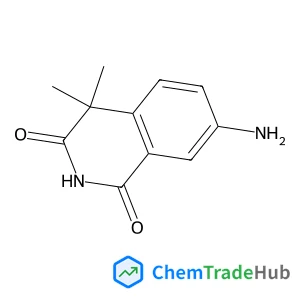
1,3(2H,4H)-Isoquinolinedione, 7-amino-4,4-dimethyl-
CAS Number:
14576-22-8
Molecular Formula:
C11H12N2O2
![(2E)-3-(3-Chlorophenyl)-N-{2-[4-(methylsulfonyl)-1-piperazinyl]-2-oxoethyl}acrylamide structure](https://static.chemtradehub.com/structs/250/2505001-54-5-c1e9.webp "(2E)-3-(3-Chlorophenyl)-N-{2-[4-(methylsulfonyl)-1-piperazinyl]-2-oxoethyl}acrylamide structure")
(2E)-3-(3-Chlorophenyl)-N-{2-[4-(methylsulfonyl)-1-piperazinyl]-2-oxoethyl}acrylamide
CAS Number:
2505001-54-5
Molecular Formula:
C16H20ClN3O4S
Recommended Suppliers




Disclaimer
This page provides academic journal information for reference and research purposes only. We are not affiliated with any journal publishers and do not handle publication submissions. For publication-related inquiries, please contact the respective journal publishers directly.
If you notice any inaccuracies in the information displayed, please contact us at support@chemtradehub.com. We will promptly review and address your concerns.