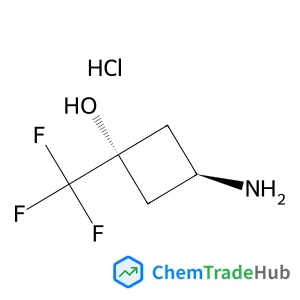
cis-3-Amino-1-(trifluoromethyl)cyclobutanol hydrochloride (1:1)
CAS Number:
1408075-16-0
Molecular Formula:
C5H9ClF3NO
Saeed Akbari, Mohammad Taghi Hamed Mosavian, Fatemeh Moosavi, Ali Ahmadpour
A perfluorosulfonic acid (PFSA) membrane, i.e. Nafion® 117, was doped with the heteropoly salts (HPS) Cs3PW12O40, Rb3PW12O40, and (NH4)3PW12O40. Also, composite membranes with CsxH3−xPW12O40 (x = 1, 2, and 3) as dopants were investigated, which were rendered insoluble by substituting protons with larger cations. Morphological assessment and a detailed analysis of the hopping events via SAXS measurement and analysis of the hydrogen bond networks were performed using classical and quantum hopping molecular dynamics simulation. The phase segregation decreased by increasing the extent proton substitution in HPA. HPS containing cations with a larger ionic radius induced smaller phase segregation in the membrane, as confirmed by the RDF plots. SAXS simulation revealed that the hydrophilic phase domains in the HPS-doped Nafion® membrane were spaced further apart than that in the HPA-doped membrane. Although there was a greater number of isolated clusters for the Cs3PW12O40-doped Nafion®, the average number of cluster decreased with an increase in the substitution cation/proton ratio and ionic radius of the cation. The analysis of the H-bond network stability revealed that the proton hops slower when the membrane contains HPS particles and the mean residence time of a proton on water molecules increases with an increase in the extent of proton substitution in H3PW12O40. Indeed, for the HPA-doped membrane, the diffusion of water molecules is lower than that in the HPS-doped system.

Saudi Pharmaceutical Journal

Russian Journal of Applied Chemistry

Russian Chemical Bulletin

Journal of Natural Medicines

Russian Journal of Coordination Chemistry

Nature Medicine

Russian Journal of Bioorganic Chemistry

Journal of Saudi Chemical Society

Russian Journal of Organic Chemistry

New Journal of Chemistry
Yiliu Liu, Zehuan Huang, Kai Liu, Hans Kelgtermans, Wim Dehaen, Zhiqiang Wang, Xi Zhang
DOI: 10.1039/C3PY01036H
L. Sambe, F. Stoffelbach, J. Lyskawa, F. Delattre, M. Bria, F. X. Sauvage, M. Sliwa, V. Humblot, B. Charleux, G. Cooke, P. Woisel
DOI: 10.1039/C3PY01093G
DOI: 10.1039/C3PY00869J
Peng Liu, Caixia Yue, Zonghai Sheng, Guanhui Gao, Mingxing Li, Huqiang Yi, Cuifang Zheng, Bi Wang, Lintao Cai
DOI: 10.1039/C3PY01173A
Webster L. Santos, John B. Matson, Regina C. So
DOI: 10.1039/C3PY01069D
Li-Min Zhang, Tao Wang, Bao-Hang Han
DOI: 10.1039/C3PY00854A
Liulin Yang, Xiaoguang Liu, Xinxin Tan, Hui Yang, Zhiqiang Wang, Xi Zhang
DOI: 10.1039/C3PY01161E
Anja Thomas, Kerstin Niederer, Frederik Wurm, Holger Frey
DOI: 10.1039/C3PY01078C
4-Nitrophenyl phosphate disodium salt hexahydrate is primarily used as a substra...
2-(Trifluoromethyl)-1,3-oxazole-4-carboxylic Acid (CAS: 1060816-01-4) is widely ...
2-Fluoro-4-biphenylcarboxylic acid should be stored in a cool, dry place at room...
Prednisolone-21-Carboxylic Acid is primarily used in the pharmaceutical industry...
4-(Hydrazinomethyl)-1,2,3-benzenetriol (CAS: 3614-72-0) should be stored in a co...
4-Amino-1-methyl-1H-pyrazole-5-carboxylic acid hydrochloride (CAS: 92534-70-8) i...
Dehydropachymic acid (CAS: 77012-31-8) is regulated by various agencies. It fall...
The market and research trends for 6-[(2,2-Dimethylpropanoyl)amino]nicotinic aci...
1,10-Phenanthroline-2,9-dicarbaldehyde should be stored in a cool, dry place awa...
5-Carbamoyl-11-oxo-10,11-dihydro-5H-dibenzo[b,f]azepin-10-yl acetate can be synt...

Physical Chemistry Chemical Physics (PCCP) is an international journal co-owned by 19 physical chemistry and physics societies from around the world. This journal publishes original, cutting-edge research in physical chemistry, chemical physics and biophysical chemistry. To be suitable for publication in PCCP, articles must include significant innovation and/or insight into physical chemistry; this is the most important criterion that reviewers and Editors will judge against when evaluating submissions. The journal has a broad scope and welcomes contributions spanning experiment, theory, computation and data science. Topical coverage includes spectroscopy, dynamics, kinetics, statistical mechanics, thermodynamics, electrochemistry, catalysis, surface science, quantum mechanics, quantum computing and machine learning. Interdisciplinary research areas such as polymers and soft matter, materials, nanoscience, energy, surfaces/interfaces, and biophysical chemistry are welcomed if they demonstrate significant innovation and/or insight into physical chemistry. Joined experimental/theoretical studies are particularly appreciated when complementary and based on up-to-date approaches.