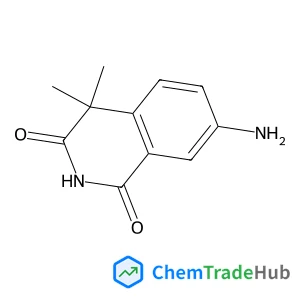
1,3(2H,4H)-Isoquinolinedione, 7-amino-4,4-dimethyl-
CAS Number:
14576-22-8
Molecular Formula:
C11H12N2O2
V. S. Veena, Kavya Illath, Anish Lazar, C. P. Vinod, T. G. Ajithkumar, S. Jayanthi
Solid state proton (1H) magic angle spinning (MAS) NMR has been employed to study the distribution of confined water in ethane substituted periodic mesoporous organosilicate (PMOE) materials. Proton spectra acquired at different hydration levels are analysed and interpreted in terms of water clusters of various sizes and distributions of water layers on the pore surface. For comparison, we also performed similar experiments on SBA-15. The formation of larger clusters at lower hydration suggests that the pores of PMOE are getting filled with water at lower hydration levels than those in SBA-15. For PMOE, the simultaneous presence of two major resonances in the ranges 3.6–4.1 ppm and 4.4–5.2 ppm and their behaviour upon hydration imply a water layer distribution that is the sum of two contributions, corresponding to fully filled and partially filled pores or pore segments. Furthermore, the behaviour mentioned above suggests that both radial and axial filling mechanisms play a significant role in the hydration process. For SBA-15, as a function of hydration, we observed a smooth variation in the proton chemical shift of the main dynamic resonance. In accordance with previous studies, this is attributed to the gradual increase in the average thickness of water layers with an increase in hydration, and to a pore filling mechanism that is predominantly radial.
Yasushi Ishido, Arihiro Kanazawa, Shokyoku Kanaoka, Sadahito Aoshima
DOI: 10.1039/C3PY00842H
Longqiang Xiao, Shaojun Cai, Qingye Liu, Liqiong Liao, Xin Guo, Yan Li, Xiangxiang Jia, Feifei Li, Lijian Liu
DOI: 10.1039/C3PY01105D
Daniel J. Phillips, Joseph P. Patterson, Rachel K. O'Reilly, Matthew I. Gibson
DOI: 10.1039/C3PY00991B
Jimy Hadiono So, David Mayevsky, Orawan Winther-Jensen, Bjorn Winther-Jensen
DOI: 10.1039/C3PY01265D
Bin Liu, Lingfeng Li, Cuiling Lin, Jingdan Zhou, Zhexin Zhu, Hongyao Xu, Huayu Qiu, Shouchun Yin
DOI: 10.1039/C3PY01021J
Xiqi Zhang, Xiaoyong Zhang, Bin Yang, Junfeng Hui, Meiying Liu, Zhenguo Chi, Siwei Liu, Jiarui Xu, Yen Wei
DOI: 10.1039/C3PY01143G
Ying-Hsuan Chou, Sanae Takasugi, Raita Goseki, Takashi Ishizone, Wen-Chang Chen
DOI: 10.1039/C3PY01124K
Shi-qiang Gong, D. Jeevanie Epasinghe, Wei Zhang, Bin Zhou, Li-na Niu, Heonjune Ryou, Ashraf A. Eid, Andrea Frassetto, Cynthia K. Y. Yiu, Dwayne D. Arola, Jing Mao, David H. Pashley, Franklin R. Tay
DOI: 10.1039/C3PY00635B
Zhijia Liu, Ping Yao
DOI: 10.1039/C3PY01083J
Toshifumi Satoh, Naoki Nishikawa, Daisuke Kawato, Daichi Suemasa, Sungmin Jung, Young Yong Kim, Moonhor Ree, Toyoji Kakuchi
DOI: 10.1039/C3PY00985H
4-Nitrophenyl phosphate disodium salt hexahydrate is primarily used as a substra...
2-(Trifluoromethyl)-1,3-oxazole-4-carboxylic Acid (CAS: 1060816-01-4) is widely ...
2-Fluoro-4-biphenylcarboxylic acid should be stored in a cool, dry place at room...
Prednisolone-21-Carboxylic Acid is primarily used in the pharmaceutical industry...
4-(Hydrazinomethyl)-1,2,3-benzenetriol (CAS: 3614-72-0) should be stored in a co...
4-Amino-1-methyl-1H-pyrazole-5-carboxylic acid hydrochloride (CAS: 92534-70-8) i...
Dehydropachymic acid (CAS: 77012-31-8) is regulated by various agencies. It fall...
The market and research trends for 6-[(2,2-Dimethylpropanoyl)amino]nicotinic aci...
1,10-Phenanthroline-2,9-dicarbaldehyde should be stored in a cool, dry place awa...
5-Carbamoyl-11-oxo-10,11-dihydro-5H-dibenzo[b,f]azepin-10-yl acetate can be synt...

Physical Chemistry Chemical Physics (PCCP) is an international journal co-owned by 19 physical chemistry and physics societies from around the world. This journal publishes original, cutting-edge research in physical chemistry, chemical physics and biophysical chemistry. To be suitable for publication in PCCP, articles must include significant innovation and/or insight into physical chemistry; this is the most important criterion that reviewers and Editors will judge against when evaluating submissions. The journal has a broad scope and welcomes contributions spanning experiment, theory, computation and data science. Topical coverage includes spectroscopy, dynamics, kinetics, statistical mechanics, thermodynamics, electrochemistry, catalysis, surface science, quantum mechanics, quantum computing and machine learning. Interdisciplinary research areas such as polymers and soft matter, materials, nanoscience, energy, surfaces/interfaces, and biophysical chemistry are welcomed if they demonstrate significant innovation and/or insight into physical chemistry. Joined experimental/theoretical studies are particularly appreciated when complementary and based on up-to-date approaches.