


van der Waals interaction-induced photoluminescence weakening and multilayer growth in epitaxially aligned WS2
Literature Information
Publication Date
2018-11-07
DOI
10.1039/C8CP04418J
Impact Factor
3.676
Authors
Hyun Goo Ji, Mina Maruyama, Adha Sukma Aji, Susumu Okada, Kazunari Matsuda
View Original
Abstract
Recently, transition metal dichalcogenides (TMDCs) have attracted great interest due to their unique electronic and optical properties. Chemical vapor deposition (CVD) has been regarded as the most promising method for the synthesis of large-area TMDCs with high reproducibility. Having similar hexagonal crystal structures with many TMDCs, c-plane sapphire is commonly used as a growth substrate in CVD. However, few studies have been reported on the influence of the sapphire substrate on the growth behavior and physical properties of TMDCs. In this work, we demonstrate that higher strain is induced in epitaxially grown WS2 grains via van der Waals interactions with sapphire as compared with misaligned WS2 grains. In addition, this strain was found to enhance overlayer deposition on monolayer WS2, while multilayer growth was not observed in non-epitaxial WS2. Photoluminescence (PL) of the epitaxially grown WS2 grains was reduced, reflecting the effective van der Waals interaction with sapphire. Moreover, low-temperature PL measurements revealed strong influence of the c-plane sapphire surface on the optical properties of WS2. Density functional theory (DFT) calculation supports that the aligned WS2 grains are more strongly bound to the sapphire surface, as compared with misaligned WS2. Our work offers a new insight into the understanding of the influence of the substrate on the CVD-grown TMDC materials.
Recommended Journals

Russian Journal of General Chemistry

Russian Journal of Bioorganic Chemistry

Organic Process Research & Development

Current Opinion in Solid State & Materials Science

Drug Discovery Today

Russian Journal of Coordination Chemistry

New Journal of Chemistry

Saudi Pharmaceutical Journal

Chemistry Education Research and Practice

Nature Medicine
Related Literature
The synthesis and characterization of supramolecular elastomers based on linear carboxyl-terminated polydimethylsiloxane oligomers
Lin Yang, Yaling Lin, Lianshi Wang, Anqiang Zhang
2013-08-07
Paper
DOI: 10.1039/C3PY01005H
Reversibly crosslinked thermo- and redox-responsive nanogels for controlled drug release
Christophe Detrembleur, Marie Hurtgen, Antoine Debuigne, Marie-Claire De Pauw-Gillet, Stéphane Mornet, Etienne Duguet, Christine Jérôme
2013-07-31
Paper
DOI: 10.1039/C3PY00839H
Porphyrin-containing hyperbranched supramolecular polymers: enhancing 1O2-generation efficiency by supramolecular polymerization
Yiliu Liu, Zehuan Huang, Kai Liu, Hans Kelgtermans, Wim Dehaen, Zhiqiang Wang, Xi Zhang
2013-08-22
Communication
DOI: 10.1039/C3PY01036H
Synthesis of functionalized cyclic carbonate monomers using a versatile pentafluorophenyl carbonate intermediate
Daniel P. Sanders, Daniel J. Coady, Manabu Yasumoto, Masaki Fujiwara, Haritz Sardon, James L. Hedrick
2013-09-23
Communication
DOI: 10.1039/C3PY01128C
Photosensitizer-conjugated redox-responsive dextran theranostic nanoparticles for near-infrared cancer imaging and photodynamic therapy
Peng Liu, Caixia Yue, Zonghai Sheng, Guanhui Gao, Mingxing Li, Huqiang Yi, Cuifang Zheng, Bi Wang, Lintao Cai
2013-09-20
Paper
DOI: 10.1039/C3PY01173A
Synthesis of antimicrobial silsesquioxane–silica hybrids by hydrolytic co-condensation of alkoxysilanes
Shi-qiang Gong, D. Jeevanie Epasinghe, Wei Zhang, Bin Zhou, Li-na Niu, Heonjune Ryou, Ashraf A. Eid, Andrea Frassetto, Cynthia K. Y. Yiu, Dwayne D. Arola, Jing Mao, David H. Pashley, Franklin R. Tay
2013-08-14
Paper
DOI: 10.1039/C3PY00635B
Multi-stimuli responsive polymers – the all-in-one talents
Florian D. Jochum, Patrick Theato
2013-08-07
Review Article
DOI: 10.1039/C3PY00880K
You might also like
Compound Q&A
What are the main uses of 4-Nitrophenyl phosphate disodium salt hexahydrate (CAS: 333338-18-4)?
4-Nitrophenyl phosphate disodium salt hexahydrate is primarily used as a substra...
333338-18-44-Nitrophenyl phosph...
Compound Q&A
What are the main uses of 2-(Trifluoromethyl)-1,3-oxazole-4-carboxylic Acid (CAS: 1060816-01-4)?
2-(Trifluoromethyl)-1,3-oxazole-4-carboxylic Acid (CAS: 1060816-01-4) is widely ...
1060816-01-42-(Trifluoromethyl)-...
Compound Q&A
How should 2-Fluoro-4-biphenylcarboxylic acid (CAS: 137045-30-8) be stored?
2-Fluoro-4-biphenylcarboxylic acid should be stored in a cool, dry place at room...
137045-30-82-Fluoro-4-biphenylc...
Compound Q&A
What industries use Prednisolone-21-Carboxylic Acid (CAS: 61549-70-0)?
Prednisolone-21-Carboxylic Acid is primarily used in the pharmaceutical industry...
61549-70-0Prednisolone-21-Carb...
Compound Q&A
How should 4-(Hydrazinomethyl)-1,2,3-benzenetriol (CAS: 3614-72-0) be stored?
4-(Hydrazinomethyl)-1,2,3-benzenetriol (CAS: 3614-72-0) should be stored in a co...
3614-72-04-(Hydrazinomethyl)-...
Compound Q&A
What industries use 4-Amino-1-methyl-1H-pyrazole-5-carboxylic acid hydrochloride (CAS: 92534-70-8)?
4-Amino-1-methyl-1H-pyrazole-5-carboxylic acid hydrochloride (CAS: 92534-70-8) i...
92534-70-84-Amino-1-methyl-1H-...
Compound Q&A
What regulatory guidelines apply to dehydropachymic acid (CAS: 77012-31-8)?
Dehydropachymic acid (CAS: 77012-31-8) is regulated by various agencies. It fall...
77012-31-8Dehydropachymic acid
Compound Q&A
What is the market or research trend for 6-[(2,2-Dimethylpropanoyl)amino]nicotinic acid (CAS: 898561-66-5)?
The market and research trends for 6-[(2,2-Dimethylpropanoyl)amino]nicotinic aci...
898561-66-56-[(2,2-Dimethylprop...
Compound Q&A
How should 1,10-Phenanthroline-2,9-dicarbaldehyde (CAS: 57709-62-3) be stored?
1,10-Phenanthroline-2,9-dicarbaldehyde should be stored in a cool, dry place awa...
57709-62-31,10-Phenanthroline-...
Compound Q&A
How is 5-Carbamoyl-11-oxo-10,11-dihydro-5H-dibenzo[b,f]azepin-10-yl acetate (CAS: 113952-21-9) typically synthesized?
5-Carbamoyl-11-oxo-10,11-dihydro-5H-dibenzo[b,f]azepin-10-yl acetate can be synt...
113952-21-95-Carbamoyl-11-oxo-1...
Source Journal
Physical Chemistry Chemical Physics

CiteScore:
5.5
Self-citation Rate:
10.3%
Articles per Year:
3036
Physical Chemistry Chemical Physics (PCCP) is an international journal co-owned by 19 physical chemistry and physics societies from around the world. This journal publishes original, cutting-edge research in physical chemistry, chemical physics and biophysical chemistry. To be suitable for publication in PCCP, articles must include significant innovation and/or insight into physical chemistry; this is the most important criterion that reviewers and Editors will judge against when evaluating submissions. The journal has a broad scope and welcomes contributions spanning experiment, theory, computation and data science. Topical coverage includes spectroscopy, dynamics, kinetics, statistical mechanics, thermodynamics, electrochemistry, catalysis, surface science, quantum mechanics, quantum computing and machine learning. Interdisciplinary research areas such as polymers and soft matter, materials, nanoscience, energy, surfaces/interfaces, and biophysical chemistry are welcomed if they demonstrate significant innovation and/or insight into physical chemistry. Joined experimental/theoretical studies are particularly appreciated when complementary and based on up-to-date approaches.
Recommended Compounds
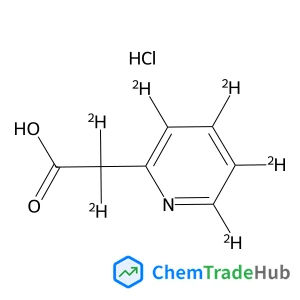
2,2-dideuterio-2-(3,4,5,6-tetradeuterio-2-pyridyl)acetic acid;hydrochloride
CAS Number:
1329799-67-8
Molecular Formula:
C7H2ClD6NO2
Recommended Suppliers







Disclaimer
This page provides academic journal information for reference and research purposes only. We are not affiliated with any journal publishers and do not handle publication submissions. For publication-related inquiries, please contact the respective journal publishers directly.
If you notice any inaccuracies in the information displayed, please contact us at support@chemtradehub.com. We will promptly review and address your concerns.