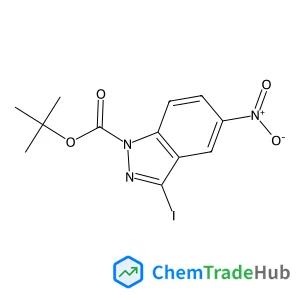
Tert-butyl 3-iodo-5-nitro-1H-indazole-1-carboxylate
CAS Number:
459133-69-8
Molecular Formula:
C12H12IN3O4
Renlu Han, Weiping Li, Laihui Luo, Weidong Fei
With the increasing demand of high energy density dielectric films, macrostructure design, for instance the construction of sandwich-structured films, has been attracting much attention due to its promise in raising the discharge energy density along with an enhanced electric breakdown strength. However, the contrast of dielectric constants between neighboring layers plays a dominate role in the distribution of the electric field, which might decrease the electric breakdown strength, and has attracted little attention up to now. Additionally, high energy storage efficiency with low energy dissipation should also be considered for dielectric applications despite enhancing the discharge energy density. In this study, the effects of dielectric constant contrast between neighboring layers have been proposed and investigated in the BiFeO3/BaTiO3/BiFeO3 sandwich-structured films through regulating the annealing temperature, in which the polarization behavior has also been tuned by partially crystallizing BiFeO3 and BaTiO3 films. As a result, the BiFeO3/BaTiO3/BiFeO3 sandwich-structured film annealed at 550 °C exhibits a favorable discharge energy density of 18.5 J cm−3 and a high energy storage efficiency of 82.3%, which result from the synergetic effect of the polarization behavior (Pm − Pr = 12.1 μC cm−2) and enhanced electric breakdown strength (EBDS = 2320 kV cm−1). By rational design of the dielectric and ferroelectric properties of individual layers, both excellent discharge energy density and energy storage efficiency could be simultaneously obtained in the sandwich-structured films.

Nature Medicine

Journal of Saudi Chemical Society

Acta Materialia

Russian Journal of Applied Chemistry

New Journal of Chemistry

Journal of Peptide Science

Chemistry Education Research and Practice

Russian Journal of General Chemistry

Current Opinion in Solid State & Materials Science

Journal of Natural Medicines
Sergio Ferro, Achille De Battisti
DOI: 10.1039/B109931K
Chetan K. Parmar, Garry Rumbles, Christopher J. Winscom
DOI: 10.1039/B108865C
Sture Nordholm, Hongrei Li
DOI: 10.1039/B108996J
P. Dagaut, G. Pengloan, A. Ristori
DOI: 10.1039/B110282F
Hee-Seung Lee, Anne B. McCoy
DOI: 10.1039/B110963D
P. Larrégaray, L. Bonnet, J. C. Rayez
DOI: 10.1039/B109739N
Ali El-Agamey, David J. McGarvey
DOI: 10.1039/B109309F
Vera Maura Fernandes de Lima, Marc Weimer, Wolfgang Hanke
DOI: 10.1039/B109914K
K. Bernhard, S. Naumov
DOI: 10.1039/B109064J
When handling 4-Methyl-6-(trifluoromethyl)quinoline (CAS: 40716-16-3), safety go...
4-(3,5-Difluorophenyl)aniline is an aromatic organic compound with the CAS numbe...
5-{[4-(Trifluoromethyl)phenyl]sulfanyl}-1,2,3-thiadiazole-4-carboxylic acid can ...
The market for 4-Benzylaniline hydrochloride (CAS: 6317-57-3) is steadily growin...
[3-(Diethylsulfamoyl)phenyl]boronic acid is generally considered safe when handl...
3-Bromo-2,5-dimethoxyaniline is mainly used in the pharmaceutical and chemical i...
N-Methyl-1-(5-methyl-1H-indol-3-yl)methanamine (CAS: 915922-67-7) is subject to ...
This compound is primarily used in the pharmaceutical industry for the synthesis...
2-Methyl-2-propanyl [(1S,3R)-3-aminocyclohexyl]carbamate (CAS: 1298101-47-9) sho...
Ethyl 2-bromo-4,4,4-trifluorobutanoate (CAS: 367-33-9) is utilized in the pharma...

Physical Chemistry Chemical Physics (PCCP) is an international journal co-owned by 19 physical chemistry and physics societies from around the world. This journal publishes original, cutting-edge research in physical chemistry, chemical physics and biophysical chemistry. To be suitable for publication in PCCP, articles must include significant innovation and/or insight into physical chemistry; this is the most important criterion that reviewers and Editors will judge against when evaluating submissions. The journal has a broad scope and welcomes contributions spanning experiment, theory, computation and data science. Topical coverage includes spectroscopy, dynamics, kinetics, statistical mechanics, thermodynamics, electrochemistry, catalysis, surface science, quantum mechanics, quantum computing and machine learning. Interdisciplinary research areas such as polymers and soft matter, materials, nanoscience, energy, surfaces/interfaces, and biophysical chemistry are welcomed if they demonstrate significant innovation and/or insight into physical chemistry. Joined experimental/theoretical studies are particularly appreciated when complementary and based on up-to-date approaches.