












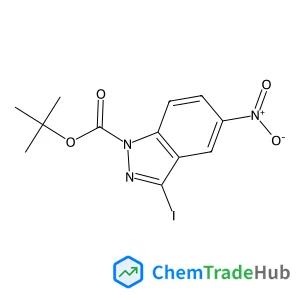
Tert-butyl 3-iodo-5-nitro-1H-indazole-1-carboxylate
CAS Number:
459133-69-8
Molecular Formula:
C12H12IN3O4
Pablo Nieto, David Müller, Alexander Sheldrick, Alan Günther, Otto Dopfer
The photochemical properties of flavins depend sensitively on their environment and are strongly modified by coordination with metal ions. Herein, the electronic spectra of cold complexes of the smallest flavin molecule (lumichrome, LC, C12N4O2H10) with alkali ions (M+LC, M = Li–Cs) are measured by photodissociation in the visible range (VISPD) in a cryogenic ion trap coupled to a tandem mass spectrometer and an electrospray ionization source. The observed vibronic spectra of all ions are assigned to the optically bright S1 ← S0 (ππ*) transition of the most stable O4 isomer of M+LC by comparison with quantum chemical calculations at the PBE0/cc-pVDZ level coupled to multidimensional Franck–Condon simulations. The rich vibronic spectra indicate substantial geometry changes upon S1 excitation. Large red shifts of the S1 origins upon metal complexation and progressions in the intermolecular in-plane metal stretch and bend modes demonstrate that the strength of the metal–flavin interaction in M+LC(O4) strongly increases by S1 excitation. The stronger M+⋯LC bond in the S1 state of M+LC(O4) is rationalized by the charge reorganization upon ππ* excitation of the LC chromophore. The computations confirm that the optical properties of LC can be strongly modulated by metalation via both the type and binding site of the metal ion.
A. V. Larin, L. Leherte, D. P. Vercauteren
DOI: 10.1039/B107243A
Stewart F. Parker, Kenneth P. J. Williams, Tim Smith, Manfred Bortz, Bernard Bertheville, Klaus Yvon
DOI: 10.1039/B109975B
Hiroshi Takahashi, Akira Matsuo, Ichiro Hatta
DOI: 10.1039/B110852B
Tsutomu Ioroi, Kazuaki Yasuda, Yoshinori Miyazaki
DOI: 10.1039/B111652E
F. Atadinç, C. Selçuki, L. Sari, V. Aviyente
DOI: 10.1039/B109970C
Sergio Ferro, Achille De Battisti
DOI: 10.1039/B109931K
Chika Minejima, Takayuki Ebata, Naohiko Mikami
DOI: 10.1039/B108039C
DOI: 10.1039/B110899A
DOI: 10.1039/B110887E
Weihong Wang, Michael J. Ezell, Alisa A. Ezell, Gennady Soskin, Barbara J. Finlayson-Pitts
DOI: 10.1039/B111557J
When handling 4-Methyl-6-(trifluoromethyl)quinoline (CAS: 40716-16-3), safety go...
4-(3,5-Difluorophenyl)aniline is an aromatic organic compound with the CAS numbe...
5-{[4-(Trifluoromethyl)phenyl]sulfanyl}-1,2,3-thiadiazole-4-carboxylic acid can ...
The market for 4-Benzylaniline hydrochloride (CAS: 6317-57-3) is steadily growin...
[3-(Diethylsulfamoyl)phenyl]boronic acid is generally considered safe when handl...
3-Bromo-2,5-dimethoxyaniline is mainly used in the pharmaceutical and chemical i...
N-Methyl-1-(5-methyl-1H-indol-3-yl)methanamine (CAS: 915922-67-7) is subject to ...
This compound is primarily used in the pharmaceutical industry for the synthesis...
2-Methyl-2-propanyl [(1S,3R)-3-aminocyclohexyl]carbamate (CAS: 1298101-47-9) sho...
Ethyl 2-bromo-4,4,4-trifluorobutanoate (CAS: 367-33-9) is utilized in the pharma...

Physical Chemistry Chemical Physics (PCCP) is an international journal co-owned by 19 physical chemistry and physics societies from around the world. This journal publishes original, cutting-edge research in physical chemistry, chemical physics and biophysical chemistry. To be suitable for publication in PCCP, articles must include significant innovation and/or insight into physical chemistry; this is the most important criterion that reviewers and Editors will judge against when evaluating submissions. The journal has a broad scope and welcomes contributions spanning experiment, theory, computation and data science. Topical coverage includes spectroscopy, dynamics, kinetics, statistical mechanics, thermodynamics, electrochemistry, catalysis, surface science, quantum mechanics, quantum computing and machine learning. Interdisciplinary research areas such as polymers and soft matter, materials, nanoscience, energy, surfaces/interfaces, and biophysical chemistry are welcomed if they demonstrate significant innovation and/or insight into physical chemistry. Joined experimental/theoretical studies are particularly appreciated when complementary and based on up-to-date approaches.
![(4aR,5S,6R,8aS)-5-[2-(3-Furyl)ethyl]-8a-(hydroxymethyl)-5,6-dimethyl-3,4,4a,5,6,7,8,8a-octahydro-1-naphthalenecarboxylic acid structure](https://static.chemtradehub.com/structs/184/18411-75-1-d4cd.webp "(4aR,5S,6R,8aS)-5-[2-(3-Furyl)ethyl]-8a-(hydroxymethyl)-5,6-dimethyl-3,4,4a,5,6,7,8,8a-octahydro-1-naphthalenecarboxylic acid structure")
![Methyl 3-({2'-[(E)-(hydroxyhydrazono)methyl]-4-biphenylyl}methyl)-2-oxo-2,3-dihydro-1H-benzimidazole-4-carboxylate structure](https://static.chemtradehub.com/structs/149/1499167-72-4-034a.webp "Methyl 3-({2'-[(E)-(hydroxyhydrazono)methyl]-4-biphenylyl}methyl)-2-oxo-2,3-dihydro-1H-benzimidazole-4-carboxylate structure")




