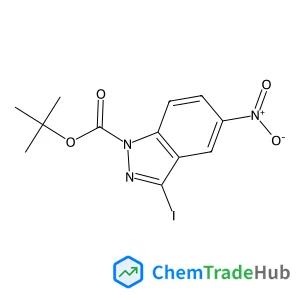
Tert-butyl 3-iodo-5-nitro-1H-indazole-1-carboxylate
CAS Number:
459133-69-8
Molecular Formula:
C12H12IN3O4
Huu Duc Luong, Thi Dung Pham, Yoshitada Morikawa
Using the density functional method, we investigated the crystal and electronic structures and the electrochemical properties of NaxVOPO4 (x = 0, 1) and explored the diffusion mechanism of Na ions in these materials. The van der Waals interaction was also taken into account to include the non-local electron correlation in the calculation of structural parameters and voltage. The diffusion of Na ions is treated as a process of the Na vacancy–positive small polaron complex in NaVOPO4 and the Na ion–negative small polaron complex in VOPO4, respectively. During the charging (discharging) process, the removal (insertion) of a Na ion would result in the formation of a positive (negative) small polaron at one of the two first nearest vanadium sites to the Na vacancy. Three elementary diffusion processes, including the single, crossing and parallel diffusion processes, are explored. It is found that the [010] direction is preferable for Na ion diffusion in both the charging and discharging processes. The influence of small polaron migration on Na ion diffusion in the charging state is negligible, whereas such effect is considerably strong in the discharging process. Moreover, while three elementary diffusion processes in NaVOPO4 require the same energy, the parallel diffusion process in VOPO4 is not preferred. The diffusion of Na vacancy accompanied by a positive polaron in the full charging process requires an activation energy of 395 meV, while the diffusion of Na ion accompanied by a negative polaron in the discharging state, VOPO4, has a higher activation energy of 627 meV. With a voltage and activation barrier similar to that of the olivine phosphate LiFePO4, these sodium-based materials are expected to be promising cathode materials for sodium ion batteries.
Gary C. Davies, Roger S. Hutton, Nicolas Millot, Simon J. F. Macdonald, Mike S. Anson, Ian B. Campbell
DOI: 10.1039/B110971E
Esa Isoniemi, Leonid Khriachtchev, Jan Lundell, Markku Räsänen
DOI: 10.1039/B110109A
Vladislav Papper, Vladimir Kharlanov, Wolfgang Rettig
DOI: 10.1039/B111681A
Stewart F. Parker, Kenneth P. J. Williams, Tim Smith, Manfred Bortz, Bernard Bertheville, Klaus Yvon
DOI: 10.1039/B109975B
V. V. Roddatis, V. L. Kuznetsov, Yu. V. Butenko, D. S. Su, R. Schlögl
DOI: 10.1039/B110487J
DOI: 10.1039/B109479C
Meike Wiedemann, Vera M. Fernandes de Lima, Wolfgang Hanke
DOI: 10.1039/B109166M
B. Bonelli, B. Civalleri, P. Ugliengo, Z. Gabelica, E. Garrone
DOI: 10.1039/B108577H
Tsutomu Ioroi, Kazuaki Yasuda, Yoshinori Miyazaki
DOI: 10.1039/B111652E
When handling 4-Methyl-6-(trifluoromethyl)quinoline (CAS: 40716-16-3), safety go...
4-(3,5-Difluorophenyl)aniline is an aromatic organic compound with the CAS numbe...
5-{[4-(Trifluoromethyl)phenyl]sulfanyl}-1,2,3-thiadiazole-4-carboxylic acid can ...
The market for 4-Benzylaniline hydrochloride (CAS: 6317-57-3) is steadily growin...
[3-(Diethylsulfamoyl)phenyl]boronic acid is generally considered safe when handl...
3-Bromo-2,5-dimethoxyaniline is mainly used in the pharmaceutical and chemical i...
N-Methyl-1-(5-methyl-1H-indol-3-yl)methanamine (CAS: 915922-67-7) is subject to ...
This compound is primarily used in the pharmaceutical industry for the synthesis...
2-Methyl-2-propanyl [(1S,3R)-3-aminocyclohexyl]carbamate (CAS: 1298101-47-9) sho...
Ethyl 2-bromo-4,4,4-trifluorobutanoate (CAS: 367-33-9) is utilized in the pharma...

Physical Chemistry Chemical Physics (PCCP) is an international journal co-owned by 19 physical chemistry and physics societies from around the world. This journal publishes original, cutting-edge research in physical chemistry, chemical physics and biophysical chemistry. To be suitable for publication in PCCP, articles must include significant innovation and/or insight into physical chemistry; this is the most important criterion that reviewers and Editors will judge against when evaluating submissions. The journal has a broad scope and welcomes contributions spanning experiment, theory, computation and data science. Topical coverage includes spectroscopy, dynamics, kinetics, statistical mechanics, thermodynamics, electrochemistry, catalysis, surface science, quantum mechanics, quantum computing and machine learning. Interdisciplinary research areas such as polymers and soft matter, materials, nanoscience, energy, surfaces/interfaces, and biophysical chemistry are welcomed if they demonstrate significant innovation and/or insight into physical chemistry. Joined experimental/theoretical studies are particularly appreciated when complementary and based on up-to-date approaches.
![Methyl 3-({2'-[(E)-(hydroxyhydrazono)methyl]-4-biphenylyl}methyl)-2-oxo-2,3-dihydro-1H-benzimidazole-4-carboxylate structure](https://static.chemtradehub.com/structs/149/1499167-72-4-034a.webp "Methyl 3-({2'-[(E)-(hydroxyhydrazono)methyl]-4-biphenylyl}methyl)-2-oxo-2,3-dihydro-1H-benzimidazole-4-carboxylate structure")