


![Imidazo[1,2-c]pyrimidine structure](https://static.chemtradehub.com/structs/274/274-78-2-8b4c.webp "Imidazo[1,2-c]pyrimidine structure")
A spectroscopic and ab initio study of the hydrogen peroxide–formic acid complex: hindering the internal motion of H2O2
Literature Information
Publication Date
2018-08-03
DOI
10.1039/C8CP03342K
Impact Factor
3.676
Authors
Leo Yuxiu Li, Nathan A. Seifert, Fan Xie, Matthias Heger, Yunjie Xu, Wolfgang Jäger
View Original
Abstract
The microwave spectrum of the hydrogen-bonded hydrogen peroxide–formic acid complex was measured in the range from 4 to 17 GHz. Assignment of transitions and analyses of the spectrum were supported by ab initio wavefunction and density functional calculations. The detected conformer features a seven-membered hydrogen-bonded ring, in which the H-atom of one hydroxyl group of H2O2 and the O-atom of the other OH group are a hydrogen bond donor and acceptor, respectively, to the carboxyl group of formic acid. The rotational transitions show a tunnelling splitting, which is attributed to a wagging-like motion of the free H-atom of H2O2 from above to below the heavy atom plane of formic acid. Transitions between tunneling states are driven by the change in dipole moment accompanying this motion and were measured and analyzed. Ab initio analyses of the tunneling path reveal an asymmetric potential, which reflects the (transiently) chiral nature of the complex.
Recommended Journals

Organic Process Research & Development

Chemistry Education Research and Practice

Current Opinion in Solid State & Materials Science

Russian Journal of Bioorganic Chemistry

Russian Chemical Bulletin

Nature Medicine

Drug Discovery Today

Russian Journal of Coordination Chemistry

Saudi Pharmaceutical Journal

Journal of Natural Medicines
Related Literature
X-ray diffraction and 13C solid-state NMR studies of the solvate of tetra(C-undecyl)calix[4]resorcinarene with dimethylacetamide
Lukasz Dobrzycki, Krzysztof Wozniak, Francesca Benevelli, Jacek Klinowski
2002-05-01
Paper
DOI: 10.1039/B107416B
Coadsorption of CO and O2 on small free gold cluster anions at cryogenic temperatures: Model complexes for catalytic CO oxidation
Jan Hagen, Liana D. Socaciu, Maryam Elijazyfer, Ueli Heiz, Thorsten M. Bernhardt, Ludger Wöste
2002-04-15
Communication
DOI: 10.1039/B201236G
Interaction between probe molecules and zeolites. Part I: Pair-wise addition scheme applied to the calculation of the interaction energy of CO and N2 adsorbed in Na4Ca4A
A. V. Larin, L. Leherte, D. P. Vercauteren
2002-04-29
Paper
DOI: 10.1039/B107243A
Fourier transform EPR study and quantum chemical calculations of dihydrofuran radicals formed by triplet sensitized electron transfer in aqueous solution
K. Bernhard, S. Naumov
2002-04-09
Paper
DOI: 10.1039/B109064J
The vacuum ultraviolet laser excitation spectra for free ion-pair (X+ + Y−) formation from jet-cooled I2 and ICl
Kenneth P. Lawley, Alexander C. Flexen, Robert R. J. Maier, Andreas Manck, Trevor Ridley, Robert J. Donovan
2002-03-21
Paper
DOI: 10.1039/B109558G
The effect of gravity on the rate of a simple neutralisation reaction in a small, open cylindrical vessel
David F. Fletcher
2002-03-19
Paper
DOI: 10.1039/B110795J
The effect of surface texture on total reflection of neutrons and X-rays from modified interfaces
Arach Goldar, Steve Roser, Arwel Hughes, Karen Edler, Michael C. Gerstenberg
2002-05-02
Paper
DOI: 10.1039/B200410K
XPS, XANES and EXAFS investigations of CuO/ZnO/Al2O3/ZrO2 mixed oxidecatalysts
Chinnakonda S. Gopinath, H. Yoshida, T. Hattori
2002-04-18
Paper
DOI: 10.1039/B109766K
Internal pressure of a thermodynamically ideal mixture and the excess internal pressure
2002-04-15
Paper
DOI: 10.1039/B110887E
You might also like
Compound Q&A
What precautions should be taken when handling 4-Methyl-6-(trifluoromethyl)quinoline (CAS: 40716-16-3)?
When handling 4-Methyl-6-(trifluoromethyl)quinoline (CAS: 40716-16-3), safety go...
40716-16-34-Methyl-6-(trifluor...
Compound Q&A
What is 4-(3,5-Difluorophenyl)aniline (CAS: 405058-00-6)?
4-(3,5-Difluorophenyl)aniline is an aromatic organic compound with the CAS numbe...
405058-00-64-(3,5-Difluoropheny...
Compound Q&A
How is 5-{[4-(Trifluoromethyl)phenyl]sulfanyl}-1,2,3-thiadiazole-4-carboxylic acid (CAS: 338982-07-3) typically synthesized?
5-{[4-(Trifluoromethyl)phenyl]sulfanyl}-1,2,3-thiadiazole-4-carboxylic acid can ...
338982-07-35-{[4-(Trifluorometh...
Compound Q&A
What is the market or research trend for 4-Benzylaniline hydrochloride (CAS: 6317-57-3)?
The market for 4-Benzylaniline hydrochloride (CAS: 6317-57-3) is steadily growin...
6317-57-34-Benzylaniline hydr...
Compound Q&A
Is [3-(Diethylsulfamoyl)phenyl]boronic acid (CAS: 871329-58-7) safe?
[3-(Diethylsulfamoyl)phenyl]boronic acid is generally considered safe when handl...
871329-58-7[3-(Diethylsulfamoyl...
Compound Q&A
What are the main uses of 3-Bromo-2,5-dimethoxyaniline (CAS: 115929-62-9)?
3-Bromo-2,5-dimethoxyaniline is mainly used in the pharmaceutical and chemical i...
115929-62-93-Bromo-2,5-dimethox...
Compound Q&A
What regulatory guidelines apply to N-Methyl-1-(5-methyl-1H-indol-3-yl)methanamine (CAS: 915922-67-7)?
N-Methyl-1-(5-methyl-1H-indol-3-yl)methanamine (CAS: 915922-67-7) is subject to ...
915922-67-7N-Methyl-1-(5-methyl...
Compound Q&A
What industries use Carbamic acid, N-[(5S)-5,6-diamino-6-oxohexyl]-, 1,1-dimethylethyl ester (CAS: 24828-96-4)?
This compound is primarily used in the pharmaceutical industry for the synthesis...
24828-96-4Carbamic acid, N-[(5...
Compound Q&A
How should 2-Methyl-2-propanyl [(1S,3R)-3-aminocyclohexyl]carbamate (CAS: 1298101-47-9) be stored?
2-Methyl-2-propanyl [(1S,3R)-3-aminocyclohexyl]carbamate (CAS: 1298101-47-9) sho...
1298101-47-92-Methyl-2-propanyl ...
Compound Q&A
What industries use Ethyl 2-bromo-4,4,4-trifluorobutanoate (CAS: 367-33-9)?
Ethyl 2-bromo-4,4,4-trifluorobutanoate (CAS: 367-33-9) is utilized in the pharma...
367-33-9Ethyl 2-bromo-4,4,4-...
Source Journal
Physical Chemistry Chemical Physics

CiteScore:
5.5
Self-citation Rate:
10.3%
Articles per Year:
3036
Physical Chemistry Chemical Physics (PCCP) is an international journal co-owned by 19 physical chemistry and physics societies from around the world. This journal publishes original, cutting-edge research in physical chemistry, chemical physics and biophysical chemistry. To be suitable for publication in PCCP, articles must include significant innovation and/or insight into physical chemistry; this is the most important criterion that reviewers and Editors will judge against when evaluating submissions. The journal has a broad scope and welcomes contributions spanning experiment, theory, computation and data science. Topical coverage includes spectroscopy, dynamics, kinetics, statistical mechanics, thermodynamics, electrochemistry, catalysis, surface science, quantum mechanics, quantum computing and machine learning. Interdisciplinary research areas such as polymers and soft matter, materials, nanoscience, energy, surfaces/interfaces, and biophysical chemistry are welcomed if they demonstrate significant innovation and/or insight into physical chemistry. Joined experimental/theoretical studies are particularly appreciated when complementary and based on up-to-date approaches.
Recommended Compounds
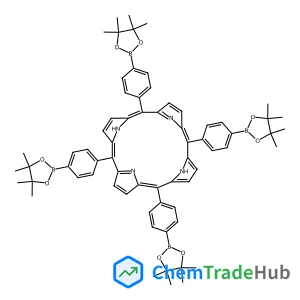
5,10,15,20-tetrakis(4-boronic acid pinacol ester phenyl) porphyrin
CAS Number:
1332748-00-1
Molecular Formula:
C68H74B4N4O8
Recommended Suppliers






Disclaimer
This page provides academic journal information for reference and research purposes only. We are not affiliated with any journal publishers and do not handle publication submissions. For publication-related inquiries, please contact the respective journal publishers directly.
If you notice any inaccuracies in the information displayed, please contact us at support@chemtradehub.com. We will promptly review and address your concerns.