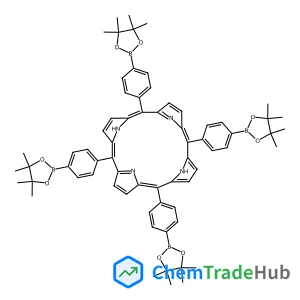
5,10,15,20-tetrakis(4-boronic acid pinacol ester phenyl) porphyrin
CAS Number:
1332748-00-1
Molecular Formula:
C68H74B4N4O8
San-Dong Guo, Jun Dong, Jiang-Tao Liu
An increasing number of two-dimensional (2D) materials have already been achieved experimentally or predicted theoretically, which have potential applications in nano- and opto-electronics. Various applications of electronic devices are closely related to their thermal transport properties. In this work, the strain dependence of phonon transport in monolayer SiC with a perfect planar hexagonal honeycomb structure is investigated by solving the linearized phonon Boltzmann equation. It is found that the room-temperature lattice thermal conductivity (κL) of monolayer SiC is two orders of magnitude lower than that of graphene. The low κL is due to small group velocities and short phonon lifetimes, which can also be explained by the polarized covalent bond due to large charge transfer from Si to C atoms. In a considered strain range, it is proved that the SiC monolayer is mechanically and dynamically stable. With increased tensile strain, the κL of the SiC monolayer shows an unusual nonmonotonic up-and-down behavior, which is due to the competition between the change of phonon group velocities and phonon lifetimes of low frequency phonon modes. At low strain values (<8%), the phonon lifetime enhancement induces the increased κL, while at high strain values (>8%) the reduction of group velocities as well as the decrease of the phonon lifetimes are the major mechanisms responsible for decreased κL. Our works further enrich the studies on the phonon transport properties of 2D materials with a perfect planar hexagonal honeycomb structure, and motivate further experimental studies.
Sankar Muniappan, Sophia Lipstman, Israel Goldberg
DOI: 10.1039/B719625C
Shinobu Takizawa, Tomomi Katayama, Chiaki Kameyama, Kiyotaka Onitsuka, Takeyuki Suzuki, Takeshi Yanagida, Tomoji Kawai, Hiroaki Sasai
DOI: 10.1039/B717068H
Fiorella L. Callari, Salvatore Sortino
DOI: 10.1039/B800132D
Elisa Biavardi, Gionata Battistini, Marco Montalti, Roger M. Yebeutchou, Luca Prodi, Enrico Dalcanale
DOI: 10.1039/B801729H
Bronwyn H. Gillon, Brian O. Patrick, Derek P. Gates
DOI: 10.1039/B719199E
Kazuyuki Nobusawa, Atsushi Ikeda, Yasunori Tanaka, Mineo Hashizume, Jun-ichi Kikuchi, Michihiro Shirakawa, Tatsuya Kitahara, Norifumi Fujita, Seiji Shinkai
DOI: 10.1039/B715960A
Suobo Zhang, Zhaohui Su
DOI: 10.1039/B801784K
Werner Fudickar, Torsten Linker
DOI: 10.1039/B719637G
Jye-Shane Yang, Jyu-Lun Yan
DOI: 10.1039/B713428M
When handling 4-Methyl-6-(trifluoromethyl)quinoline (CAS: 40716-16-3), safety go...
4-(3,5-Difluorophenyl)aniline is an aromatic organic compound with the CAS numbe...
5-{[4-(Trifluoromethyl)phenyl]sulfanyl}-1,2,3-thiadiazole-4-carboxylic acid can ...
The market for 4-Benzylaniline hydrochloride (CAS: 6317-57-3) is steadily growin...
[3-(Diethylsulfamoyl)phenyl]boronic acid is generally considered safe when handl...
3-Bromo-2,5-dimethoxyaniline is mainly used in the pharmaceutical and chemical i...
N-Methyl-1-(5-methyl-1H-indol-3-yl)methanamine (CAS: 915922-67-7) is subject to ...
This compound is primarily used in the pharmaceutical industry for the synthesis...
2-Methyl-2-propanyl [(1S,3R)-3-aminocyclohexyl]carbamate (CAS: 1298101-47-9) sho...
Ethyl 2-bromo-4,4,4-trifluorobutanoate (CAS: 367-33-9) is utilized in the pharma...

Physical Chemistry Chemical Physics (PCCP) is an international journal co-owned by 19 physical chemistry and physics societies from around the world. This journal publishes original, cutting-edge research in physical chemistry, chemical physics and biophysical chemistry. To be suitable for publication in PCCP, articles must include significant innovation and/or insight into physical chemistry; this is the most important criterion that reviewers and Editors will judge against when evaluating submissions. The journal has a broad scope and welcomes contributions spanning experiment, theory, computation and data science. Topical coverage includes spectroscopy, dynamics, kinetics, statistical mechanics, thermodynamics, electrochemistry, catalysis, surface science, quantum mechanics, quantum computing and machine learning. Interdisciplinary research areas such as polymers and soft matter, materials, nanoscience, energy, surfaces/interfaces, and biophysical chemistry are welcomed if they demonstrate significant innovation and/or insight into physical chemistry. Joined experimental/theoretical studies are particularly appreciated when complementary and based on up-to-date approaches.
![Methyl 3-({2'-[(E)-(hydroxyhydrazono)methyl]-4-biphenylyl}methyl)-2-oxo-2,3-dihydro-1H-benzimidazole-4-carboxylate structure](https://static.chemtradehub.com/structs/149/1499167-72-4-034a.webp "Methyl 3-({2'-[(E)-(hydroxyhydrazono)methyl]-4-biphenylyl}methyl)-2-oxo-2,3-dihydro-1H-benzimidazole-4-carboxylate structure")
![2-[(5Z,8Z,11Z,14Z)-5,8,11,14-Icosatetraen-1-yloxy]-1,3-propanediol structure](https://static.chemtradehub.com/structs/222/222723-55-9-0348.webp "2-[(5Z,8Z,11Z,14Z)-5,8,11,14-Icosatetraen-1-yloxy]-1,3-propanediol structure")