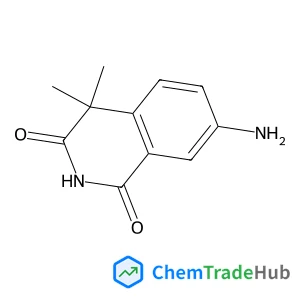
1,3(2H,4H)-Isoquinolinedione, 7-amino-4,4-dimethyl-
CAS Number:
14576-22-8
Molecular Formula:
C11H12N2O2
Jundong Li, Yilin Ye, Yandong Zhang
Pyrrolidines are privileged substructures of numerous bioactive natural products and drugs. How to synthesize these important synthetic targets in a more efficient manner is a hot research topic. Plenty of novel strategies and methods have been developed in recent years. Among them, cycloaddition and annulation strategies are the most efficient methods for the construction of multisubstituted pyrrolidines in terms of atom economy, stereoselectivity, diversity of products, and especially, their potential for asymmetric synthesis. These advantages have been well demonstrated by their applications in the syntheses of pyrrolidine-containing alkaloids. In this review, we highlight both the reaction and strategy development and synthetic applications from 2008 to June of 2017. This review covers 1,3-dipolar cycloadditions, formal [3 + 2] cycloadditions/annulations, and other interesting cycloaddition or annulation strategies to illustrate a so-called “reaction-based” strategy for the total synthesis of related natural products.

Angewandte Chemie International Edition

European Journal of Organic Chemistry

Molecular Diversity

Mini-Reviews in Medicinal Chemistry

Journal of Enzyme inhibition and Medicinal Chemistry

Molecules

Nature Reviews Drug Discovery

Advanced Engineering Materials

Physical Chemistry Chemical Physics

Coloration Technology
D. Carta, M. F. Casula, P. Floris, A. Falqui, G. Mountjoy, A. Boni, C. Sangregorio, A. Corrias
DOI: 10.1039/B922646J
I. García Cuesta, J. Sánchez Marín, A. Sánchez de Merás, P. Lazzeretti
DOI: 10.1039/B925241J
Fei Yang, Yukina Takahashi, Nobuyuki Sakai, Tetsu Tatsuma
DOI: 10.1039/B925146D
Rafal Panek, Josef Granwehr, James Leggett, Walter Köckenberger
DOI: 10.1039/C002710N
Yoh Matsuki, Hiroki Takahashi, Keisuke Ueda, Toshitaka Idehara, Isamu Ogawa, Mitsuru Toda, Hideo Akutsu, Toshimichi Fujiwara
DOI: 10.1039/C002268C
Nuria Queralto, Fernando Battaglini, Omar Azzaroni
DOI: 10.1039/C000797H
Tsutomu Ioroi, Hiroyuki Kageyama, Tomoki Akita, Kazuaki Yasuda
DOI: 10.1039/B923218D
Patrick W. Fowler, Jean-Paul Malrieu
DOI: 10.1039/B923893J
Jiangtian Li, Limin Guo, Jianlin Shi
DOI: 10.1039/B925431E
J. Steven Ogden, David C. Harrowven, Robert S. Wyatt, Francesco Ferrante, John P. Cannady
DOI: 10.1039/C001453B
When handling 4-Methyl-6-(trifluoromethyl)quinoline (CAS: 40716-16-3), safety go...
4-(3,5-Difluorophenyl)aniline is an aromatic organic compound with the CAS numbe...
5-{[4-(Trifluoromethyl)phenyl]sulfanyl}-1,2,3-thiadiazole-4-carboxylic acid can ...
The market for 4-Benzylaniline hydrochloride (CAS: 6317-57-3) is steadily growin...
[3-(Diethylsulfamoyl)phenyl]boronic acid is generally considered safe when handl...
3-Bromo-2,5-dimethoxyaniline is mainly used in the pharmaceutical and chemical i...
N-Methyl-1-(5-methyl-1H-indol-3-yl)methanamine (CAS: 915922-67-7) is subject to ...
This compound is primarily used in the pharmaceutical industry for the synthesis...
2-Methyl-2-propanyl [(1S,3R)-3-aminocyclohexyl]carbamate (CAS: 1298101-47-9) sho...
Ethyl 2-bromo-4,4,4-trifluorobutanoate (CAS: 367-33-9) is utilized in the pharma...

Organic Chemistry Frontiers publishes high-quality research from across organic chemistry. Emphases are placed on studies that make significant contributions to the field of organic chemistry by reporting either new or significantly improved protocols or methodologies. Topics include, but are not limited to the following: Organic synthesis Development of synthetic methodologies Catalysis Natural products Functional organic materials Supramolecular and macromolecular chemistry Physical and computational organic chemistry
phosphoryl}methyl 4-methylbenzenesulfonate structure](https://static.chemtradehub.com/structs/864/864068-45-1-ba7c.webp "{[3-(Hexadecyloxy)propoxy](hydroxy)phosphoryl}methyl 4-methylbenzenesulfonate structure")