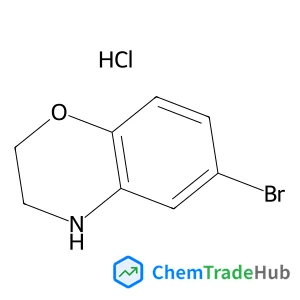
6-Bromo-3,4-dihydro-2H-1,4-benzoxazine hydrochloride (1:1)
CAS Number:
1260803-10-8
Molecular Formula:
C8H9BrClNO
Tingting Xia, Zhenyi Hu, Wenzhi Ji, Shujie Zhang, Hui Shi, Chenguang Liu, Bo Pang, Guijian Liu, Xuebin Liao
Fragment-based drug discovery has recently drawn great attention from both industry and academia. Fragment library design is critical to success in this field. Herein we report our facile access to pyrazole derivatives via a cascade reaction involving a double C(sp3)–H functionalization and dehydrogenative aromatization sequence. Based on the newly developed method, we completed the synthesis of the Indian herbal medicine, withasomnine, in only two steps. In addition, inspired by the different biological activities of withasomnine, this cascade reaction sequence enables us to quickly build up a natural product-based fragment library. The compounds in this fragment library exhibit a variety of biological activities and demonstrate high hit rates on initial biological screening against COX-2.
J. Steven Ogden, David C. Harrowven, Robert S. Wyatt, Francesco Ferrante, John P. Cannady
DOI: 10.1039/C001453B
Iván Bravo, Yolanda Díaz-de-Mera, Alfonso Aranda, Kevin Smith, Keith P. Shine, George Marston
DOI: 10.1039/B923092K
Kateřina Maliňáková, Radek Marek, Jaromír Marek, Michal Hocek, Michal Straka
DOI: 10.1039/B921383J
Sean Bowen, Christian Hilty
DOI: 10.1039/C002316G
Pedro C. Gómez, Oscar Gálvez, Rafael G. Mosteo, Cristina Puzzarini, R. Escribano
DOI: 10.1039/B924890K
Nuria Queralto, Fernando Battaglini, Omar Azzaroni
DOI: 10.1039/C000797H
Roland Schmidt, Sebastian Hagen, Daniel Brete, Robert Carley, Cornelius Gahl, Jadranka Dokić, Peter Saalfrank, Stefan Hecht, Petra Tegeder
DOI: 10.1039/B924409C
Glen R. Jenness, Ozan Karalti, Kenneth D. Jordan
DOI: 10.1039/C000988A
When handling 4-Methyl-6-(trifluoromethyl)quinoline (CAS: 40716-16-3), safety go...
4-(3,5-Difluorophenyl)aniline is an aromatic organic compound with the CAS numbe...
5-{[4-(Trifluoromethyl)phenyl]sulfanyl}-1,2,3-thiadiazole-4-carboxylic acid can ...
The market for 4-Benzylaniline hydrochloride (CAS: 6317-57-3) is steadily growin...
[3-(Diethylsulfamoyl)phenyl]boronic acid is generally considered safe when handl...
3-Bromo-2,5-dimethoxyaniline is mainly used in the pharmaceutical and chemical i...
N-Methyl-1-(5-methyl-1H-indol-3-yl)methanamine (CAS: 915922-67-7) is subject to ...
This compound is primarily used in the pharmaceutical industry for the synthesis...
2-Methyl-2-propanyl [(1S,3R)-3-aminocyclohexyl]carbamate (CAS: 1298101-47-9) sho...
Ethyl 2-bromo-4,4,4-trifluorobutanoate (CAS: 367-33-9) is utilized in the pharma...

Organic Chemistry Frontiers publishes high-quality research from across organic chemistry. Emphases are placed on studies that make significant contributions to the field of organic chemistry by reporting either new or significantly improved protocols or methodologies. Topics include, but are not limited to the following: Organic synthesis Development of synthetic methodologies Catalysis Natural products Functional organic materials Supramolecular and macromolecular chemistry Physical and computational organic chemistry
![(2E)-3-(3-Chlorophenyl)-N-{2-[4-(methylsulfonyl)-1-piperazinyl]-2-oxoethyl}acrylamide structure](https://static.chemtradehub.com/structs/250/2505001-54-5-c1e9.webp "(2E)-3-(3-Chlorophenyl)-N-{2-[4-(methylsulfonyl)-1-piperazinyl]-2-oxoethyl}acrylamide structure")