












Rearranged limonoids with unique 6/5/6/5 tetracarbocyclic skeletons from Toona ciliata and biomimetic structure divergence
Literature Information
Publication Date
2017-09-06
DOI
10.1039/C7QO00678K
Impact Factor
5.281
Authors
Jun Luo, Wan-Sha Huang, Sheng-Mou Hu, Pan-Pan Zhang, Xu-Wei Zhou, Xiao-Bing Wang, Ming-Hua Yang, Jian-Guang Luo, Chen Wang, Chang Liu, He-Quan Yao, Can Zhang, Hong-Bin Sun, Yi-Jun Chen, Ling-Yi Kong
View Original
Abstract
Tooniliatone A (1), a novel limonoid with an unprecedented 6/5/6/5 tetracarbocyclic skeleton was isolated from Toona ciliata Roem. var. yunnanensis. Its rearranged ring-seco backbone was proposed to biosynthetically originate from co-isolated known toonacilin (3) via a rare electron-deficient alkene electrophilic cyclization and 1,2-alkyl shift sequence. The acid-catalyzed biomimetic conversion of 3 not only successfully afforded 1 but also another novel 6/5/6/5 tetracarbocyclic skeleton, tooniliatone B (2). The priority of 2 in this biomimetic conversion, the existence of 1 and the absence of 2 in the crude extract suggested the biosynthetic selectivity of 1 from 3. The divergent biomimetic sequence, based on a carbocation from an epoxide moiety, provided an inspiration for constructing complex polycyclic carbon skeletons.
Related Literature
Relative stability of thiol and selenol based SAMs on Au(111) — exchange experiments
Katarzyna Szelągowska-Kunstman, Piotr Cyganik, Bjorn Schüpbach, Andreas Terfort
2010-02-24
Paper
DOI: 10.1039/B923274P
Micro-FTIR study of soot chemical composition—evidence of aliphatic hydrocarbons on nascent soot surfaces
Jeremy P. Cain, Paul L. Gassman, Hai Wang, Alexander Laskin
2010-03-19
Paper
DOI: 10.1039/B924344E
Trityl biradicals and 13C dynamic nuclear polarization
Sven Macholl, Haukur Jóhannesson, Jan Henrik Ardenkjaer-Larsen
2010-05-10
Paper
DOI: 10.1039/C002699A
Structure and dynamics of electrical double layers in organic electrolytes
Guang Feng, Jingsong Huang, Bobby G. Sumpter, Vincent Meunier, Rui Qiao
2010-03-30
Paper
DOI: 10.1039/C000451K
Rules and trends of metal cation driven hydride-transfer mechanisms in metal amidoboranes
Dong Young Kim, Han Myoung Lee, Jongcheol Seo, Seung Koo Shin, Kwang S. Kim
2010-04-06
Paper
DOI: 10.1039/B925235E
Conformational behaviors of a charged-neutral star micelle in salt-free solution
2010-04-20
Paper
DOI: 10.1039/B924281C
Reactivity of the β-AlF3(100) surface: defects, fluorine mobility and catalysis of the CCl2F2 dismutation reaction
C. L. Bailey, S. Mukhopadhyay, A. Wander, B. G. Searle, J. M. Carr
2010-04-13
Paper
DOI: 10.1039/B920542J
Photostability and solvation: photodynamics of microsolvated zwitterionic glycine
2010-02-11
Paper
DOI: 10.1039/B925246K
The chemical roots of the matching polynomial
Patrick W. Fowler, Jean-Paul Malrieu
2010-04-06
Paper
DOI: 10.1039/B923893J
On the electronic and geometrical structure of the trans- and cis-isomer of tetra-tert-butyl-azobenzene on Au(111)
Roland Schmidt, Sebastian Hagen, Daniel Brete, Robert Carley, Cornelius Gahl, Jadranka Dokić, Peter Saalfrank, Stefan Hecht, Petra Tegeder
2010-03-23
Paper
DOI: 10.1039/B924409C
You might also like
Compound Q&A
What precautions should be taken when handling 4-Methyl-6-(trifluoromethyl)quinoline (CAS: 40716-16-3)?
When handling 4-Methyl-6-(trifluoromethyl)quinoline (CAS: 40716-16-3), safety go...
40716-16-34-Methyl-6-(trifluor...
Compound Q&A
What is 4-(3,5-Difluorophenyl)aniline (CAS: 405058-00-6)?
4-(3,5-Difluorophenyl)aniline is an aromatic organic compound with the CAS numbe...
405058-00-64-(3,5-Difluoropheny...
Compound Q&A
How is 5-{[4-(Trifluoromethyl)phenyl]sulfanyl}-1,2,3-thiadiazole-4-carboxylic acid (CAS: 338982-07-3) typically synthesized?
5-{[4-(Trifluoromethyl)phenyl]sulfanyl}-1,2,3-thiadiazole-4-carboxylic acid can ...
338982-07-35-{[4-(Trifluorometh...
Compound Q&A
What is the market or research trend for 4-Benzylaniline hydrochloride (CAS: 6317-57-3)?
The market for 4-Benzylaniline hydrochloride (CAS: 6317-57-3) is steadily growin...
6317-57-34-Benzylaniline hydr...
Compound Q&A
Is [3-(Diethylsulfamoyl)phenyl]boronic acid (CAS: 871329-58-7) safe?
[3-(Diethylsulfamoyl)phenyl]boronic acid is generally considered safe when handl...
871329-58-7[3-(Diethylsulfamoyl...
Compound Q&A
What are the main uses of 3-Bromo-2,5-dimethoxyaniline (CAS: 115929-62-9)?
3-Bromo-2,5-dimethoxyaniline is mainly used in the pharmaceutical and chemical i...
115929-62-93-Bromo-2,5-dimethox...
Compound Q&A
What regulatory guidelines apply to N-Methyl-1-(5-methyl-1H-indol-3-yl)methanamine (CAS: 915922-67-7)?
N-Methyl-1-(5-methyl-1H-indol-3-yl)methanamine (CAS: 915922-67-7) is subject to ...
915922-67-7N-Methyl-1-(5-methyl...
Compound Q&A
What industries use Carbamic acid, N-[(5S)-5,6-diamino-6-oxohexyl]-, 1,1-dimethylethyl ester (CAS: 24828-96-4)?
This compound is primarily used in the pharmaceutical industry for the synthesis...
24828-96-4Carbamic acid, N-[(5...
Compound Q&A
How should 2-Methyl-2-propanyl [(1S,3R)-3-aminocyclohexyl]carbamate (CAS: 1298101-47-9) be stored?
2-Methyl-2-propanyl [(1S,3R)-3-aminocyclohexyl]carbamate (CAS: 1298101-47-9) sho...
1298101-47-92-Methyl-2-propanyl ...
Compound Q&A
What industries use Ethyl 2-bromo-4,4,4-trifluorobutanoate (CAS: 367-33-9)?
Ethyl 2-bromo-4,4,4-trifluorobutanoate (CAS: 367-33-9) is utilized in the pharma...
367-33-9Ethyl 2-bromo-4,4,4-...
Source Journal
Organic Chemistry Frontiers

CiteScore:
7.8
Self-citation Rate:
8.7%
Articles per Year:
724
Organic Chemistry Frontiers publishes high-quality research from across organic chemistry. Emphases are placed on studies that make significant contributions to the field of organic chemistry by reporting either new or significantly improved protocols or methodologies. Topics include, but are not limited to the following: Organic synthesis Development of synthetic methodologies Catalysis Natural products Functional organic materials Supramolecular and macromolecular chemistry Physical and computational organic chemistry
Recommended Compounds

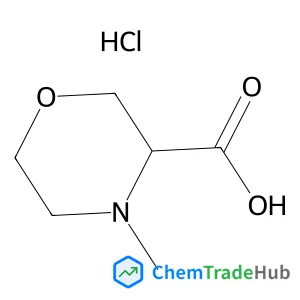
4-Methyl-3-morpholinecarboxylic acid hydrochloride (1:1)
CAS Number:
1240518-90-4
Molecular Formula:
C6H12ClNO3

Recommended Suppliers




Disclaimer
This page provides academic journal information for reference and research purposes only. We are not affiliated with any journal publishers and do not handle publication submissions. For publication-related inquiries, please contact the respective journal publishers directly.
If you notice any inaccuracies in the information displayed, please contact us at support@chemtradehub.com. We will promptly review and address your concerns.