












Diffusion ordered spectroscopy (DOSY) as applied to polymers
Literature Information
Publication Date
2017-10-25
DOI
10.1039/C7PY01577A
Impact Factor
5.582
Authors
View Original
Abstract
Diffusion ordered spectroscopy (DOSY) is a well established NMR method that reports diffusion coefficients for individual resonances in NMR spectra. DOSY is primarily used to analyse mixtures of small molecules and the oligomeric state of biomolecules. DOSY has also been used to analyse polymers and investigate micellization properties but different acquisition and processing parameters are recommended for polymers. In particular, the molecular weight dispersion of polymers and micelles are at odds with the physical limits of DOSY. Confidence in the quality of published DOSY data is lowered when critical parameters are poorly optimized or not reported. This tutorial provides a ‘top ten’ of DOSY parameters, an explanation of their source and importance, as well as suggested starting parameters and optimization for polymer/micelle samples. By following these guidelines, DOSY can emerge from being an occasional method to confirm data obtained from other experimental techniques, to one that provides strong physical evidence in its own right as the originators of DOSY intended.
Related Literature
Model-based design of the polymer microstructure: bridging the gap between polymer chemistry and engineering
Paul H. M. Van Steenberge, Pieter Derboven, Marie-Françoise Reyniers, Guy B. Marin
2015-08-20
Review Article
DOI: 10.1039/C5PY01069A
Continuous flow SET-LRP in the presence of P(VDF-co-CTFE) as macroinitiator in a copper tubular reactor
Ning Zhu, Xin Hu, Yajun Zhang, Kai Zhang, Zhenjiang Li, Kai Guo
2015-11-09
Paper
DOI: 10.1039/C5PY01728A
RAFT/MADIX polymerization of N-vinylcaprolactam in water–ethanol solvent mixtures
Ine Van Nieuwenhove, Samarendra Maji, Mamoni Dash, Sandra Van Vlierberghe, Richard Hoogenboom, Peter Dubruel
2017-03-28
Communication
DOI: 10.1039/C6PY02224C
Entropically-driven ring-opening metathesis polymerization (ED-ROMP) of macrocyclic olefins prepared from deoxycholic acid to give functionalized polymers‡
Philip Hodge, Abdel Chakiri
2015-04-30
Paper
DOI: 10.1039/C5PY00272A
One-pot synthesis of poly(vinylidene fluoride) methacrylate macromonomers via thia-Michael addition
Marc Guerre, Bruno Ameduri, Vincent Ladmiral
2015-11-03
Paper
DOI: 10.1039/C5PY01651G
Post-polymerization modification of poly(vinyl ether)s: a Ru-catalyzed oxidative synthesis of poly(vinyl ester)s and poly(propenyl ester)s
Di Liu
2015-10-20
Paper
DOI: 10.1039/C5PY01409C
Controlled radical polymerization and in-depth mass-spectrometric characterization of poly(ionic liquid)s and their photopatterning on surfaces
Birgit Huber, Vanessa Trouillet, Steffen M. Weidner, Leonie Barner, Peter W. Roesky, Jiayin Yuan
2015-10-26
Paper
DOI: 10.1039/C5PY01320H
You might also like
Compound Q&A
What are the main uses of 4-Nitrophenyl phosphate disodium salt hexahydrate (CAS: 333338-18-4)?
4-Nitrophenyl phosphate disodium salt hexahydrate is primarily used as a substra...
333338-18-44-Nitrophenyl phosph...
Compound Q&A
What are the main uses of 2-(Trifluoromethyl)-1,3-oxazole-4-carboxylic Acid (CAS: 1060816-01-4)?
2-(Trifluoromethyl)-1,3-oxazole-4-carboxylic Acid (CAS: 1060816-01-4) is widely ...
1060816-01-42-(Trifluoromethyl)-...
Compound Q&A
How should 2-Fluoro-4-biphenylcarboxylic acid (CAS: 137045-30-8) be stored?
2-Fluoro-4-biphenylcarboxylic acid should be stored in a cool, dry place at room...
137045-30-82-Fluoro-4-biphenylc...
Compound Q&A
What industries use Prednisolone-21-Carboxylic Acid (CAS: 61549-70-0)?
Prednisolone-21-Carboxylic Acid is primarily used in the pharmaceutical industry...
61549-70-0Prednisolone-21-Carb...
Compound Q&A
How should 4-(Hydrazinomethyl)-1,2,3-benzenetriol (CAS: 3614-72-0) be stored?
4-(Hydrazinomethyl)-1,2,3-benzenetriol (CAS: 3614-72-0) should be stored in a co...
3614-72-04-(Hydrazinomethyl)-...
Compound Q&A
What industries use 4-Amino-1-methyl-1H-pyrazole-5-carboxylic acid hydrochloride (CAS: 92534-70-8)?
4-Amino-1-methyl-1H-pyrazole-5-carboxylic acid hydrochloride (CAS: 92534-70-8) i...
92534-70-84-Amino-1-methyl-1H-...
Compound Q&A
What regulatory guidelines apply to dehydropachymic acid (CAS: 77012-31-8)?
Dehydropachymic acid (CAS: 77012-31-8) is regulated by various agencies. It fall...
77012-31-8Dehydropachymic acid
Compound Q&A
What is the market or research trend for 6-[(2,2-Dimethylpropanoyl)amino]nicotinic acid (CAS: 898561-66-5)?
The market and research trends for 6-[(2,2-Dimethylpropanoyl)amino]nicotinic aci...
898561-66-56-[(2,2-Dimethylprop...
Compound Q&A
How should 1,10-Phenanthroline-2,9-dicarbaldehyde (CAS: 57709-62-3) be stored?
1,10-Phenanthroline-2,9-dicarbaldehyde should be stored in a cool, dry place awa...
57709-62-31,10-Phenanthroline-...
Compound Q&A
How is 5-Carbamoyl-11-oxo-10,11-dihydro-5H-dibenzo[b,f]azepin-10-yl acetate (CAS: 113952-21-9) typically synthesized?
5-Carbamoyl-11-oxo-10,11-dihydro-5H-dibenzo[b,f]azepin-10-yl acetate can be synt...
113952-21-95-Carbamoyl-11-oxo-1...
Source Journal
Polymer Chemistry

CiteScore:
8.6
Self-citation Rate:
7.3%
Articles per Year:
457
Polymer Chemistry welcomes submissions in all areas of polymer science that have a strong focus on macromolecular chemistry. Manuscripts may cover a broad range of fields, yet no direct application focus is required.
Recommended Compounds
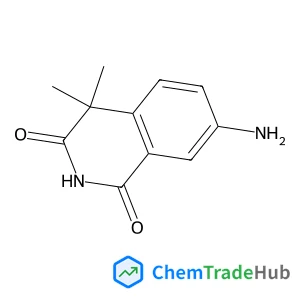
1,3(2H,4H)-Isoquinolinedione, 7-amino-4,4-dimethyl-
CAS Number:
14576-22-8
Molecular Formula:
C11H12N2O2

cis-3-Amino-1-(trifluoromethyl)cyclobutanol hydrochloride (1:1)
CAS Number:
1408075-16-0
Molecular Formula:
C5H9ClF3NO
phosphoryl}methyl 4-methylbenzenesulfonate structure](https://static.chemtradehub.com/structs/864/864068-45-1-ba7c.webp "{[3-(Hexadecyloxy)propoxy](hydroxy)phosphoryl}methyl 4-methylbenzenesulfonate structure")
{[3-(Hexadecyloxy)propoxy](hydroxy)phosphoryl}methyl 4-methylbenzenesulfonate
CAS Number:
864068-45-1
Molecular Formula:
C27H49O7PS
Recommended Suppliers





Disclaimer
This page provides academic journal information for reference and research purposes only. We are not affiliated with any journal publishers and do not handle publication submissions. For publication-related inquiries, please contact the respective journal publishers directly.
If you notice any inaccuracies in the information displayed, please contact us at support@chemtradehub.com. We will promptly review and address your concerns.