












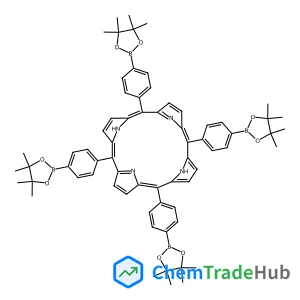
5,10,15,20-tetrakis(4-boronic acid pinacol ester phenyl) porphyrin
CAS Number:
1332748-00-1
Molecular Formula:
C68H74B4N4O8
Yueqian Fan, Juan Chen, Le Yu, Anyang Li, Gaohong Zhai, Yibo Lei, Chaoyuan Zhu
Single methyl group substitution on the p-position of the phenyl ring (tt-DPB-me1) or the conjugated CC bond (tt-DPB-me2) has been found to enhance the photoisomerization efficiency for two trans,trans-1,4-diphenyl-1,3-butadiene (tt-DPB) derivatives by performing direct ab initio trajectory surface hopping dynamics simulations. With implementation of the Zhu–Nakamura global switching algorithm, on-the-fly trajectory surface hopping dynamics simulations based on the ground state and first excited state potential energies and their gradients calculated by the two state averaged complete active space self-consistent field method with basis set 6-31G were propagated up to 3000 femtoseconds. Four-hundred sampling trajectories have been performed for both tt-DPB-me1 and tt-DPB-me2, and five distinctive photoisomerization pathways were observed for both of them. Among which, One Bond Flipping (OBF) and Hula-Twist (HT) are the dominant photoisomerization mechanisms. The lifetime of the S1 state is estimated to be 1423.0 fs (819.0 fs), and the photoisomerization quantum yields are 0.088 (0.378) in tt → ct, 0.070 (0.015) in tt → tc and 0.073 (0.065) in tt → cc for tt-DPB-me1 (tt-DPB-me2). By analyzing the dynamics simulation data, it can be concluded that closer methyl substitution with respect to the central CC double bond results in a higher percentage of the corresponding photoisomerization products. The present simulation results are in agreement with the ultrafast spectroscopy measurements, which unveil the photoisomerization mechanisms of tt-DPB derivatives and present useful physical insights on how to tune the photoisomerization of the substituted DPB.
Kosaku Sakeda, Tadashi Suzuki, Yoshihisa Matsushita, Teijiro Ichimura
DOI: 10.1039/B111406A
Gary Knight, A. R. Ravishankara, James B. Burkholder
DOI: 10.1039/B108904H
Hee-Seung Lee, Anne B. McCoy
DOI: 10.1039/B110963D
Stefan Kaskel, Klaus Schlichte, Bodo Zibrowius
DOI: 10.1039/B109708N
David Delaere, Minh Tho Nguyen, Luc G. Vanquickenborne
DOI: 10.1039/B109008A
P. Larrégaray, L. Bonnet, J. C. Rayez
DOI: 10.1039/B109739N
Giuseppe D'Amico, Marcel Snels, Hans Hollenstein, Martin Quack
DOI: 10.1039/B110919G
J. Lee, W. B. Wang, M. S. Zei, G. Ertl
DOI: 10.1039/B109547A
DOI: 10.1039/B107802J
Weihong Wang, Michael J. Ezell, Alisa A. Ezell, Gennady Soskin, Barbara J. Finlayson-Pitts
DOI: 10.1039/B111557J
When handling 4-Methyl-6-(trifluoromethyl)quinoline (CAS: 40716-16-3), safety go...
4-(3,5-Difluorophenyl)aniline is an aromatic organic compound with the CAS numbe...
5-{[4-(Trifluoromethyl)phenyl]sulfanyl}-1,2,3-thiadiazole-4-carboxylic acid can ...
The market for 4-Benzylaniline hydrochloride (CAS: 6317-57-3) is steadily growin...
[3-(Diethylsulfamoyl)phenyl]boronic acid is generally considered safe when handl...
3-Bromo-2,5-dimethoxyaniline is mainly used in the pharmaceutical and chemical i...
N-Methyl-1-(5-methyl-1H-indol-3-yl)methanamine (CAS: 915922-67-7) is subject to ...
This compound is primarily used in the pharmaceutical industry for the synthesis...
2-Methyl-2-propanyl [(1S,3R)-3-aminocyclohexyl]carbamate (CAS: 1298101-47-9) sho...
Ethyl 2-bromo-4,4,4-trifluorobutanoate (CAS: 367-33-9) is utilized in the pharma...

Physical Chemistry Chemical Physics (PCCP) is an international journal co-owned by 19 physical chemistry and physics societies from around the world. This journal publishes original, cutting-edge research in physical chemistry, chemical physics and biophysical chemistry. To be suitable for publication in PCCP, articles must include significant innovation and/or insight into physical chemistry; this is the most important criterion that reviewers and Editors will judge against when evaluating submissions. The journal has a broad scope and welcomes contributions spanning experiment, theory, computation and data science. Topical coverage includes spectroscopy, dynamics, kinetics, statistical mechanics, thermodynamics, electrochemistry, catalysis, surface science, quantum mechanics, quantum computing and machine learning. Interdisciplinary research areas such as polymers and soft matter, materials, nanoscience, energy, surfaces/interfaces, and biophysical chemistry are welcomed if they demonstrate significant innovation and/or insight into physical chemistry. Joined experimental/theoretical studies are particularly appreciated when complementary and based on up-to-date approaches.
![Methyl 3-({2'-[(E)-(hydroxyhydrazono)methyl]-4-biphenylyl}methyl)-2-oxo-2,3-dihydro-1H-benzimidazole-4-carboxylate structure](https://static.chemtradehub.com/structs/149/1499167-72-4-034a.webp "Methyl 3-({2'-[(E)-(hydroxyhydrazono)methyl]-4-biphenylyl}methyl)-2-oxo-2,3-dihydro-1H-benzimidazole-4-carboxylate structure")





