


A computational study of CO oxidation reactions on metal impurities in graphene divacancies
Literature Information
Publication Date
2017-12-15
DOI
10.1039/C7CP07397F
Impact Factor
3.676
Authors
Yanan Tang, Weiguang Chen, Zigang Shen, Chenggang Li, Dongwei Ma, Xianqi Dai
View Original
Abstract
Based on the density functional theory calculations, the formation geometry, electronic properties, and catalytic activity of metal impurities in divacancy graphene (M-DG, M = Mo, Fe, Co, and Ni) were systematically investigated. It has been found that the reactive gases have different stabilities on M-DG substrates, and these quite stable substrates exhibit high catalytic activity for CO oxidation by comparing the traditional Eley–Rideal (ER) and Langmuir–Hinshelwood (LH), as well as the new termolecular ER (TER) mechanisms. For the Co-DG substrate, the coadsorption of O2 and CO as a starting step is an energetically more favorable process, whereas the dissociation reaction of O2 molecules on Mo-DG substrate has a much smaller energy barrier, and the generation of atomic oxygen is active for CO oxidation. These results indicate that the varied adsorption behaviors of reactive gases on M-DG substrates can determine the catalytic pathways and energy barriers, which give us insight into the surface reactivity of graphene–metal composite catalysis in energy-related devices.
Recommended Journals

Nature Medicine

Russian Journal of Applied Chemistry

Journal of Natural Medicines

Drug Discovery Today

Saudi Pharmaceutical Journal

Russian Chemical Bulletin

Current Opinion in Colloid & Interface Science

Chemistry Education Research and Practice

Russian Journal of Organic Chemistry

Organic Process Research & Development
Related Literature
Time-resolved dual fluorescence of 1-phenylpyrrole in acetonitrile: molecular dynamics simulations of solvent response to twisted intramolecular charge transfer
Jörn Manz, Boris Proppe, Burkhard Schmidt
2002-04-10
Paper
DOI: 10.1039/B109488B
Mechanistic studies on the bromate–1,4-cyclohexanedione–ferroin oscillatory system
István Szalai, Krisztina Kurin-Csörgei, Miklós Orbán
2002-03-13
Paper
DOI: 10.1039/B109388F
Rotational conformers of m-methoxybenzyl radical in a supersonic jet
Kosaku Sakeda, Tadashi Suzuki, Yoshihisa Matsushita, Teijiro Ichimura
2002-04-18
Paper
DOI: 10.1039/B111406A
Covalently bound CdTe nanocrystals
Kathrin Hoppe, Ekkehard Geidel, Horst Weller, Alexander Eychmüller
2002-04-09
Communication
DOI: 10.1039/B201219G
Influence of building block aromaticity in the determination of electronic properties of five-membered heterocyclic oligomers
David Delaere, Minh Tho Nguyen, Luc G. Vanquickenborne
2002-03-22
Paper
DOI: 10.1039/B109008A
The C19H39OH–C20H41OH system: Experimental phase diagram and thermodynamic modelling
L. Ventolà, T. Calvet, M. A. Cuevas-Diarte, D. Mondieig, H. A. J. Oonk
2002-04-17
Paper
DOI: 10.1039/B111635E
Electrochemistry of the aqueous ceric/cerous redox couple at conductive diamond and gold electrodes
Sergio Ferro, Achille De Battisti
2002-04-05
Paper
DOI: 10.1039/B109931K
On product state distributions in triatomic unimolecular reactions Part II. Processes governed by non-linear bending forces
P. Larrégaray, L. Bonnet, J. C. Rayez
2002-03-25
Paper
DOI: 10.1039/B109739N
Propagating fronts in periodic precipitation systems with redissolution
2002-03-14
Invited Article
DOI: 10.1039/B109278M
You might also like
Compound Q&A
What precautions should be taken when handling 4-Methyl-6-(trifluoromethyl)quinoline (CAS: 40716-16-3)?
When handling 4-Methyl-6-(trifluoromethyl)quinoline (CAS: 40716-16-3), safety go...
40716-16-34-Methyl-6-(trifluor...
Compound Q&A
What is 4-(3,5-Difluorophenyl)aniline (CAS: 405058-00-6)?
4-(3,5-Difluorophenyl)aniline is an aromatic organic compound with the CAS numbe...
405058-00-64-(3,5-Difluoropheny...
Compound Q&A
How is 5-{[4-(Trifluoromethyl)phenyl]sulfanyl}-1,2,3-thiadiazole-4-carboxylic acid (CAS: 338982-07-3) typically synthesized?
5-{[4-(Trifluoromethyl)phenyl]sulfanyl}-1,2,3-thiadiazole-4-carboxylic acid can ...
338982-07-35-{[4-(Trifluorometh...
Compound Q&A
What is the market or research trend for 4-Benzylaniline hydrochloride (CAS: 6317-57-3)?
The market for 4-Benzylaniline hydrochloride (CAS: 6317-57-3) is steadily growin...
6317-57-34-Benzylaniline hydr...
Compound Q&A
Is [3-(Diethylsulfamoyl)phenyl]boronic acid (CAS: 871329-58-7) safe?
[3-(Diethylsulfamoyl)phenyl]boronic acid is generally considered safe when handl...
871329-58-7[3-(Diethylsulfamoyl...
Compound Q&A
What are the main uses of 3-Bromo-2,5-dimethoxyaniline (CAS: 115929-62-9)?
3-Bromo-2,5-dimethoxyaniline is mainly used in the pharmaceutical and chemical i...
115929-62-93-Bromo-2,5-dimethox...
Compound Q&A
What regulatory guidelines apply to N-Methyl-1-(5-methyl-1H-indol-3-yl)methanamine (CAS: 915922-67-7)?
N-Methyl-1-(5-methyl-1H-indol-3-yl)methanamine (CAS: 915922-67-7) is subject to ...
915922-67-7N-Methyl-1-(5-methyl...
Compound Q&A
What industries use Carbamic acid, N-[(5S)-5,6-diamino-6-oxohexyl]-, 1,1-dimethylethyl ester (CAS: 24828-96-4)?
This compound is primarily used in the pharmaceutical industry for the synthesis...
24828-96-4Carbamic acid, N-[(5...
Compound Q&A
How should 2-Methyl-2-propanyl [(1S,3R)-3-aminocyclohexyl]carbamate (CAS: 1298101-47-9) be stored?
2-Methyl-2-propanyl [(1S,3R)-3-aminocyclohexyl]carbamate (CAS: 1298101-47-9) sho...
1298101-47-92-Methyl-2-propanyl ...
Compound Q&A
What industries use Ethyl 2-bromo-4,4,4-trifluorobutanoate (CAS: 367-33-9)?
Ethyl 2-bromo-4,4,4-trifluorobutanoate (CAS: 367-33-9) is utilized in the pharma...
367-33-9Ethyl 2-bromo-4,4,4-...
Source Journal
Physical Chemistry Chemical Physics

CiteScore:
5.5
Self-citation Rate:
10.3%
Articles per Year:
3036
Physical Chemistry Chemical Physics (PCCP) is an international journal co-owned by 19 physical chemistry and physics societies from around the world. This journal publishes original, cutting-edge research in physical chemistry, chemical physics and biophysical chemistry. To be suitable for publication in PCCP, articles must include significant innovation and/or insight into physical chemistry; this is the most important criterion that reviewers and Editors will judge against when evaluating submissions. The journal has a broad scope and welcomes contributions spanning experiment, theory, computation and data science. Topical coverage includes spectroscopy, dynamics, kinetics, statistical mechanics, thermodynamics, electrochemistry, catalysis, surface science, quantum mechanics, quantum computing and machine learning. Interdisciplinary research areas such as polymers and soft matter, materials, nanoscience, energy, surfaces/interfaces, and biophysical chemistry are welcomed if they demonstrate significant innovation and/or insight into physical chemistry. Joined experimental/theoretical studies are particularly appreciated when complementary and based on up-to-date approaches.
Recommended Compounds
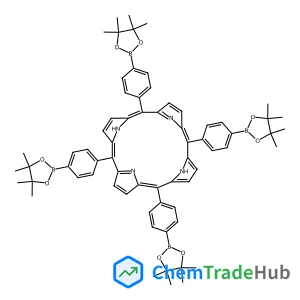
5,10,15,20-tetrakis(4-boronic acid pinacol ester phenyl) porphyrin
CAS Number:
1332748-00-1
Molecular Formula:
C68H74B4N4O8
Recommended Suppliers




Disclaimer
This page provides academic journal information for reference and research purposes only. We are not affiliated with any journal publishers and do not handle publication submissions. For publication-related inquiries, please contact the respective journal publishers directly.
If you notice any inaccuracies in the information displayed, please contact us at support@chemtradehub.com. We will promptly review and address your concerns.