


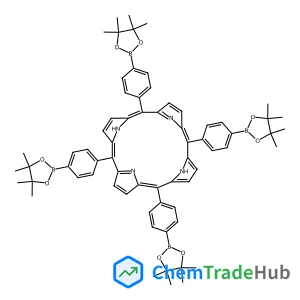
5,10,15,20-tetrakis(4-boronic acid pinacol ester phenyl) porphyrin
CAS Number:
1332748-00-1
Molecular Formula:
C68H74B4N4O8
Chunlin Guan, Ning Song, Yuanyuan Zhang, Hong Liu
Herein, we present an effective bottom-up strategy to fabricate unprecedented macroscopic two-dimensional (2D) plasmonic gold superlattices composed of high-index faceted gold nanocrystal building blocks (NBBs) at the air–liquid interface. In this approach, a synergistic electrostatic and layered self-assembly technique was executed using unique icosidodecahedral gold nanocrystals. It showed that centimeter-squared areas of close-packed monolayer films were formed, and the interparticle spacing of neighbouring Au NBBs could be facilely manipulated from hundreds to several nanometers. Optical characterization demonstrated that particular plasmonic coupling could occur and enhance in a wide spectral range (visible and near-IR) as the self-assembled Au superlattices were tuned for an appropriate gap distance and specific NBB size; however, the orientation of individual NBBs remained somewhat unorganized. Thus, the well pronounced shift of localized surface plasmon resonances (LSPR) and the in-depth resonance splitting behaviors were presented in our investigations. Furthermore, corresponding electromagnetic simulations showed good agreement with the experimental results; this indicated that a new class of tunable coupled plasmonic Au superlattices was realized. This study complements the insights into the plasmonic coupling of layered Au superlattices and enables the colloidal self-assembly to extend to unconventional NBBs; thus, it may facilitate the design of novel plasmonic metamaterials or other superstructures for desired functionalities and applications in the future.

Crystallography Reports

Journal of Natural Medicines

Russian Journal of Applied Chemistry

Acta Materialia

Saudi Pharmaceutical Journal

Russian Chemical Bulletin

Organic Process Research & Development

Current Opinion in Colloid & Interface Science

Russian Journal of Bioorganic Chemistry

Chemical Communications
DOI: 10.1039/B200372D
Chika Minejima, Takayuki Ebata, Naohiko Mikami
DOI: 10.1039/B108039C
Jan Petersen, David J. Lowe
DOI: 10.1039/B110486C
Hee-Seung Lee, Anne B. McCoy
DOI: 10.1039/B110963D
Lukasz Dobrzycki, Krzysztof Wozniak, Francesca Benevelli, Jacek Klinowski
DOI: 10.1039/B107416B
DOI: 10.1039/B109479C
P. Larregaray, L. Bonnet, J. C. Rayez
DOI: 10.1039/B110235B
Arwel V. Hughes, Arach Goldar, Michael C. Gerstenberg, Steve J. Roser, Jeremy Bradshaw
DOI: 10.1039/B200409G
Vladislav Papper, Vladimir Kharlanov, Wolfgang Rettig
DOI: 10.1039/B111681A
Laura Rivas, Santiago Sánchez-Cortés, José V. García-Ramos
DOI: 10.1039/B110564G
When handling 4-Methyl-6-(trifluoromethyl)quinoline (CAS: 40716-16-3), safety go...
4-(3,5-Difluorophenyl)aniline is an aromatic organic compound with the CAS numbe...
5-{[4-(Trifluoromethyl)phenyl]sulfanyl}-1,2,3-thiadiazole-4-carboxylic acid can ...
The market for 4-Benzylaniline hydrochloride (CAS: 6317-57-3) is steadily growin...
[3-(Diethylsulfamoyl)phenyl]boronic acid is generally considered safe when handl...
3-Bromo-2,5-dimethoxyaniline is mainly used in the pharmaceutical and chemical i...
N-Methyl-1-(5-methyl-1H-indol-3-yl)methanamine (CAS: 915922-67-7) is subject to ...
This compound is primarily used in the pharmaceutical industry for the synthesis...
2-Methyl-2-propanyl [(1S,3R)-3-aminocyclohexyl]carbamate (CAS: 1298101-47-9) sho...
Ethyl 2-bromo-4,4,4-trifluorobutanoate (CAS: 367-33-9) is utilized in the pharma...

Physical Chemistry Chemical Physics (PCCP) is an international journal co-owned by 19 physical chemistry and physics societies from around the world. This journal publishes original, cutting-edge research in physical chemistry, chemical physics and biophysical chemistry. To be suitable for publication in PCCP, articles must include significant innovation and/or insight into physical chemistry; this is the most important criterion that reviewers and Editors will judge against when evaluating submissions. The journal has a broad scope and welcomes contributions spanning experiment, theory, computation and data science. Topical coverage includes spectroscopy, dynamics, kinetics, statistical mechanics, thermodynamics, electrochemistry, catalysis, surface science, quantum mechanics, quantum computing and machine learning. Interdisciplinary research areas such as polymers and soft matter, materials, nanoscience, energy, surfaces/interfaces, and biophysical chemistry are welcomed if they demonstrate significant innovation and/or insight into physical chemistry. Joined experimental/theoretical studies are particularly appreciated when complementary and based on up-to-date approaches.
![2,4-Dichloro-6-isopropyl-5H-pyrrolo[3,4-d]pyrimidin-7(6H)-one structure](https://static.chemtradehub.com/structs/107/1079649-94-7-ad4a.webp "2,4-Dichloro-6-isopropyl-5H-pyrrolo[3,4-d]pyrimidin-7(6H)-one structure")
![6-Bromo-3-ethyl-3H-imidazo[4,5-b]pyridine structure](https://static.chemtradehub.com/structs/103/1033202-59-3-2a8f.webp "6-Bromo-3-ethyl-3H-imidazo[4,5-b]pyridine structure")
![6,7-Dihydro-5H-pyrrolo[1,2-a]imidazole-6-carboxylic acid structure](https://static.chemtradehub.com/structs/136/1369160-12-2-6524.webp "6,7-Dihydro-5H-pyrrolo[1,2-a]imidazole-6-carboxylic acid structure")







