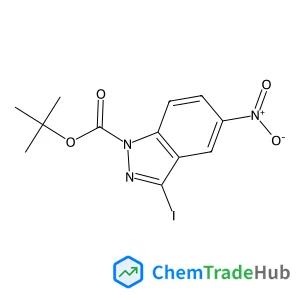
Tert-butyl 3-iodo-5-nitro-1H-indazole-1-carboxylate
CAS Number:
459133-69-8
Molecular Formula:
C12H12IN3O4
Xian-Zhu Deng, Chuang Song, Yin-Lin Tong, Guoliang Yuan, Feng Gao, Dan-Qing Liu, Shan-Tao Zhang
As one of the most promising photocatalysts, graphitic carbon nitride (g-C3N4) shows a visible light response and great chemical stability. However, its relatively low photocatalytic efficiency is a major obstacle to actual applications. Here an effective and feasible method to dramatically increase the visible light photocatalytic efficiency by forming C3N4/BiFeO3 ferroelectric heterojunctions is reported, wherein the band alignment and piezo-/ferroelectricity have synergistic positive effects in accelerating the separation of the photogenerated carriers. At the optimum composition of 10 wt% BiFeO3, the heterojunction shows 1.4 times improved photocatalytic efficiency than that of the pure C3N4. Most importantly, mechanical pressing and electrical poling can also improve the photocatalytic efficiencies by 1.3 times and 1.8 times, respectively. The optimized photocatalytic efficiency is even comparable with that of some noble metal based compounds. These results not only prove the improved photocatalytic activity of the C3N4–ferroelectric heterojunctions, but also provide a new approach for designing high-performance photocatalysts by taking advantage of ferroelectricity.

Russian Journal of Bioorganic Chemistry

Journal of Peptide Science

Current Opinion in Solid State & Materials Science

Journal of Natural Medicines

Russian Journal of Applied Chemistry

Russian Chemical Bulletin

Russian Journal of Organic Chemistry

Crystallography Reports

Russian Journal of General Chemistry

Current Opinion in Colloid & Interface Science
DOI: 10.1039/B109479C
Susana Jarmelo, Rui Fausto
DOI: 10.1039/B110949A
Chika Minejima, Takayuki Ebata, Naohiko Mikami
DOI: 10.1039/B108039C
J. Lee, W. B. Wang, M. S. Zei, G. Ertl
DOI: 10.1039/B109547A
David Delaere, Minh Tho Nguyen, Luc G. Vanquickenborne
DOI: 10.1039/B109008A
Bin Wen, Jifei Jia, Shuyou Li, Tao Liu, Lin X. Chen, Wolfgang M. H. Sachtler
DOI: 10.1039/B111200G
Vladana Vukojević, Slobodan Anić, Ljiljana Kolar-Anić
DOI: 10.1039/B109401G
Lidia Wasyluk, Barbara Peplinska, Stefan Jurga
DOI: 10.1039/B200634K
DOI: 10.1039/B107802J
When handling 4-Methyl-6-(trifluoromethyl)quinoline (CAS: 40716-16-3), safety go...
4-(3,5-Difluorophenyl)aniline is an aromatic organic compound with the CAS numbe...
5-{[4-(Trifluoromethyl)phenyl]sulfanyl}-1,2,3-thiadiazole-4-carboxylic acid can ...
The market for 4-Benzylaniline hydrochloride (CAS: 6317-57-3) is steadily growin...
[3-(Diethylsulfamoyl)phenyl]boronic acid is generally considered safe when handl...
3-Bromo-2,5-dimethoxyaniline is mainly used in the pharmaceutical and chemical i...
N-Methyl-1-(5-methyl-1H-indol-3-yl)methanamine (CAS: 915922-67-7) is subject to ...
This compound is primarily used in the pharmaceutical industry for the synthesis...
2-Methyl-2-propanyl [(1S,3R)-3-aminocyclohexyl]carbamate (CAS: 1298101-47-9) sho...
Ethyl 2-bromo-4,4,4-trifluorobutanoate (CAS: 367-33-9) is utilized in the pharma...

Physical Chemistry Chemical Physics (PCCP) is an international journal co-owned by 19 physical chemistry and physics societies from around the world. This journal publishes original, cutting-edge research in physical chemistry, chemical physics and biophysical chemistry. To be suitable for publication in PCCP, articles must include significant innovation and/or insight into physical chemistry; this is the most important criterion that reviewers and Editors will judge against when evaluating submissions. The journal has a broad scope and welcomes contributions spanning experiment, theory, computation and data science. Topical coverage includes spectroscopy, dynamics, kinetics, statistical mechanics, thermodynamics, electrochemistry, catalysis, surface science, quantum mechanics, quantum computing and machine learning. Interdisciplinary research areas such as polymers and soft matter, materials, nanoscience, energy, surfaces/interfaces, and biophysical chemistry are welcomed if they demonstrate significant innovation and/or insight into physical chemistry. Joined experimental/theoretical studies are particularly appreciated when complementary and based on up-to-date approaches.
![6,7-Dihydro-5H-pyrrolo[1,2-a]imidazole-6-carboxylic acid structure](https://static.chemtradehub.com/structs/136/1369160-12-2-6524.webp "6,7-Dihydro-5H-pyrrolo[1,2-a]imidazole-6-carboxylic acid structure")