












Controlling particle deposit morphologies in drying nano-particle laden sessile droplets using substrate oscillations
Literature Information
Publication Date
2016-04-29
DOI
10.1039/C6CP01272H
Impact Factor
3.676
Authors
Apratim Sanyal, Saptarshi Basu, Swetaprovo Chaudhuri
View Original
Abstract
Sessile water droplets containing nano-silica particles are allowed to evaporate in the presence of driven substrate oscillations at chosen frequencies. Different mode shapes are observed at different oscillation frequencies. As reference, the evaporation of the same droplets is also observed under stationary conditions i.e. in the absence of any oscillations. For all cases, the deposit structures formed by the agglomeration of the nano-silica particles have been imaged. It has been observed that for the stationary droplets and for droplets whose oscillations are initiated close to the resonance of the lowest allowable oscillation mode, the structures are similar having larger spread over height, while for higher frequencies the structures are dome-like with more uniform outer dimensions. The possible reasons behind these structures are investigated using experimental techniques such as high-speed imaging of droplet oscillations, internal flow visualization and SEM imaging. Understanding of the underlying mechanisms behind the formation of these striking features is required for these methods to be applicable in larger scale drying operations or micro-device applications. Altogether a novel methodology has been presented and investigated for manipulating the morphological features in evaporating nano-particle laden sessile droplets.
Related Literature
How intermolecular interactions influence electronic absorption spectra: insights from the molecular packing of uracil in condensed phases
Fangjia Fu, Kang Liao, Jing Ma, Zheng Cheng, Dong Zheng, Liuzhou Gao, Chungen Liu, Shuhua Li, Wei Li
2019-01-16
Paper
DOI: 10.1039/C8CP06152A
Carrier dynamics in highly excited TlInS2: evidence of 2D electron–hole charge separation at parallel layers
Vytautas Grivickas, Patrik Ščajev, Vitalijus Bikbajevas, Olga V. Korolik, Alexander V. Mazanik
2018-12-21
Paper
DOI: 10.1039/C8CP06209A
Singlet excitation in the intermediate magnetic equivalence regime and field-dependent study of singlet–triplet leakage
Boris Kharkov, Xueyou Duan, Emily S. Tovar, James W. Canary, Alexej Jerschow
2019-01-10
Paper
DOI: 10.1039/C8CP06883F
Kinetics of the reactions of NO3 radical with alkanes
Li Zhou, Mahmoud Idir, Véronique Daële, Abdelwahid Mellouki
2019-02-05
Paper
DOI: 10.1039/C8CP07675H
Building intermixed donor–acceptor architectures for water-processable organic photovoltaics
Melissa Marks, Natalie P. Holmes, Xun Pan, Riku Chowdhury, Matthew G. Barr, Coralie Fenn, Matthew J. Griffith, A. L. David Kilcoyne, David A. Lewis, Mats R. Andersson, Warwick J. Belcher, Paul C. Dastoor
2019-02-19
Paper
DOI: 10.1039/C8CP07137C
Ultrafast internal conversion dynamics of bilirubin bound to UnaG and its N57A mutant
Xiaodan Cao, Changcheng Zhang, Ziheng Gao, Yangyi Liu, Yuzheng Zhao, Yi Yang
2019-01-16
Paper
DOI: 10.1039/C8CP07553K
Solving the Schrödinger equation of hydrogen molecules with the free-complement variational theory: essentially exact potential curves and vibrational levels of the ground and excited states of the Σ symmetry
Yusaku I. Kurokawa, Hiroyuki Nakashima, Hiroshi Nakatsuji
2018-11-27
Paper
DOI: 10.1039/C8CP05949G
The band structure and optical absorption of hematite (α-Fe2O3): a first-principles GW-BSE study
2019-01-16
Paper
DOI: 10.1039/C8CP07132B
You might also like
Compound Q&A
What are the main uses of 4-Nitrophenyl phosphate disodium salt hexahydrate (CAS: 333338-18-4)?
4-Nitrophenyl phosphate disodium salt hexahydrate is primarily used as a substra...
333338-18-44-Nitrophenyl phosph...
Compound Q&A
What are the main uses of 2-(Trifluoromethyl)-1,3-oxazole-4-carboxylic Acid (CAS: 1060816-01-4)?
2-(Trifluoromethyl)-1,3-oxazole-4-carboxylic Acid (CAS: 1060816-01-4) is widely ...
1060816-01-42-(Trifluoromethyl)-...
Compound Q&A
How should 2-Fluoro-4-biphenylcarboxylic acid (CAS: 137045-30-8) be stored?
2-Fluoro-4-biphenylcarboxylic acid should be stored in a cool, dry place at room...
137045-30-82-Fluoro-4-biphenylc...
Compound Q&A
What industries use Prednisolone-21-Carboxylic Acid (CAS: 61549-70-0)?
Prednisolone-21-Carboxylic Acid is primarily used in the pharmaceutical industry...
61549-70-0Prednisolone-21-Carb...
Compound Q&A
How should 4-(Hydrazinomethyl)-1,2,3-benzenetriol (CAS: 3614-72-0) be stored?
4-(Hydrazinomethyl)-1,2,3-benzenetriol (CAS: 3614-72-0) should be stored in a co...
3614-72-04-(Hydrazinomethyl)-...
Compound Q&A
What industries use 4-Amino-1-methyl-1H-pyrazole-5-carboxylic acid hydrochloride (CAS: 92534-70-8)?
4-Amino-1-methyl-1H-pyrazole-5-carboxylic acid hydrochloride (CAS: 92534-70-8) i...
92534-70-84-Amino-1-methyl-1H-...
Compound Q&A
What regulatory guidelines apply to dehydropachymic acid (CAS: 77012-31-8)?
Dehydropachymic acid (CAS: 77012-31-8) is regulated by various agencies. It fall...
77012-31-8Dehydropachymic acid
Compound Q&A
What is the market or research trend for 6-[(2,2-Dimethylpropanoyl)amino]nicotinic acid (CAS: 898561-66-5)?
The market and research trends for 6-[(2,2-Dimethylpropanoyl)amino]nicotinic aci...
898561-66-56-[(2,2-Dimethylprop...
Compound Q&A
How should 1,10-Phenanthroline-2,9-dicarbaldehyde (CAS: 57709-62-3) be stored?
1,10-Phenanthroline-2,9-dicarbaldehyde should be stored in a cool, dry place awa...
57709-62-31,10-Phenanthroline-...
Compound Q&A
How is 5-Carbamoyl-11-oxo-10,11-dihydro-5H-dibenzo[b,f]azepin-10-yl acetate (CAS: 113952-21-9) typically synthesized?
5-Carbamoyl-11-oxo-10,11-dihydro-5H-dibenzo[b,f]azepin-10-yl acetate can be synt...
113952-21-95-Carbamoyl-11-oxo-1...
Source Journal
Physical Chemistry Chemical Physics

CiteScore:
5.5
Self-citation Rate:
10.3%
Articles per Year:
3036
Physical Chemistry Chemical Physics (PCCP) is an international journal co-owned by 19 physical chemistry and physics societies from around the world. This journal publishes original, cutting-edge research in physical chemistry, chemical physics and biophysical chemistry. To be suitable for publication in PCCP, articles must include significant innovation and/or insight into physical chemistry; this is the most important criterion that reviewers and Editors will judge against when evaluating submissions. The journal has a broad scope and welcomes contributions spanning experiment, theory, computation and data science. Topical coverage includes spectroscopy, dynamics, kinetics, statistical mechanics, thermodynamics, electrochemistry, catalysis, surface science, quantum mechanics, quantum computing and machine learning. Interdisciplinary research areas such as polymers and soft matter, materials, nanoscience, energy, surfaces/interfaces, and biophysical chemistry are welcomed if they demonstrate significant innovation and/or insight into physical chemistry. Joined experimental/theoretical studies are particularly appreciated when complementary and based on up-to-date approaches.
Recommended Compounds
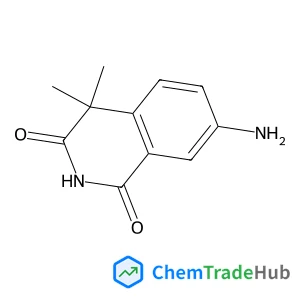
1,3(2H,4H)-Isoquinolinedione, 7-amino-4,4-dimethyl-
CAS Number:
14576-22-8
Molecular Formula:
C11H12N2O2
Recommended Suppliers




Disclaimer
This page provides academic journal information for reference and research purposes only. We are not affiliated with any journal publishers and do not handle publication submissions. For publication-related inquiries, please contact the respective journal publishers directly.
If you notice any inaccuracies in the information displayed, please contact us at support@chemtradehub.com. We will promptly review and address your concerns.