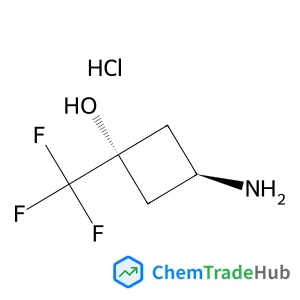
cis-3-Amino-1-(trifluoromethyl)cyclobutanol hydrochloride (1:1)
CAS Number:
1408075-16-0
Molecular Formula:
C5H9ClF3NO
Enrique M. Cabaleiro-Lago, Jesús Rodríguez-Otero
Non-local effects are crucial in order to give an accurate description of substituent effects in extended aromatic systems. As a consequence, the predictions based on the currently accepted through-space picture can lead to large errors in the strength of cation⋯π interactions, especially for rings furthest from the substituent.
Swetlana Jungblut, Jan-Ole Joswig, Alexander Eychmüller
DOI: 10.1039/C9CP00549H
Martin Drøhse Kilde, Sandeep Kumar Singh, Paul Erhart, Kasper Moth-Poulsen, Mogens Brøndsted Nielsen
DOI: 10.1039/C8CP07744D
David Ibáñez, Alejandro Pérez-Junquera, María Begoña González-García, David Hernández-Santos, Pablo Fanjul-Bolado
DOI: 10.1039/C9CP00484J
Simuck F. Yuk, Valentino R. Cooper
DOI: 10.1039/C8CP02405G
DOI: 10.1039/C8CP07012A
DOI: 10.1039/C8CP07734G
DOI: 10.1039/C8CP07275B
Dominik Sidler, Sereina Riniker
DOI: 10.1039/C8CP06800C
Jens Antony, Stefan Grimme, Anouk M. Rijs
DOI: 10.1039/C8CP04480E
Wen-Hua Yang, Shan-Dong Li, Xu-Yan Xue, Qing-Jun Zang, K. M. Ho, C. Z. Wang
DOI: 10.1039/C9CP00310J
4-Nitrophenyl phosphate disodium salt hexahydrate is primarily used as a substra...
2-(Trifluoromethyl)-1,3-oxazole-4-carboxylic Acid (CAS: 1060816-01-4) is widely ...
2-Fluoro-4-biphenylcarboxylic acid should be stored in a cool, dry place at room...
Prednisolone-21-Carboxylic Acid is primarily used in the pharmaceutical industry...
4-(Hydrazinomethyl)-1,2,3-benzenetriol (CAS: 3614-72-0) should be stored in a co...
4-Amino-1-methyl-1H-pyrazole-5-carboxylic acid hydrochloride (CAS: 92534-70-8) i...
Dehydropachymic acid (CAS: 77012-31-8) is regulated by various agencies. It fall...
The market and research trends for 6-[(2,2-Dimethylpropanoyl)amino]nicotinic aci...
1,10-Phenanthroline-2,9-dicarbaldehyde should be stored in a cool, dry place awa...
5-Carbamoyl-11-oxo-10,11-dihydro-5H-dibenzo[b,f]azepin-10-yl acetate can be synt...

Physical Chemistry Chemical Physics (PCCP) is an international journal co-owned by 19 physical chemistry and physics societies from around the world. This journal publishes original, cutting-edge research in physical chemistry, chemical physics and biophysical chemistry. To be suitable for publication in PCCP, articles must include significant innovation and/or insight into physical chemistry; this is the most important criterion that reviewers and Editors will judge against when evaluating submissions. The journal has a broad scope and welcomes contributions spanning experiment, theory, computation and data science. Topical coverage includes spectroscopy, dynamics, kinetics, statistical mechanics, thermodynamics, electrochemistry, catalysis, surface science, quantum mechanics, quantum computing and machine learning. Interdisciplinary research areas such as polymers and soft matter, materials, nanoscience, energy, surfaces/interfaces, and biophysical chemistry are welcomed if they demonstrate significant innovation and/or insight into physical chemistry. Joined experimental/theoretical studies are particularly appreciated when complementary and based on up-to-date approaches.
phosphoryl}methyl 4-methylbenzenesulfonate structure](https://static.chemtradehub.com/structs/864/864068-45-1-ba7c.webp "{[3-(Hexadecyloxy)propoxy](hydroxy)phosphoryl}methyl 4-methylbenzenesulfonate structure")
![(3R,5R)-1-[(Benzyloxy)carbonyl]-5-methyl-3-piperidinecarboxylic acid structure](https://static.chemtradehub.com/structs/126/1269757-29-0-c552.webp "(3R,5R)-1-[(Benzyloxy)carbonyl]-5-methyl-3-piperidinecarboxylic acid structure")