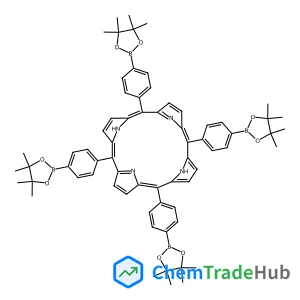
5,10,15,20-tetrakis(4-boronic acid pinacol ester phenyl) porphyrin
CAS Number:
1332748-00-1
Molecular Formula:
C68H74B4N4O8
A. Peristyy, P. N. Nesterenko, A. Das, D. M. D'Alessandro
Composite particles containing the Zr-based metal–organic framework (MOF) UiO-66 were prepared using microwave-assisted solvothermal synthesis. Scanning electron microscopy, infrared spectroscopy, powder X-ray diffraction and nitrogen physisorption studies confirmed the deposition of 100–300 nm microporous particles with the UiO-66 topology on the surface of mesoporous 5 μm and non-porous 2.1 μm silica particles. The core–shell particles exhibited a unique flow-dependent separation selectivity (FDSS) effect which allows changes in both the retention and separation selectivity of small molecules by simple variation of the mobile phase flow rate under isocratic conditions. The impact of the loading of UiO-66 as well as the porosity of the underlying silica core (mesoporous and non-porous) on the FDSS effect was evaluated. The prepared adsorbents were also tested for the normal-phase (NP) and reversed-phase (RP) separation of xylene isomers, substituted benzenes and polyaromatic hydrocarbons (PAHs). Efficiencies of up to 32 400 plates per m (styrene, k 1.59) and 37 200 plates per m (anisole, k 2.90) were achieved under NP and RP modes, respectively. The results demonstrate the potential of novel MOF-based stationary phases for the separation of closely related compounds (e.g. positional isomers).
Lovemore Hakuna, Brandon Doughan, Jorge O. Escobedo, Robert M. Strongin
DOI: 10.1039/C5AN00345H
Xu Wang, Jutta Pauli, Reinhard Niessner, Ute Resch-Genger, Dietmar Knopp
DOI: 10.1039/C5AN01300C
Gregory Q. Wallace, Mariachiara S. Zuin, Mohammadali Tabatabaei, Pierangelo Gobbo, François Lagugné-Labarthet, Mark S. Workentin
DOI: 10.1039/C5AN01127B
M. A. Prieto, J. A. Vazquez, M. A. Murado
DOI: 10.1039/C4AN02136C
Sarah S. Park, Minyoung Hong, Yejin Ha, Gil-Ja Jhon, Youngmi Lee
DOI: 10.1039/C5AN00122F
Zipin Zhang, Jie Hao, Tongfang Xiao, Ping Yu, Lanqun Mao
DOI: 10.1039/C5AN00593K
Na Weng, Lingyan Liu
DOI: 10.1039/C4AN00815D
Hajra Basit, Vinnie Gaul, Sean Maher, Robert J. Forster, Tia E. Keyes
DOI: 10.1039/C4AN02317J
When handling 4-Methyl-6-(trifluoromethyl)quinoline (CAS: 40716-16-3), safety go...
4-(3,5-Difluorophenyl)aniline is an aromatic organic compound with the CAS numbe...
5-{[4-(Trifluoromethyl)phenyl]sulfanyl}-1,2,3-thiadiazole-4-carboxylic acid can ...
The market for 4-Benzylaniline hydrochloride (CAS: 6317-57-3) is steadily growin...
[3-(Diethylsulfamoyl)phenyl]boronic acid is generally considered safe when handl...
3-Bromo-2,5-dimethoxyaniline is mainly used in the pharmaceutical and chemical i...
N-Methyl-1-(5-methyl-1H-indol-3-yl)methanamine (CAS: 915922-67-7) is subject to ...
This compound is primarily used in the pharmaceutical industry for the synthesis...
2-Methyl-2-propanyl [(1S,3R)-3-aminocyclohexyl]carbamate (CAS: 1298101-47-9) sho...
Ethyl 2-bromo-4,4,4-trifluorobutanoate (CAS: 367-33-9) is utilized in the pharma...

Analyst publishes analytical and bioanalytical research that reports premier fundamental discoveries and inventions, and the applications of those discoveries, unconfined by traditional discipline barriers.