












Rapid capillary mixing experiments for the analysis of hydrophobic membrane complexes directly from aqueous lipid bilayer solutions
Literature Information
Publication Date
2016-12-08
DOI
10.1039/C6AN02290A
Impact Factor
4.616
Authors
John W. Patrick, Breanna Zerfas, Jianmin Gao, David H. Russell
View Original
Abstract
In this study the gas-phase conformer preferences of Gramicidin A (GA), a linear antimicrobial pentadecapeptide, were investigated directly from aqueous solutions of lipid vesicle bilayers using a mixing tee-electrospray ionization (MT-ESI) setup coupled with ion mobility mass spectrometry (IM-MS). The required time for GA sample preparation was decreased by approximately 50% using MT-ESI when compared to previously reported methods which required freeze-drying of samples. Using an MT-ESI approach to analyze samples of GA associated with POPC (16:0, 18:1 PC) and DEPC (22:1 PC) lipid bilayers yielded dimer conformer preferences comparable to results obtained using more lengthy protocols. GA analogues that contain leucine to lysine substitutions were analyzed; these analogues yielded more hydrophilic GA dimers owing to the hydrophilicity of lysine head groups. The conformer preferences of lipid bilayer associated hydrophilic GA analogues can be obtained owing to disassociation of lipids during the fast mixing time MT-ESI process. The data for both GA analogues associated with negatively charged POPC/POPG (16:0, 18:1 PC/PG) lipid bilayers reveal a preference for antiparallel double helix (ADH) formation. The adoption of nascent conformers for both GA analogues was observed using MT-ESI for samples associated with DMPC/DMPG (12:0 PC/PG) bilayers.
Related Literature
Ground and excited electronic structure analysis of XM4 (X = N, P and M = Li, Na) and their anions
2021-06-30
Paper
DOI: 10.1039/D1CP02273C
Enhanced photocatalytic activity, transport properties and electronic structure of Mn doped GdFeO3 synthesized using the sol–gel process
Ritwik Maity, Alo Dutta, Saswata Halder, Santiranjan Shannigrahi, Kalyan Mandal, T. P. Sinha
2021-07-22
Paper
DOI: 10.1039/D1CP00621E
Identification of intermediates of a molecular ruthenium catalyst for water oxidation using in situ electrochemical X-ray absorption spectroscopy
Huacai Yan, Fusheng Li, Qingyu Kong
2021-10-12
Paper
DOI: 10.1039/D1CP03837K
Generation, contraction, and polarisation of Gaussian basis sets for atomic and molecular calculations using the generator coordinate method with polynomial discretisation: atoms from Na through Cl
Amanda R. Guimarães, Rugles C. Barbosa, Ana Cristina Mora Tello, Aldineia P. da Silva, Júlia M. A. Alves, Milena Palhares Maringolo, Albérico B. F. da Silva
2021-07-23
Paper
DOI: 10.1039/D1CP01879E
Single sheets of graphene for fabrication of fibers with enhanced mechanical properties
Muhammad G. Salim, Luke A. Thimons, Min A. Kim, Brennan Carr, Michelle Montgomery, Nathan Tolman, Tevis D. B. Jacobs, Haitao Liu
2021-09-20
Paper
DOI: 10.1039/D1CP03238K
Assessing nickel oxide electrocatalysts incorporating diamines and having improved oxygen evolution activity using operando UV/visible and X-ray absorption spectroscopy
Takafumi Miura, Shun Tsunekawa, Sho Onishi, Toshiaki Ina, Kehsuan Wang, Genta Watanabe, Chechia Hu, Hiroshi Kondoh, Takeshi Kawai
2021-10-11
Paper
DOI: 10.1039/D1CP03323A
Proton transport mechanism and pathways in the superprotonic phase of M3H(AO4)2 solid acids from ab initio molecular dynamics simulations
Boris V. Merinov, Sergey I. Morozov
2021-07-28
Paper
DOI: 10.1039/D1CP00757B
Mixed-diphosphine-protected chiral undecagold clusters Au11(S,S-DIOP)4(rac-/R-/S-BINAP): effect of the handedness of BINAP on their chiroptical responses
Yasuhiko Sato, Hiroshi Yao
2021-07-26
Paper
DOI: 10.1039/D1CP02106K
Revisiting the glass transition temperature of water–glycerol mixtures in the bulk and confined in mesoporous silica
Ivette Angarita, Ma. Florencia Mazzobre
2021-07-10
Paper
DOI: 10.1039/D1CP02153B
You might also like
Compound Q&A
What precautions should be taken when handling 4-Methyl-6-(trifluoromethyl)quinoline (CAS: 40716-16-3)?
When handling 4-Methyl-6-(trifluoromethyl)quinoline (CAS: 40716-16-3), safety go...
40716-16-34-Methyl-6-(trifluor...
Compound Q&A
What is 4-(3,5-Difluorophenyl)aniline (CAS: 405058-00-6)?
4-(3,5-Difluorophenyl)aniline is an aromatic organic compound with the CAS numbe...
405058-00-64-(3,5-Difluoropheny...
Compound Q&A
How is 5-{[4-(Trifluoromethyl)phenyl]sulfanyl}-1,2,3-thiadiazole-4-carboxylic acid (CAS: 338982-07-3) typically synthesized?
5-{[4-(Trifluoromethyl)phenyl]sulfanyl}-1,2,3-thiadiazole-4-carboxylic acid can ...
338982-07-35-{[4-(Trifluorometh...
Compound Q&A
What is the market or research trend for 4-Benzylaniline hydrochloride (CAS: 6317-57-3)?
The market for 4-Benzylaniline hydrochloride (CAS: 6317-57-3) is steadily growin...
6317-57-34-Benzylaniline hydr...
Compound Q&A
Is [3-(Diethylsulfamoyl)phenyl]boronic acid (CAS: 871329-58-7) safe?
[3-(Diethylsulfamoyl)phenyl]boronic acid is generally considered safe when handl...
871329-58-7[3-(Diethylsulfamoyl...
Compound Q&A
What are the main uses of 3-Bromo-2,5-dimethoxyaniline (CAS: 115929-62-9)?
3-Bromo-2,5-dimethoxyaniline is mainly used in the pharmaceutical and chemical i...
115929-62-93-Bromo-2,5-dimethox...
Compound Q&A
What regulatory guidelines apply to N-Methyl-1-(5-methyl-1H-indol-3-yl)methanamine (CAS: 915922-67-7)?
N-Methyl-1-(5-methyl-1H-indol-3-yl)methanamine (CAS: 915922-67-7) is subject to ...
915922-67-7N-Methyl-1-(5-methyl...
Compound Q&A
What industries use Carbamic acid, N-[(5S)-5,6-diamino-6-oxohexyl]-, 1,1-dimethylethyl ester (CAS: 24828-96-4)?
This compound is primarily used in the pharmaceutical industry for the synthesis...
24828-96-4Carbamic acid, N-[(5...
Compound Q&A
How should 2-Methyl-2-propanyl [(1S,3R)-3-aminocyclohexyl]carbamate (CAS: 1298101-47-9) be stored?
2-Methyl-2-propanyl [(1S,3R)-3-aminocyclohexyl]carbamate (CAS: 1298101-47-9) sho...
1298101-47-92-Methyl-2-propanyl ...
Compound Q&A
What industries use Ethyl 2-bromo-4,4,4-trifluorobutanoate (CAS: 367-33-9)?
Ethyl 2-bromo-4,4,4-trifluorobutanoate (CAS: 367-33-9) is utilized in the pharma...
367-33-9Ethyl 2-bromo-4,4,4-...
Source Journal
Analyst

CiteScore:
7.8
Self-citation Rate:
5.6%
Articles per Year:
653
Analyst publishes analytical and bioanalytical research that reports premier fundamental discoveries and inventions, and the applications of those discoveries, unconfined by traditional discipline barriers.
Recommended Compounds
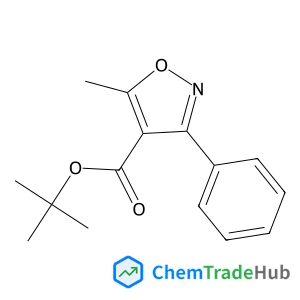
2-Methyl-2-propanyl 5-methyl-3-phenyl-1,2-oxazole-4-carboxylate
CAS Number:
211429-79-7
Molecular Formula:
C15H17NO3
Recommended Suppliers







Disclaimer
This page provides academic journal information for reference and research purposes only. We are not affiliated with any journal publishers and do not handle publication submissions. For publication-related inquiries, please contact the respective journal publishers directly.
If you notice any inaccuracies in the information displayed, please contact us at support@chemtradehub.com. We will promptly review and address your concerns.