













Strategies for large-scale targeted metabolomics quantification by liquid chromatography-mass spectrometry
Literature Information
Publication Date
2016-09-26
DOI
10.1039/C6AN01753C
Impact Factor
4.616
Authors
Juntuo Zhou, Yuxin Yin
View Original
Abstract
Advances in liquid chromatography-mass spectrometry (LC-MS) instruments and analytical strategies have brought about great progress in targeted metabolomics analysis. This methodology is now capable of performing precise targeted measurement of dozens or hundreds of metabolites in complex biological samples. Classic targeted quantification assay using the multiple reaction monitoring (MRM) mode has been the foundation of high-quality metabolite quantitation. However, utilization of this strategy in biological studies has been limited by its relatively low metabolite coverage and throughput capacity. A number of methods for large-scale targeted metabolomics assay which have been developed overcome these limitations. These strategies have enabled extended metabolite coverage which is defined as targeting of large numbers of metabolites, while maintaining reliable quantification performance. These recently developed techniques thus bridge the gap between traditional targeted metabolite quantification and untargeted metabolomics profiling, and have proven to be powerful tools for metabolomics study. Although the LC-MRM-MS strategy has been used widely in large-scale metabolomics quantification analysis due to its fast scan speed and ideal analytic stability, there are still drawbacks which are due to the low resolution of the triple quadrupole instruments used for MRM assays. New approaches have been developed to expand the options for large-scale targeted metabolomics study, using high-resolution instruments such as parallel reaction monitoring (PRM). MRM and PRM-based techniques are now attractive strategies for quantitative metabolomics analysis and high-throughput biomarker discovery. Here we provide an overview of the major developments in LC-MS-based strategies for large-scale targeted metabolomics quantification in biological samples. The advantages of LC-MRM/PRM-MS based analytical strategies which may be used in multiplexed and high throughput quantitation for a wide range of metabolites are highlighted. In particular, PRM and MRM strategies are compared, and we summarize the work flow commonly used for large-scale targeted metabolomics analysis including sample preparation, LC separation and data analysis, as well as recent applications in biological studies.
Recommended Journals
Related Literature
Sequence-dependent aggregation-prone conformations of islet amyloid polypeptide
Bumjoon Choi, Nam Hyeong Kim, Geun Young Jin, Yung Sam Kim, Kilho Eom
2021-09-04
Paper
DOI: 10.1039/D1CP01061A
The Fermi level as an energy reference in liquid jet X-ray photoelectron spectroscopy studies of aqueous solutions
Lucía Pérez Ramírez, Anthony Boucly, Florent Saudrais, Emmanuel Maisonhaute, Aleksandar R. Milosavljević, Christophe Nicolas, François Rochet
2021-07-05
Paper
DOI: 10.1039/D1CP01511G
Effects of substituent position on aminobenzoate relaxation pathways in solution
Jack M. Woolley, Konstantina M. Krokidi, Maria A. Tesa-Serrate, Nicholas D. M. Hine, Vasilios G. Stavros
2021-10-06
Paper
DOI: 10.1039/D1CP03759E
New complexes of liquid crystal discotic triphenylenes: induction of the double gyroid phase
O. A. Otmakhova, G. N. Bondarenko, G. A. Shandryuk, A. S. Merekalov, R. V. Talroze
2021-07-22
Paper
DOI: 10.1039/D1CP00660F
The effect of interface angle on the thermal conductivity of Si/Ge superlattices
Aleksandr Chernatynskiy, Xiao-Feng Zhao
2021-10-08
Paper
DOI: 10.1039/D1CP03544D
Scouting for strong light–matter coupling signatures in Raman spectra
Lukasz Piatkowski, Frank Wackenhut, Sylwester Gawinkowski, Alfred J. Meixner
2021-07-29
Paper
DOI: 10.1039/D1CP01863A
Molecular dynamics study on the inhibition mechanisms of ReACp53 peptide for p53–R175H mutant aggregation
Jiangtao Lei, Mengqiang Cai, Yun Shen, Dongdong Lin, Xiaohua Deng
2021-09-22
Paper
DOI: 10.1039/D1CP03094A
Chiral recognition via a stereodynamic vanadium probe using the electronic circular dichroism effect in differential Raman scattering
Davide Carraro, Giulia Licini, Petr Bouř, Cristiano Zonta
2021-09-21
Paper
DOI: 10.1039/D1CP03020E
Reactive force fields for aqueous and interfacial magnesium carbonate formation
Siavash Zare, Mohammad Javad Abdolhosseini Qomi
2021-10-01
Paper
DOI: 10.1039/D1CP02627E
An evaluation of solvent effects and ethanol oxidation
Yuhan Mei, N. Aaron Deskins
2021-07-19
Paper
DOI: 10.1039/D1CP00630D
You might also like
Compound Q&A
What precautions should be taken when handling 4-Methyl-6-(trifluoromethyl)quinoline (CAS: 40716-16-3)?
When handling 4-Methyl-6-(trifluoromethyl)quinoline (CAS: 40716-16-3), safety go...
40716-16-34-Methyl-6-(trifluor...
Compound Q&A
What is 4-(3,5-Difluorophenyl)aniline (CAS: 405058-00-6)?
4-(3,5-Difluorophenyl)aniline is an aromatic organic compound with the CAS numbe...
405058-00-64-(3,5-Difluoropheny...
Compound Q&A
How is 5-{[4-(Trifluoromethyl)phenyl]sulfanyl}-1,2,3-thiadiazole-4-carboxylic acid (CAS: 338982-07-3) typically synthesized?
5-{[4-(Trifluoromethyl)phenyl]sulfanyl}-1,2,3-thiadiazole-4-carboxylic acid can ...
338982-07-35-{[4-(Trifluorometh...
Compound Q&A
What is the market or research trend for 4-Benzylaniline hydrochloride (CAS: 6317-57-3)?
The market for 4-Benzylaniline hydrochloride (CAS: 6317-57-3) is steadily growin...
6317-57-34-Benzylaniline hydr...
Compound Q&A
Is [3-(Diethylsulfamoyl)phenyl]boronic acid (CAS: 871329-58-7) safe?
[3-(Diethylsulfamoyl)phenyl]boronic acid is generally considered safe when handl...
871329-58-7[3-(Diethylsulfamoyl...
Compound Q&A
What are the main uses of 3-Bromo-2,5-dimethoxyaniline (CAS: 115929-62-9)?
3-Bromo-2,5-dimethoxyaniline is mainly used in the pharmaceutical and chemical i...
115929-62-93-Bromo-2,5-dimethox...
Compound Q&A
What regulatory guidelines apply to N-Methyl-1-(5-methyl-1H-indol-3-yl)methanamine (CAS: 915922-67-7)?
N-Methyl-1-(5-methyl-1H-indol-3-yl)methanamine (CAS: 915922-67-7) is subject to ...
915922-67-7N-Methyl-1-(5-methyl...
Compound Q&A
What industries use Carbamic acid, N-[(5S)-5,6-diamino-6-oxohexyl]-, 1,1-dimethylethyl ester (CAS: 24828-96-4)?
This compound is primarily used in the pharmaceutical industry for the synthesis...
24828-96-4Carbamic acid, N-[(5...
Compound Q&A
How should 2-Methyl-2-propanyl [(1S,3R)-3-aminocyclohexyl]carbamate (CAS: 1298101-47-9) be stored?
2-Methyl-2-propanyl [(1S,3R)-3-aminocyclohexyl]carbamate (CAS: 1298101-47-9) sho...
1298101-47-92-Methyl-2-propanyl ...
Compound Q&A
What industries use Ethyl 2-bromo-4,4,4-trifluorobutanoate (CAS: 367-33-9)?
Ethyl 2-bromo-4,4,4-trifluorobutanoate (CAS: 367-33-9) is utilized in the pharma...
367-33-9Ethyl 2-bromo-4,4,4-...
Source Journal
Analyst

CiteScore:
7.8
Self-citation Rate:
5.6%
Articles per Year:
653
Analyst publishes analytical and bioanalytical research that reports premier fundamental discoveries and inventions, and the applications of those discoveries, unconfined by traditional discipline barriers.
Recommended Compounds
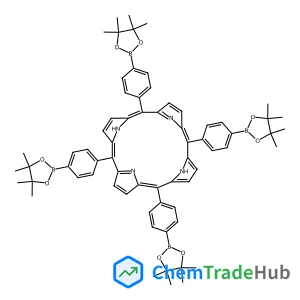
5,10,15,20-tetrakis(4-boronic acid pinacol ester phenyl) porphyrin
CAS Number:
1332748-00-1
Molecular Formula:
C68H74B4N4O8

![Methyl 3-({2'-[(E)-(hydroxyhydrazono)methyl]-4-biphenylyl}methyl)-2-oxo-2,3-dihydro-1H-benzimidazole-4-carboxylate structure](https://static.chemtradehub.com/structs/149/1499167-72-4-034a.webp "Methyl 3-({2'-[(E)-(hydroxyhydrazono)methyl]-4-biphenylyl}methyl)-2-oxo-2,3-dihydro-1H-benzimidazole-4-carboxylate structure")
Methyl 3-({2'-[(E)-(hydroxyhydrazono)methyl]-4-biphenylyl}methyl)-2-oxo-2,3-dihydro-1H-benzimidazole-4-carboxylate
CAS Number:
1499167-72-4
Molecular Formula:
C23H20N4O4
Recommended Suppliers






Disclaimer
This page provides academic journal information for reference and research purposes only. We are not affiliated with any journal publishers and do not handle publication submissions. For publication-related inquiries, please contact the respective journal publishers directly.
If you notice any inaccuracies in the information displayed, please contact us at support@chemtradehub.com. We will promptly review and address your concerns.