












Uncertainty budgeting in fold change determination and implications for non-targeted metabolomics studies in model systems
Literature Information
Publication Date
2016-09-30
DOI
10.1039/C6AN01342B
Impact Factor
4.616
Authors
Verena Charwat, Cornelia Kasper, Stephan Hann, Gunda Koellensperger
View Original
Abstract
The p-value is the most prominent established metric for statistical significance in non-targeted metabolomics. However, its adequacy has repeatedly been the subject of discussion criticizing its uncertainty and its dependence on sample size and statistical power. These issues compromise non-targeted metabolomics in model systems, where studies typically investigate 5–10 samples per group. In this paper we propose a different approach for assessing the relevance of fold change (FC) data, where the FC is treated as a quantitative value and is validated by uncertainty budgeting. For the purpose of large-scale application in non-targeted metabolomics, we present a simplified approach for uncertainty propagation using experimental standard deviations of metabolite intensities as type A-summarized standard uncertainties. The resulting expanded FC uncertainty can be used to derive a minimum relevant FC as a complementary criterion in metabolomics data evaluation. This concept overcomes the need for a uniform p-value cut-off for all metabolites by considering the experimental uncertainty for each metabolite individually. The proposed procedure is part of analytical method validation, however the concept has not previously been applied to non-targeted metabolomics. A case study on mesenchymal stem cells cultured in normoxia and hypoxia demonstrates the practical value of this approach, in particular for studies with a small sample size. An online two-dimensional LC method coupled to mass spectrometry was crucial in providing both broad metabolome coverage and excellent experimental precision (<8% CV for peak areas, on average 0.5% CV for retention times) that was required for sensitive differential analysis as low as FC 1.1.
Related Literature
Revisiting the glass transition temperature of water–glycerol mixtures in the bulk and confined in mesoporous silica
Ivette Angarita, Ma. Florencia Mazzobre
2021-07-10
Paper
DOI: 10.1039/D1CP02153B
Oscillatory dynamics during the methanol electrooxidation reaction on Pt(111)
Kaline Nascimento da Silva
2021-08-02
Paper
DOI: 10.1039/D1CP02490F
Mixed-diphosphine-protected chiral undecagold clusters Au11(S,S-DIOP)4(rac-/R-/S-BINAP): effect of the handedness of BINAP on their chiroptical responses
Yasuhiko Sato, Hiroshi Yao
2021-07-26
Paper
DOI: 10.1039/D1CP02106K
Preferred penetration of active nano-rods into narrow channels and their clustering
Zhengjia Wang, Kang-Ching Chu, Yu-Jane Sheng
2021-07-05
Paper
DOI: 10.1039/D1CP01065D
Cation enrichment in the ion atmosphere is promoted by local hydration of DNA
Chun Yu Ma, Simone Pezzotti, Gerhard Schwaab, Magdalena Gebala, Daniel Herschlag, Martina Havenith
2021-09-15
Paper
DOI: 10.1039/D1CP01963E
Kinetic and thermodynamic stability comparison for the fibrillar form of small amyloid-β(1–42) oligomers using scaled molecular dynamics
Debasis Saha, Biman Jana
2021-07-06
Paper
DOI: 10.1039/D1CP01866C
Adenine ultrafast photorelaxation via electron-driven proton transfer
Naeem Ullah, Shunwei Chen
2021-09-18
Paper
DOI: 10.1039/D1CP03162G
Characterizing hydrogen and tetrel bonds in clusters of CO2 with carboxylic acids
Weixing Li, Sonia Melandri, Luca Evangelisti, Camilla Calabrese, Annalisa Vigorito, Assimo Maris
2021-07-24
Paper
DOI: 10.1039/D1CP02568F
Polymer network formation mechanism of multifunctional poly(ethylene glycol)s in ionic liquid electrolyte with a lithium salt
Asumi Ishikawa, Namie Ikeda, Shuichi Maeda, Kenta Fujii
2021-07-27
Paper
DOI: 10.1039/D1CP02710G
Ambiguities in solvation free energies from cluster-continuum quasichemical theory: lithium cation in protic and aprotic solvents
Luigi Cavallo
2021-07-02
Paper
DOI: 10.1039/D1CP01454D
You might also like
Compound Q&A
What precautions should be taken when handling 4-Methyl-6-(trifluoromethyl)quinoline (CAS: 40716-16-3)?
When handling 4-Methyl-6-(trifluoromethyl)quinoline (CAS: 40716-16-3), safety go...
40716-16-34-Methyl-6-(trifluor...
Compound Q&A
What is 4-(3,5-Difluorophenyl)aniline (CAS: 405058-00-6)?
4-(3,5-Difluorophenyl)aniline is an aromatic organic compound with the CAS numbe...
405058-00-64-(3,5-Difluoropheny...
Compound Q&A
How is 5-{[4-(Trifluoromethyl)phenyl]sulfanyl}-1,2,3-thiadiazole-4-carboxylic acid (CAS: 338982-07-3) typically synthesized?
5-{[4-(Trifluoromethyl)phenyl]sulfanyl}-1,2,3-thiadiazole-4-carboxylic acid can ...
338982-07-35-{[4-(Trifluorometh...
Compound Q&A
What is the market or research trend for 4-Benzylaniline hydrochloride (CAS: 6317-57-3)?
The market for 4-Benzylaniline hydrochloride (CAS: 6317-57-3) is steadily growin...
6317-57-34-Benzylaniline hydr...
Compound Q&A
Is [3-(Diethylsulfamoyl)phenyl]boronic acid (CAS: 871329-58-7) safe?
[3-(Diethylsulfamoyl)phenyl]boronic acid is generally considered safe when handl...
871329-58-7[3-(Diethylsulfamoyl...
Compound Q&A
What are the main uses of 3-Bromo-2,5-dimethoxyaniline (CAS: 115929-62-9)?
3-Bromo-2,5-dimethoxyaniline is mainly used in the pharmaceutical and chemical i...
115929-62-93-Bromo-2,5-dimethox...
Compound Q&A
What regulatory guidelines apply to N-Methyl-1-(5-methyl-1H-indol-3-yl)methanamine (CAS: 915922-67-7)?
N-Methyl-1-(5-methyl-1H-indol-3-yl)methanamine (CAS: 915922-67-7) is subject to ...
915922-67-7N-Methyl-1-(5-methyl...
Compound Q&A
What industries use Carbamic acid, N-[(5S)-5,6-diamino-6-oxohexyl]-, 1,1-dimethylethyl ester (CAS: 24828-96-4)?
This compound is primarily used in the pharmaceutical industry for the synthesis...
24828-96-4Carbamic acid, N-[(5...
Compound Q&A
How should 2-Methyl-2-propanyl [(1S,3R)-3-aminocyclohexyl]carbamate (CAS: 1298101-47-9) be stored?
2-Methyl-2-propanyl [(1S,3R)-3-aminocyclohexyl]carbamate (CAS: 1298101-47-9) sho...
1298101-47-92-Methyl-2-propanyl ...
Compound Q&A
What industries use Ethyl 2-bromo-4,4,4-trifluorobutanoate (CAS: 367-33-9)?
Ethyl 2-bromo-4,4,4-trifluorobutanoate (CAS: 367-33-9) is utilized in the pharma...
367-33-9Ethyl 2-bromo-4,4,4-...
Source Journal
Analyst

CiteScore:
7.8
Self-citation Rate:
5.6%
Articles per Year:
653
Analyst publishes analytical and bioanalytical research that reports premier fundamental discoveries and inventions, and the applications of those discoveries, unconfined by traditional discipline barriers.
Recommended Compounds
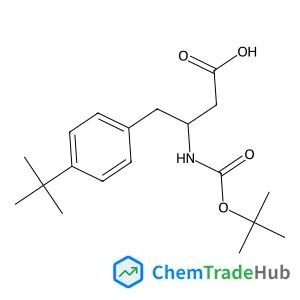
(S)-3-((tert-Butoxycarbonyl)amino)-4-(4-(tert-butyl)phenyl)butanoic acid
CAS Number:
403661-85-8
Molecular Formula:
C19H29NO4
![2,4-Dichloro-6-isopropyl-5H-pyrrolo[3,4-d]pyrimidin-7(6H)-one structure](https://static.chemtradehub.com/structs/107/1079649-94-7-ad4a.webp "2,4-Dichloro-6-isopropyl-5H-pyrrolo[3,4-d]pyrimidin-7(6H)-one structure")
2,4-Dichloro-6-isopropyl-5H-pyrrolo[3,4-d]pyrimidin-7(6H)-one
CAS Number:
1079649-94-7
Molecular Formula:
C9H9Cl2N3O
Recommended Suppliers




Disclaimer
This page provides academic journal information for reference and research purposes only. We are not affiliated with any journal publishers and do not handle publication submissions. For publication-related inquiries, please contact the respective journal publishers directly.
If you notice any inaccuracies in the information displayed, please contact us at support@chemtradehub.com. We will promptly review and address your concerns.